R-JENERATION: Eating disorder battle takes teen near death
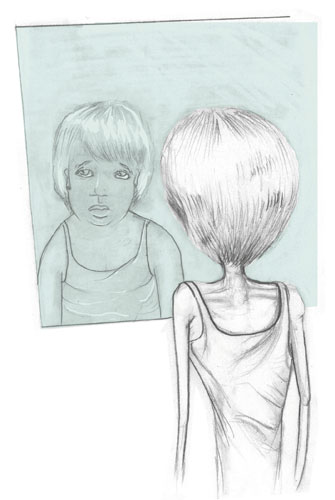





She has not eaten for the past 24 hours, yet feels no hunger in the pit of her stomach. She decides to fight against her body's natural instinct to eat and she does it for control. She does it because she's addicted to the feeling of starvation.
Seventeen-year-old Anna Mars, whose name has been changed to protect her privacy, developed numerous eating disorders during her sophomore year of high school. People around her began to notice her junior year when her disorders reached their peak. She weighed 82 pounds at 5 feet 6 inches tall, and was very near death.
"The eating disorders were brought on by more so an internal force," Mars says. "I've always been obsessive, so once I got on that track it was hard to stop. I started working out a lot and dieting and from there it was really easy to get to a bad place from being so one-track minded."
According to the National Institute of Mental Health, or NIMH, eating disorders can be the result of such situations as low self-esteem, social problems, traumatic events or by other psychiatric illnesses. Mars says she struggled mostly with a mixture of anorexia nervosa and exercise bulimia.
The institute defines anorexia nervosa as the persistent pursuit of thinness, a distorted view of body image and the obsessive need to abstain from eating despite a malnourished state. Exercise bulimia is a subcategory stemming from bulimia nervosa, bringing on the compulsion to burn calories through excessive exercise.
"Those who struggle with eating disorders battle them in his or her different way," says Valerie Rutz, a psychology teacher at Green Valley High School. "It's not like catching a disease or a cold. There are so many diverse etiologies for eating disorders to manifest psychologically, which stresses the importance of individualized treatment and care to overcome the disorder."
According to Reuters news service, almost nine out of 10 girls have felt pressured to be thin by the fashion industry and the media.
NationalEatingDisorders.org reports that the media often help shape cultural definitions of beauty and contribute to the rise of eating disorders.
"I think it's interesting that when you look back from decade to decade, our idea of beauty changes," Rutz says. "What we thought was beautiful in the 1950s was someone who looked like Marilyn Monroe: more voluptuous and a size 12. Then we get to the 1960s and beautiful was a model that looked like Twiggy, who was very thin."
In response to the issue of severely thin models depicted in international advertisement campaigns and runways, the Council of Fashion Designers of American formed a health initiative in January 2007. They aimed to educate the industry on eating disorders, but as of 2012, models still look as thin (weighing about 23 percent less than the average woman) today as they did before these initiatives were established.
Mars' ideal body would be back to the unhealthy weight of 82 pounds. She defines thin beauty as "heroin-chic" and finds emaciation more physically attractive. Contrary to the study conducted by Reuters, Mars believes the media have become a scapegoat for eating disorders.
"Everyone blames it on the media, but girls have been anorexic forever," Mars says. "I can't really evaluate the effect it has on me, but again I think it is all internal. I'm sure the media doesn't help, but I don't think it's the main factor."
After numerous days of starvation and excessive exercise routines, Mars fell victim to a third illness: binge eating disorder. She would sometimes give in to her starvation and overeat.
"I had this routine where if I would binge eat, I wouldn't eat for three days and run at least eight miles a day within those three days," Mars says. "The fourth day I would only eat 500 calories worth of food and the fifth day it would be 1,000 calories. After that, I would be starving, then I'd binge eat and the cycle would start all over."
Mars' diet, if she decided to eat that day, would consist mostly of diet sodas, apples and occasionally cigarettes to suppress her appetite. The caffeine in diet sodas became a primary source of energy when trying to counter her constant fatigue, which became a regular symptom of her disorder.
Mars became really withdrawn and chose isolation, starvation and going to the gym over hanging out with her friends to dodge situations where she would have to eat.
"I just hate food," Mars says. "Everyone says 'I love to eat,' but I really just hate eating. It doesn't taste good to me, ever. I'm not really sure where that came from, but it came out of nowhere."
Mars began therapy during her junior year after her disorder reached a new low. She was frequently tired, no matter how much she rested. Her hair began to fall out. She always felt cold. She began to feel unbearably weak. Mars realized that she was dying.
After receiving counseling three times a week, Mars has learned that her eating disorder was a product of other psychological problems linked to her depression, history of substance abuse, obsessive behavior and self-hatred/harm.
"For me, it's a control thing," Mars says. "If you can make yourself starve, it is like a high. You feel like you can control anything if you can tell your body it's wrong."
Mars received help and recovered at Creative Health Solutions Eating Disorder Clinic in the San Martin Medical Arts Pavilion in Las Vegas. Since her junior year and with the help of therapy, Mars has restored herself to a healthy weight. Though she looks healthy, she still battles with the temptation to revert to her old ways.
"It's bad, but I look at anorexia as my glory days," Mars says. "There are days where I want to go back so badly, but then I'll remember all the bad stuff that came along with it."
A study conducted in 2011 by NIMH found that an average of 40.2 percent of Americans actually receive treatment for their disorders. Rutz says it is important to receive these treatments to lead a healthy lifestyle.
"People really do need to seek out help in the form of specific treatment because it's as much as a recovery process as for someone who has been addicted to drugs," Rutz says. "Make sure you go to the right person for the right kind of help, because it's not just a matter of, 'You need to start eating now.' It's also a matter of unlocking some of the many chains of feelings and psychological disorders that may have led to this extreme."
R-Jeneration