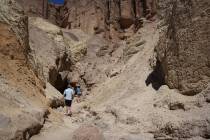
The West as John Ford Saw It
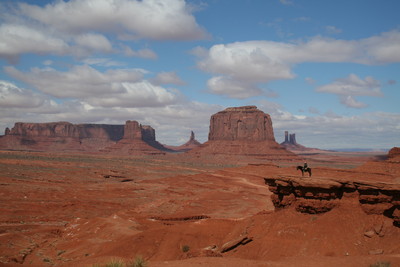




Monument Valley is off the beaten track, so it will take extra effort to get there, but the rewards are so great it is well worth almost any trouble you're likely to encounter. Once you arrive, you will be within one of the most famous panoramas in the world, yet there's even more to the place than the splendor meeting the eye.
What people come to see is properly named Monument Valley Navajo Tribal Park, encompassing 30,000 acres in northeastern Arizona and southern Utah, all within the 16 million-acre Navajo Reservation. The park was set aside in 1958 to preserve the extraordinary buttes, mesas and arches, as well as the cultural resources found here.
The reservation is home to an estimated 180,000 Diné, as Navajo call themselves; thousands more live elsewhere. The reservation lies primarily in Arizona but spreads out into New Mexico and extends into Utah. The Navajo Nation has occupied this area for more than 400 years. Before that, Ancestral Puebloans made this area home.
My daughter Charlotte and I traveled here to see one of the most extraordinary views on earth. But by the end of our two-night trip, we also had explored many of the secret places in the park, off limits to all unless on a full-day guided tour. Here we were able to get up close to astounding ruins, petroglyphs and pictographs, turning our feast for the eyes into an educational experience as well.
This area was once a lowland basin and for hundreds of millions of years, layers of sediments eroding from the early Rocky Mountains were deposited here. Compressed and cemented into rock -- mostly sandstone and limestone -- it gradually became a rock plateau. The force of the wind, rain and temperatures over millions of years wore down the surface, creating the stunning formations.
Although visitors can tour on their own, they are limited to two short hiking trails and a 17-mile drive. To take full advantage of our visit, we signed up for a guided tour. Although there are many different lengths of tours, the full day is the best choice. There are many certified Navajo tours, but the tours offered by Goulding's Lodge and Trading Post, where we were staying, came highly recommended so we opted for one of those.
Goulding's Lodge holds a special place in the hearts of the Navajo. This area was briefly public domain open to homesteading. In the 1920s, Harry Goulding and his wife, Leone, known as Mike, bought up 650 acres of land for $320. By 1928, they had set up a trading post where the Navajos could trade their livestock and handmade goods for food and other items they wanted.
After the Great Depression struck, there was a sharp decline in tourism and Navajo families suffered deeply. In 1938, when the Gouldings heard a motion picture company was looking for a location to shoot a Western movie, they set out to Hollywood. Thanks to their persistence and a choice sample of photographs, many by famed photographer Joseph Muench, film director John Ford arrived in the valley to shoot the first of nine Westerns that would forever link his legend to Monument Valley's. Locals were hired as movie extras and laborers, which brought help to the struggling families during those rough financial times.
The Gouldings former home and trading post now serve as a museum next to the 62-room lodge. The upstairs, where the Gouldings resided, remains as it did when they lived there. On the main floor are movie memorabilia, historical photographs and one room dedicated solely to Muench's photographs of the landscapes and Indians.
Located behind the museum is John Wayne's cabin from the set of the classic film, "She Wore a Yellow Ribbon." It's worth a look inside Wayne's office to see his character, Capt. Nathan Brittles -- represented by a uniformed mannequin -- frozen in the middle of some 19th-century army administrative task.
The standard guest rooms at Goulding's Lodge are on the small side, but each boasts the unique luxury of a patio with a view of Monument Valley. That alone contented us, but the property also has a swimming pool, a grocery store and gas station, and an excellent restaurant where you can get not only standard fare but also many Navajo dishes.
At the moment, Goulding's is the only place to stay in Monument Valley but once September rolls around, the View Hotel and Spa is scheduled to open. The View will be the first hotel inside the park; Goulding's is 51/2 miles outside the entrance.
Our guide, a Navajo woman named Pat Grandson, met us at the lodge at 9 a.m. and off we went in the four-wheel-drive vehicle. Our first stop was to visit a hogan, the traditional Navajo dwelling house.
"About 500 Navajos live in Monument Valley year-round, and many still prefer to live the traditional way, in a hogan," Grandson said.
Although we have seen dozens of hogans before, this was our first time to be invited inside one on the reservation.
From the outside it looked like a circular mound of mud, but inside we found it to be hexagon-shaped. The roof and walls are made of intricately crossed layers of juniper logs, which are then covered with the clay. Like most hogans, it had a dirt floor and wood stove with chimney. As in all Navajo homes, the door faces east to greet the rising sun. I estimate this one was 20 feet in diameter. Hogans are warm in winter, yet cool in summer, and blend in so well with the surrounding landscape, sometimes you won't see them.
"Today as we travel around the area you might not notice them unless you see a vehicle parked alongside," Grandson said.
Although many of those hogans still lack running water and electricity, it is also not uncommon these days to find in them televisions, factory-made furniture and other modern comforts.
Upon entering we were introduced to Lucy, an elderly Navajo woman with kind eyes, dressed in a traditional outfit consisting of a colorful pleated skirt and turquoise velveteen top. Across her chest was a simple turquoise beaded necklace; a large cluster pin of the same stone was centered on her chest between the strands.
Sitting on a sheepskin rug, she demonstrated grinding corn on a metate with a mano, an ancient technique some still use today to prepare food, and not merely to show tourists. Then Lucy showed us how she combs wool to ready it for a wooden spindle for use in weaving a rug. Navajo rugs are world-renowned. Larger rugs can take a year or more to finish and may cost tens of thousands of dollars.
After saying our goodbyes to Lucy, we headed south on the main road and within five minutes we were headed off the pavement toward Mystery Valley to visit some Ancestoral Puebloan cultural sites. Grandson said there are more than 150 ruins in Monument Valley.
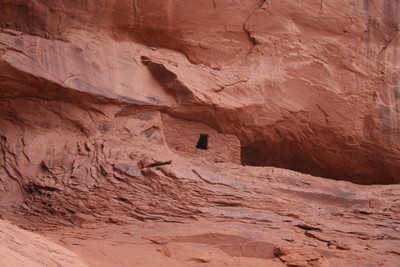
The ruins we visited were former dwellings as well as storage granaries. Although they were different in size and shape, all were located safe from the elements in alcoves, high above the valley floor. Throughout Monument Valley and the Southwest in general, most such sites are off-limits to visitors, but at some of our stops, Grandson encouraged us to scramble up the rock and peek inside.
We checked out all those except one, which was called the Long House, whose approaches were too high and steep to reach even with the difficult and somewhat dangerous rock scrambling that gave us access to the others. When Charlotte asked Grandson how the former occupants got up the steep cliffs to this home, she responded, with a slight grin, "a good running start." Actually, this ruin was once accessed by a series of wooden ladders.
During our tour we were able to see hundreds of petroglyphs and pictographs and Charlotte found dozens of pottery shards on the ground. She has found broken pieces from decorated vessels before, in East Zion and other parts of Utah, but these were different because they were so colorful and many were textured. She found some in greens and blues and one that was red. She left the shards where she found them.
One of the most interesting sites we visited was the House of Many Hands. Grandson said it was probably a hunting lodge. The walls were lined with dozens of handprints, smaller than those of men today.
"They say the Anasazi were small, maybe only four feet tall," Grandson explained. She said it is thought hunters would dip their hands in paint and make prints on the sandstone wall.
The paint was varied in color but primarily white; some prints were red, yellow, or black.
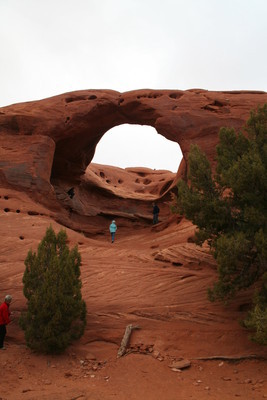
One surprising natural feature we found in the park was an abundance of arches. We lost count after seeing a dozen or so. These are not delicate arches but firm and thick with bold names such as "The Suns Eye," "Ear of the Wind," "Skull Arch" and "Big Hogan Arch."
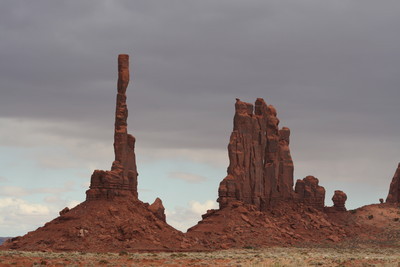
One of the most striking formations we saw was the Totem Pole. This tall, thin spire towers some 500 feet from the valley floor. It was used in the film, "The Eiger Sanction," starring Clint Eastwood, and in many commercials including some for IBM and Jeep.
Films, commercials, and magazine spreads are still shot in Monument Valley today. Some of the more popular films in which you might recognize scenes from Monument Valley are "How the West Was Won," "Back to the Future III," "Thelma and Louise" and "Forrest Gump."
Grandson taught us a few Navajo words. We learned "ya'at'eeh" which means "hello," and "hagoone" for "goodbye." "It's a dying language of the younger generation, but reading and writing Navajo is now taught today in the schools," she said. "Our language was only a spoken one until 1964, when we started using the English alphabet."
Being spoken-only was what made the language so famously useful to United States troops in World War II. More than 400 Navajos were trained to send radio communications in their native tongue, which no foreign eavesdropper could learn from a book. For further security, they learned or created code words in their own tongue for military terms. "Code talkers" served from 1942 to 1945 in all six Marine divisions. Some claimed that without them, the Marines never would have taken Iwo Jima.
A visit to this Navajo homeland will impress upon you the fact even in this 21st century, life may be lived in harmony with nature. The moment that point was made with us was when we turned onto the access road back to the lodge for the end of our tour, and looked toward the grass athletic field at the small local high school. About a dozen sheep were grazing upon it.
"What better way to mow the grass than with a Navajo lawnmower?" asked Grandson.
GETTING THERE Location: Monument Valley Navajo Tribal Park in northeast Arizona and southeast Utah, about 424 miles from Las Vegas. Directions: From Las Vegas, take U.S. Highway 93 south for 105 miles to Kingman, Ariz. Go east on Interstate 40 for 150 miles to Flagstaff. Take state Route 89 north for about 63 miles and turn right onto U.S. Highway 160 for 82 miles. Turn left onto U.S. Highway 163 and drive 24 miles to signed park entrance road, located on right. Lodging: Goulding's Lodge, 51/2 miles from the park entrance offers rooms and suites starting at $180 through Oct. 31, lower rates in off-season, also cabins and campground. (435) 727-3231, www.gouldings.com. View Hotel and Spa, within park, is scheduled to open in September. Reservations accepted now, (435) 727-3470, www.monumentvalleyview.com. Monument Valley Navajo Tribal Park: Open year-round, $5 per person entry fee, no charge for children 9 and under or for any American Indian tribal member. Scenic drive is open May-September, 6 a.m.-8:30 p.m. and October-April, 8 a.m.-4:30 p.m. (435) 727-5874, www.navajonationparks.org. Navajo Reservation: There are gas stations, restaurants, medical facilities and other services available throughout the reservation, although few and far between. All main roads are paved. No alcohol is sold on the reservation. Guided tours: Half- and full-day tours with Navajo guides. (435) 727-3231. Half-day tour, adult $50, child under 8, $30. Full-day tour, adult $90, child under 8, $70, www.gouldins.com Self-guided tour: Limited to a 17-mile scenic drive on a rough gravel road. Four-wheel-drive, high-clearance vehicle recommended. Map recommended: AAA Indian Country Guide Map Rock climbing: Not allowed in Monument Valley. Climate: Daytime temperatures average in the 70s in May and 80s in June. Timekeeping: Arizona does not participate in daylight-saving time, but Utah and Navajo Nation do participate. Therefore it will be one hour later in Utah or the teservation than in Arizona, during daylight-saving months. During the rest of the year, the time is the same in all three places.