Motorcycle helmets save lives
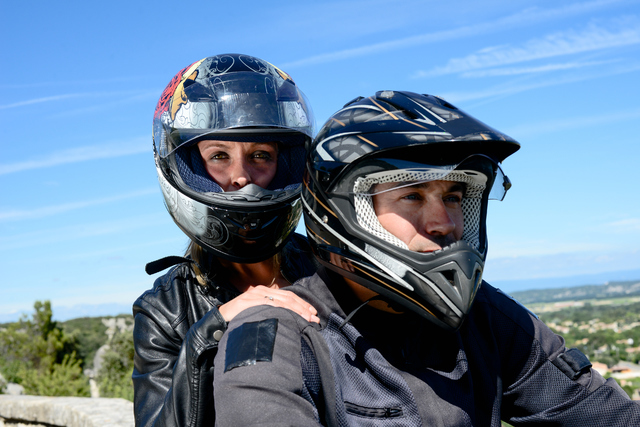





No one can deny that motorcycle helmets save lives. According to analysis of data compiled by the U.S. Department of Transportation and the National Highway Traffic Safety Administration, helmets reduce the risk of death in an accident by 37 percent and reduce the risk of traumatic head injury by 69 percent.
Universal helmet laws make it mandatory for all motorcycle riders to wear a helmet, and they are in effect in 19 states, including Nevada, California, Oregon and Washington. Statutes in 28 states require some riders to wear a helmet (usually those 17 and younger), while Iowa, Illinois and New Hampshire are the only states without a helmet law on the books.
Complying with helmet laws requires wearing a product that conforms to specific safety standards established by the DOT and enforced by the NHTSA.
Helmets bearing a DOT-approved sticker must be able to pass a series of penetration and impact tests. The retention system is also tested to ensure the helmet remains in place during an accident.
The interesting thing about DOT standards is that manufacturers are not required to submit their product to DOT prior to putting it on the market. Having said that, DOT does eventually get around to testing all helmets, and manufacturers face stiff fines if a product is sold as DOT-approved but fails to meet the proper safety standards. This is why it is so important to take manufacturer reputation into consideration when purchasing a helmet.
Motorcyclists have several types of helmets to choose from, and most of them are designed to protect against traumatic brain injury. Individuals should choose the helmet that best suits their riding style and personal preference. Comfort, fit and visibility are important factors when choosing a helmet.
Many riders prefer an open-face, or three-quarter, helmet because they feel it is less confining and more comfortable. This type of helmet, however, leaves the jaw and face vulnerable to injury in an impact or from flying debris. Because there is no face visor, this type of helmet offers no built-in eye protection.
Full-face helmets are available in several styles but all have a face shield, so they cover the head on all sides. Sport helmets are lightweight and aerodynamically designed to minimize wind drag at high speeds. These helmets tend to have a snug fit.
Touring helmets feature a larger visor than sport helmets for maximum visibility. They also have a looser fit for greater comfort during long rides. Some models have a tinted inner half-visor that the rider can flip up under low-light conditions.
A modular helmet can be worn as an open-face or full-face helmet. Depending on the product, the rider may fold away or completely remove the portion of the helmet that covers the jaw and lower portion of the face to temporarily transform the helmet from full-face to open-face.
Motocross helmets lack a face visor but feature a chin piece that extends out from the bottom of the helmet to cover the jaw and mouth. These helmets offer the rider a wide field of vision and an eye opening large enough to accommodate safety goggles for protection against debris, dust and bugs. The top has an extended lip that shades the eyes from the sun.
Regardless of helmet design, fit is crucial. A helmet that is too tight will not sit on the head properly and will be uncomfortable on long rides. A helmet that is too loose will move around too much and may interfere with visibility. In the worst case scenario, a loose helmet may come off on impact.
For the proper fit, there should be no gaps between the cheek pads and the cheeks or between the brow pads and the temples. When wearing a full-face helmet, the face shield should not touch the chin or nose when pressing on the chin piece.
Purchasing the right helmet is the most important investment any motorcyclist can make. Taking the time necessary to find the right one can mean the difference between life after a crash and death.