



Community banks get bounce in Southern Nevada


The list of community banks in Las Vegas is even shorter now, following Western Alliance Bancorp’s $55 million purchase of struggling Western Liberty Bancorp, parent of Service1st Bank of Nevada in October.
Five of the nine community banks that remain posted a profit in 2012 — a modest sign that the region’s recession-battered economy continues to heal. Most of the improvement was attributed to increasing profits from loans.
At Plaza Bank and Meadows Bank the profits mean the lenders are making loans or getting payments from loans already on their balance sheets.
“Not only did we see tremendous growth in deposits in Las Vegas, we also saw an increase in the origination of loans,” Plaza Bank Chief Banking Officer Erich Bollinger said.
Bollinger said the “quality and quantity” of commercial loan applications are stronger than at any time in the past three years.
Plaza Bank, which operates a branch in Irvine, Calif., posted net income of $2.4 million in 2012, while Meadows Bank reported net income of $2.79 million. Kirkwood Bank of Nevada ($39,000), First Security Bank of Nevada ($803,000), and Bank of George ($290,000) also posted profits in 2012.
Unprofitable banks were Town & County Bank (a 2012 loss of $4.6 million), Nevada National Bank (a $398,000 loss), Valley Bank of Nevada (a $1.3 million loss) and Bank of Las Vegas (a $3.7 million loss).
“I belong in the moderately bullish category,” said Plaza Bank President and CEO Gene Galloway. “Housing and building is picking up and that tends to lead to consumer confidence and that’s the missing piece.”
GUARANTEED LOANS
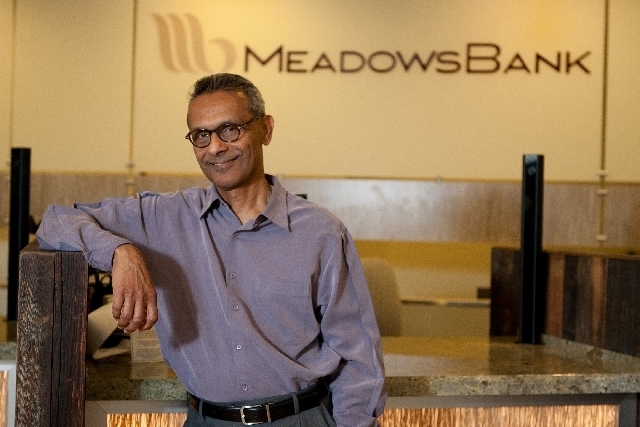
Meadows Bank has focused on Small Business Administration and U.S. Department of Agriculture guaranteed loans. Meadows Bank President and CEO Arvind Menon reports a “robust SBA platform” of loans.
Menon said the bank has been making loans through its four Nevada branches and in several other Western states.
“We then turn around and sell them to boost our noninterest income and boost our bottom line,” Menon said. “The (guaranteed loans) fetch a better value in the secondary market.”
SBA loans have become attractive to borrowers and banks. Meadows Bank has issued a number of SBA loans for gasoline stations and hotels.
The 7(a) loans are for a maximum of $2 million, with SBA loan guarantee of no more than $1.5 million, or 75 percent. The terms of SBA 7(a) loans are 25 years for real estate and equipment and seven years for working capital.
“We expect to do very well in SBA this year,” Menon said.
Plaza Bank reported $190 million in loan volume in 2012, with 60 percent in SBA real estate loans and 40 percent in traditional loans.
CLIENT COMPETITION
But new regulations and a more competitive marketplace make it difficult for small banks, those with one to four branches, to find the same kind of customers they had in the past.
Galloway acknowledged that it’s harder to find quality customers these days. But he said he won’t loosen Plaza Bank’s standards to attract clients.
“We have very good people,” Galloway said. “We are out in the market calling on potential clients. However, we are not loosening our credit standards.”
Bank of Nevada with $3 billion in assets, and Nevada State Bank with $4 billion, are larger than traditional community banks, but are competing for loans in the $2 million to $10 million range with First Security Bank of Nevada, Plaza Bank and Meadows Bank. Bank of Nevada and Nevada State Bank are known as the “big locals.” They may prefer to be thought of as local community banks, because they are chartered in Las Vegas and operate here, but both are owned by out-of-state bank holding companies.
Galloway said Bank of America, Chase and even City National Bank are “really getting aggressive” when it comes to traditional small-business loans.
“You can’t complete with them on pricing,” Galloway said. “They have lower pricing cost, but we sell customer service. We are going to be in it for the long run. Big banks get in and get out.”
It’s the same situation for First Security Bank of Nevada President and CEO John Sullivan, who describes Las Vegas as a city “dominated by larger regional and national banks.”
“A lot of community banks are still struggling,” Sullivan said. “In Lexington, Kentucky, which is where I am from, there are 300,000 people and we had eight to 10 community banks.”
Sullivan said the industry is stabler locally and not where it was when community banks were “competing themselves out of business.”
Despite increased competition, federal regulators are warning against banks loosening credit standards.
U.S. Comptroller of the Currency Thomas Curry said that when high-quality borrowers are hard to find, it’s “very tempting for financial institutions to loosen underwriting standards or move into new product lines or unfamiliar markets.”
“It’s a concern for us, and our examiners will be paying close attention,” Curry said recently in remarks to the “Bank Director: Acquired or Be Acquired” conference in Scottsdale, Ariz.
SMALLER LOANS
Community banks in Southern Nevada were hit hard by the recession. Between 2008 and 2011, the region lost six banks, four with less than $1 billion in assets, the Federal Deposit Insurance Corp. reports. Nevada Commerce Bank, SouthwestUSA Bank, Sun West Bank and Security Savings Bank all failed, replaced by City National Bank, Plaza Bank and Bank of Nevada.
The two failed banks with more than $1 billion in assets were Silver State Bank and Community Bank of Nevada. The total cost of the failures to the FDIC was about $1.5 billion.
Sullivan said First Security Bank of Nevada focuses on business and commercial loans.
He said the bank’s sweet spot is loans of $2 million to $2.5 million, primarily for small shopping centers, offices buildings and gasoline stations.
“I’m very bullish on Las Vegas,” said Sullivan. “I truly believe that Las Vegas is the best place to be in the country.”
The Federal Open Market Committee has kept short-term interest rates near zero for almost five years to encourage banks to finance new equipment, real estate or employees hires. Those rates are a challenge for community banks.
“Loan demand is low, and so are interest rates,” Curry said. “Consequently, as assets roll off the balance sheet, they will be replaced by lower-yielding instruments and it will be hard to reprice liabilities any lower than they already are.”
When the Fed’s benchmark interest rate is near zero, net margins get even tighter for community banks. Those margins have forced some community banks to look for revenue beyond loan interest.
Meadows Bank boosted its noninterest income to $5.3 million in 2012 from $3.5 million in 2011, earnings reports filed with the FDIC show. The increase was attributed to gains on sales of SBA loans.
Galloway said Plaza Bank is trying to develop alternative revenue streams, including treasury services and wealth management.
SEEKING RELIEF
Community banks in Southern Nevada are renewing their efforts to be exempted from many aspects of the Dodd-Frank financial reform law, arguing smaller financial institutions will be unable to keep up with the regulatory workload.
The Independent Community Bankers of America argue that small banks were not responsible for the financial crisis and provide critical commercial lending to small businesses.
Camden Fine, the group’s president and CEO, said smaller financial institutions should be carved out from many of the strict new regulations stemming from Dodd-Frank.
At Plaza Bank, Galloway has three employees dedicated to compliance and is about to hire a fourth.
“It’s a challenge,” Galloway said. “I have 77 employees, with four in risk management. That’s almost 5 percent of my staff. I don’t blame the regulators, it’s just the nature of the business.”
Galloway warned that sooner or later banks will price the effects of the regulation into their products.
Like other bankers in Las Vegas, Sullivan of First Security Bank of Nevada, said his industry is always facing increased regulatory pressures.
“That’s the price we pay for government guaranteed borrowings in the form of FDIC insured deposits,” Sullivan said. “No other business in the country can go out and borrow money from the general public and have the U.S. Treasury guarantee it. There’s no doubt that the increased regulatory environment is here today and will continue to increase.”
Sullivan expected the better-managed banks to be able to adapt to whatever regulators and Congress impose.
Contact reporter Chris Sieroty at
csieroty@reviewjournal.com or 702-477-3893.
Follow @sierotyfeatures on Twitter.


