



McCarran to test full-body scanners
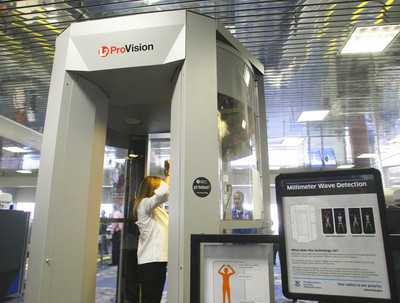
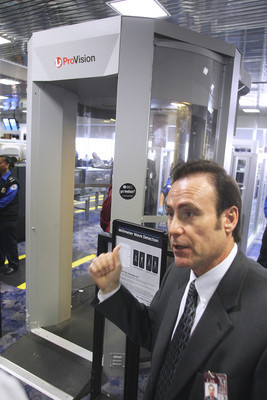


Federal security officials are using McCarran International Airport to test whether it would make sense to replace airport metal detectors throughout the nation with whole-body image scanners, devices that peer through travelers' clothing to ensure they aren't carrying weapons.
Transportation Security Administration officials on Tuesday fired up the second "whole-body imaging device" at McCarran, this one in Terminal 2, a departure point for international flights.
The second device is part of a pilot program to test whether imagers can replace metal detectors now in widespread use.
In about 60 days the TSA will evaluate the results from McCarran and five other airports and decide whether or not to continue with the plan.
"It's kind of a fine balance between safety of the passengers and privacy," said business traveler Paco Castellanos, 44, of Las Vegas.
The imaging devices caused a bit of a stir in June, when they were first rolled out as a secondary, optional screening method in about 20 airports. The first whole-body imager at McCarran went into use in October.
Castellanos, a leadership consultant who flies about once a month, recalled the outcry, but didn't share the outrage.
"I saw on the news it might be a little intrusive," he said. "I personally don't have a problem."
TSA is betting travelers like Castellanos are representative of the traveling public.
That's why the agency is continuing to experiment with the devices. The new wave represented in a pilot program at McCarran and five other airports is different from the first in that these scanners will be primary screening devices, meaning they could be used in place of a metal detector. The original machines are used in addition to metal detectors.
In each type of use, unidentifiable black-and-white images from the device are transmitted to a private room for viewing by human screeners. They use "millimeter wave" technology to scan the subjects and create the images.
The workers supervising the checkpoint do not see the images and the employees monitoring the screen shots do not see the subjects in person. Images are neither printed nor saved. They cannot be transmitted to other locations.
Whether the machines are being used in place of or in addition to metal detectors, travelers will have the choice to opt out of screening with the device.
The alternative would be a private, pat-down screening with a TSA employee of the same gender.
Officials like the imaging technology because it can scan for nonmetal hazards such as plastic, organic material and explosives residue.
But the imagers are much faster than previous technology, such as the explosives trace portal that shoots puffs of air onto passengers then "sniffs" for explosives residue.
A whole-body imager can create a scan in 1.3 seconds, while an explosives trace portal can take nearly 20 seconds.
The TSA hopes the image scanner can also be faster than a traditional metal detector by eliminating the need for second and third passes.
"We are going to take a look at this as being the wave of the future," said Jose Ralls, the TSA's federal security director in Las Vegas.
Although Ralls says the devices are more thorough than metal detectors, they do have limitations. For starters, while they can peer through clothing they can't look through skin, so they could miss an item tucked into someone's mouth.
Then again, depending on the gauge of the metal, a metal detector could also miss something in someone's mouth. And metal detectors have no chance of finding plastic or other nonmetal material. That's why it is important for the human screeners to remain attentive and alert no matter what device is in use.
Ralls says TSA not only tests the machines in the lab, it also covertly tests machines and human screeners in the field.
"We continually test the system," he said. "We don't just pop (a new device) in and walk away."
The whole-body imagers cost about $170,000 each, including full installation. If the pilot program is successful the TSA could proceed with about 400 more nationwide. A full rollout could include as many as 1,300 devices.
Contact reporter Benjamin Spillman at bspillman@reviewjournal.com or 702-477-3861.


