



Photovoltaic installation finished at Air Force base
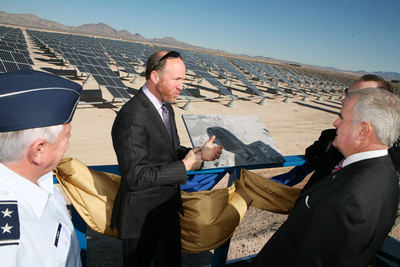
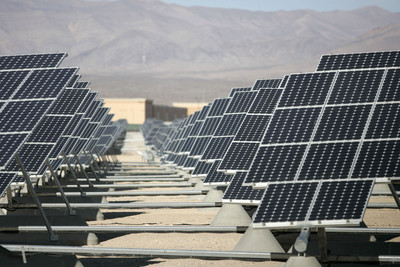


Nellis Air Force Base on Monday celebrated the completion of the largest photo voltaic installation in North America, which generates one-quarter of the base's power needs or enough to supply 13,000 houses with electricity.
The Nellis project is similar to photovoltaic systems at commercial buildings and homes, although the plant is much larger, producing 14 megawatts on a power plant site covering 140 acres.
"It's the technological equivalent of the first jumbo jet in airlines," said Rhone Resch, president of the Solar Energy Industries Association. "It's on a scale we've never seen in the United States. What we're finding is that you can use photovoltaic power on a very large scale."
The photovoltaic plant provides electricity that can be used on base, although excess power can be fed into the electric grid.
Photovoltaic systems convert sunlight into direct current. When light hits a silicon photovoltaic cell, the energy kicks electrons loose, causing electricity to flow. The panels at Nellis are connected to 54 inverters that convert the direct current into alternating current.
Resch said the Nellis facility is different than solar thermal plants, such as 64-megawatt Nevada Solar One at Boulder City. Solar thermal plants use the heat from the sun to heat fluids and spin generating turbines. They are typically are operated as centralized power sources for utilities.
Resch said photovoltaic systems can serve as a good backup system for police, fire and emergency services. Although it's not economically feasible to store power from photovoltaic systems for use after dark, researchers are working on storage systems, he said.
"The best way to secure a healthy and prosperous economy is to develop our affordable, reliable local resources," Gov. Jim Gibbons said in a statement. "Nellis Air Force Base is leading the country in solar energy deployment, a move that is good for the environment and our nation's energy security alike."
The project is a response to President Bush's challenge to reduce the country's "addiction" to foreign oil, said William Andrews, assistant secretary of the Air Force.
"This is an important first," Andrews said.
The federal official said other military bases will be following Nellis' example and establishing their own power generation systems that use either renewable energy or clean fossil fuels.
Andrews said the government next month will issue a request for proposals on military power plants. The administration official said other solar projects may be built at a military base in California, one in Arizona and one in New Mexico.
Projects such as the Nellis solar plant provide the military with a backup source of power in case a bird flying into a transmission line or a terrorist attack knocks out the electrical grid, Andrews said.
The Nellis solar plant provides clean energy, he said, and is less costly than buying power from Nevada Power Co. Nellis will save $1 million each year in power bills.
The Air Force is buying the power at a fixed price of 2.2 cents a kilowatt hour for 20 years, but Nevada Power is bearing a large part of the cost. The electric company is paying the government an undisclosed price for solar energy credits.
Photovoltaic power typically costs about 20 cents per kilowatt hour, Resch said, noting that prices have dropped by 95 percent since 1980.
Nevada Power buys solar power credits from the Nellis project and uses the credits to satisfy state requirements for use of renewable energy. With the credits, Nevada Power will comply with the state solar and nonsolar renewable energy requirements in 2008, said Michael Yackira, CEO of Nevada Power parent Sierra Pacific Resources.
If Sierra Pacific Power were allowed to buy some of the credits, both utilities would satisfy state law on renewable energy and solar power in particular, Yackira said.
The solar facility is a joint project of the Air Force, MMA Renewable Ventures, SunPower Corp. and Nevada Power Co. of Las Vegas. MMA Renewable got equity backing from CitiGroup and Allstate Insurance while John Hancock Financial Services provided long-term debt financing and Merrill Lynch helped with construction financing, said MMA CEO Matt Cheney.
Contact reporter John G. Edwards at jedwards@reviewjournal.com or (702) 383-0420.
REID CALLS FOR SOLAR POWER PLANT AT SITE OF CLOSED STATION Senate Majority Leader Harry Reid on Monday called on the majority owner of the closed Mohave Generating Station in Laughlin to use the site for a solar power plant. The 1,580-megawatt, coal-fired power plant was closed at the end of 2005 because the owners were unable to reach agreements on coal and water and, consequently, did not want to build air pollution control equipment required under a agreed court order. "When the plant closed down, the local communities and Native American tribes lost valuable jobs," Reid said in a statement. "I am urging Southern California Edison to convert the plant and its assets into a vibrant solar power producer to give the area an economic boost." In his letter to Southern California Edison President, Reid noted that the plant owners get $40 million yearly from selling sulfur dioxide credits to other industrial plants. Industrial plants can sell sulfur dioxide credits, rather than continue to operate and spew out pollution. Reid suggested Edison and the other owners use that money to build a solar power plant. An Edison spokesman had no comment on Monday. Edison operated and owns 56 percent of Mohave. Nevada Power Co. owns 14 percent and the balance belongs to the Los Angeles Department of Water and Power and the Salt River Project in Arizona. Roberto Denis, senior vice president of Nevada Power parent Sierra Pacific Resources, said Reid's idea was good but not new. Nevada Power has discussed using the site for a solar power plant or a gas-fired power plant, Denis said. The quantity of gas, however, is limited and a solar power project would replace only a fraction of the power that the coal plant generated. Denis recalled that Nevada Power opposed plans to try to reopen Mohave as a coal plant because it would not be as clean as new coal-fired plants even after building air pollution reduction equipment. "We did not want to invest billions of dollars in a plant that would continue to be a polluter," Denis said. JOHN G. EDWARDSREVIEW-JOURNAL


