



Tour operators work to stay profitable during recession


There's no recession at Quartermaster Point.
The view from this limestone outcropping at the west rim of the Grand Canyon overwhelms the brain's capacity to fear falling home prices or obsess over waning job prospects.
With conscious thought suspended, the brain works to put itself into context with a single, panoramic canvas that displays 2 billion years of history in a single snapshot.
Eyeballs once glazed by headlines declaring bankruptcy, layoffs and despair flitter back to life as they scan a page that extends 4,000 feet below the shoe soles and 15 miles beyond the outstretched hand.
Ears once calibrated to detect worried whispers of bosses and co-workers tilt against the wind and take in only silence.
The stomach pit once churning at every cloudy economic forecast searching for "the bottom," stops moving as the body absorbs the warm winter sun.
Unfortunately, the recession-free zone of solitude stops at the canyon rim.
Guides, helicopter pilots ferrying passengers to the riverbed and tour operators in Las Vegas are sweating that fewer people are willing to spend their time and money visiting the Grand Canyon and other Southwestern attractions.
It's tough to quantify precisely how the recession affects the tour business.
But it is clear the industry is important to the Las Vegas economy.
Robert Graff is vice president of marketing for the company that owns Papillon and several other Grand Canyon tour operators. With as many as 630 employees at Papillon and other brands in the organization, Graff said it is the largest helicopter sightseeing company in the world.
He said that during peak seasons the company hauls as many as 3,500 people per day for at least a portion of a Grand Canyon trip. That's more people than there are rooms in the Palazzo, a $1.8 billion hotel-casino that's among the largest on the Strip.
"The impact is definitely substantial," Graff said.
Interviews with guides and tour operators suggest that, much like the overall tourism industry, the business of hauling people to the Grand Canyon is in a gully.
"This business is pay-per-trip," said Alix Reed, general manager of Pink Jeep Tours Las Vegas. "There are busy times and not-so-busy times."
Reed's company operates high-end tours to destinations including the Grand Canyon, Hoover Dam, Red Rock Canyon National Conservation Area and Death Valley National Park, among others.
Earlier this year Pink Jeep took delivery of 15 new, 10-passenger customized tour vehicles.
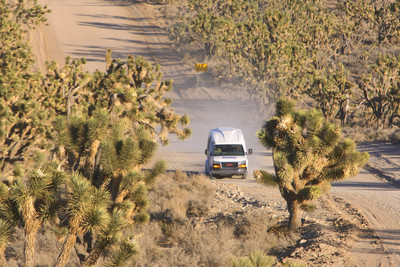
The diesel trucks from Chrysler were made especially for Pink Jeep and include custom leather seats, digital video disc players, DC plugs to recharge electronics, built-in two-way radios, all-wheel drive and a customized suspension system that uses air pumps to inflate or deflate rubber tubes for smooth riding on any surface.
Pink Jeep officials started working with Chrysler on the design in 2003 and Reed said the process became a "labor of love."
The vehicles were finally finished in mid-2008, right before the local economy lost all momentum.
Reed said she's glad Pink Jeep replaced its fleet of suburbans with the new Tour Trekkers. But, she said, if she'd known the economy was about to tank, her plans might have changed.
"I don't know if we would have done that many," she said.
Still, she said the company has managed to hold onto its work force and recently added a new tour to Death Valley.
The "Flower Power" tour aims to capitalize on spring wildflower blooms at Death Valley National Park.
Reed said diversifying the product line is important as customers become more careful about where they spend time and money.
With the Flower Power tour she hopes to bring in more business from baby boomer customers looking for something more laid back than the company's more adventurous excursions.
"We know it is going to come back, our theory is we should be ready when it comes back," Reed said of customer demand. "I really feel like by (this) spring it will start to come back."
Tour guide Jerry Seeler hopes Reed is right.
Seeler, 51, is a Massachusetts transplant who once owned his own business but decided to give it up for less stress and more enjoyment.
"We told ourselves we were only going to have jobs that we like," he said of himself and his wife.
Seeler, who recently converted from part-time to full-time work at Pink Jeep, is hopeful that enough tourists remain to keep him and the other guides working.
"I always try to remain upbeat," Seeler said. "Living in Massachusetts 20 years, we went through a few downturns, you ride it out."
On a recent day Seeler took one of the 10-person Trekkers to the Luxor to take a group of four to the Grand Canyon. When he pulled up to the casino shortly before 8 a.m., his was the only vehicle in the tour group pickup area.
About two hours later, when the group was checking in at Grand Canyon West, Seeler noted the half-filled parking lot.
"This is definitely quiet," he said. "Usually it is bustling."
The remark is an aside, however, and any worries about the economy don't crop up on the tour itself.
Seeler jokes with the group, cheerily snaps photos, answers questions and rattles off facts about plants, trees, animals, geography and communities along every stage of the trip.
In addition to being the only tour company with the right to drive its visitors to the very edge of the canyon at Quartermaster, Pink Jeep's Trekkers are the sharpest and most distinctive of any tour vehicles spotted at Grand Canyon West, the tour area on the Hualapai Indian reservation in Northern Arizona that is home to the Skywalk, a glass pier that extends over a side canyon for a one-of-a-kind view.
"I'm with people all day long who are on vacation," Seeler said. "My attitude is I'm on vacation too, except I have to drive."
Although Seeler said his hours are holding up so far, he and his wife are wary enough of the economy that they've cut back on spending. They decided against a vacation to celebrate their 25th anniversary.
Others in the tour industry are facing much greater sacrifice.
Anne McCall of the firm Tours of Distinction in Las Vegas said bookings are still coming in, just not as robustly as they had before the economy unraveled.
"A group that would come with 100 people are now coming with 50," McCall said. "We have reduced staff. We work harder."
She said her staff is down to three people from 10 at its peak.
And in 2007, her best-ever year, she served about 50,000 people on about every type of tour imaginable. She hopes to attract half that many in 2009, which she said is optimistic.
That's bad news for every aspect of the local economy with which she interacts: bus and limousine drivers, restaurants, stores and tour destinations.
"It affects everybody. It is a big circle," she said.
Among Papillon brands, including Scenic Airlines and Grand Canyon Helicopters, Graff said he's seeing a trend of customers trading down to cheaper tours.
"The customer is looking for value price, maybe not so many bells and whistles at the same time," he said.
The company has even added a stripped-down tour option for its Grand Canyon Airlines brand. The option downplays dining and other extras in favor of getting folks to the Grand Canyon to explore more independently before returning to Las Vegas.
If there's an upside to the downturn it's for customers who still have money.
McCall said restaurant and show reservations are easier to come by, hotel prices are as low as they've been in years and everyone still working in the industry is genuinely happy to be serving customers.
"You find ways to make the customer happy, to make sure you get the customer," she said. "Before you would say, 'I'll get another one.' Now you want every one of them."
Contact reporter Benjamin Spillman at bspillman@reviewjournal.com or 702-477-3861.


