



Valley land prices fall during quarter, may decline further


Land prices continued to slide in the third quarter and further reductions are expected through the end of the year as more property goes back to the bank, a real estate analyst for Colliers International brokerage in Las Vegas said.
Many highly leveraged parcels have reverted to lenders who are aggressively pricing the land to sell and get the loans off their books, Colliers research director John Stater said.
The average price for residential land is now $130,000 an acre, though some builders made purchases between $175,000 and $200,000 an acre in Summerlin South, Mountain's Edge and Henderson, Colliers reported.
Current values along the resort corridor remain difficult to pinpoint, with just one comparable sale during the quarter -- a 2.15-acre parcel at Las Ve-gas Boulevard and Harmon Avenue that sold for $25 million.
Demand for resort corridor land remained low and was not from traditional developers and gaming operators, Stater said. It's characterized by long-term investment plays or speculative bottom-feeders who can hold the land for future development.
Gone are the days when end-use land buyers were willing to pay $30 a square foot in Las Vegas, said Ron Opfer, commercial-assets director at Coldwell Banker Premier Realty. Their target today seldom reaches $10 a foot.
"Their motivation is clearly to purchase land at prices that will sustain the new economy of less consumer spending," Opfer said. "I'm tired of looking backward at what was normal. The clients I work with all tell me that this is the new normal. None of these business owners are saying, 'When will we get back to normal?' This is the new normal and they've already adjusted to it. There are no robust profits, just operations that are surviving."
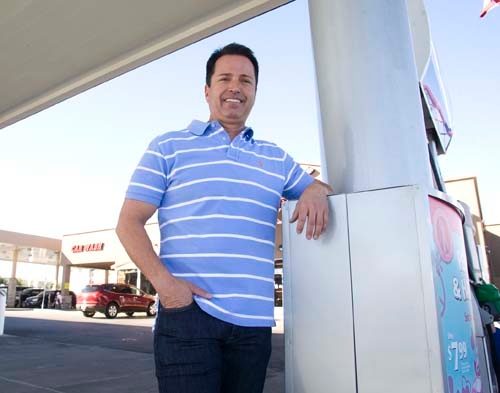
Ken Brazil, owner of six Pit Stop convenience stores and gasoline stations around the valley, has cut spending, laid off staff, renegotiated vendor contracts and streamlined operations so that he's now running in the black. He revised his business plan to take into account lower volumes for fuel sales, slot revenue, car washes and merchandise sales.
With declining land values and historically low interest rates, the cost of developing a convenience store and car wash has dropped dramatically from three years ago, Brazil said. He wants to open four new stores in the next two to three years without adding to management overhead.
"I think we're probably close to the bottom," he said at his Green Valley Pit Stop. "If this is the basement, how are we going to survive? The need for a certain volume has gone down, so we have a pro forma more reflective of where we are right now and there are still opportunities out there for my particular use."
Gasoline station and convenience store operators are looking to gain a stronger hold in Las Vegas during the economic downturn, Opfer said.
Utah-based Maverick Oil is about to close escrow on land near Blue Diamond Road and Decatur Boulevard, the company's first venture into Las Vegas. Vallero Oil plans to open more outlets in Las Vegas. Arco and 7-Eleven are also looking to expand.
Dave Johnson, senior vice president of retail for NAI Las Vegas, said he's seeing more corner parcels available for commercial development. Values have dropped to $18 to $20 a square foot from $30 a square foot in 2005 through 2007, he said. Among his clients looking for land in Las Vegas are CVS Pharmacy, Chase Bank and WinCo Foods.
Lower commercial real estate values offer one of the few upsides for small-business owners as the U.S. economy recovers from the Great Recession.
Despite these conditions, only 6 percent have purchased one or more properties over the past two years, while a majority (52 percent) hasn't even thought about making an acquisition, a study of 300 small businesses released by CIT Group shows. Slightly more than a quarter (28 percent) believe that buying real estate today presents a "great" or "substantial" opportunity.
Colliers research analyst Stater said it's "staggering" to compare this year's land transactions and values with the boom years of 2004 through 2006. Clark County had just $362 million in land sales covering 2,853 acres through the third quarter, compared with $3.7 billion in sales and 18,000 acres in 2004, he reported.
Colliers land broker Scott Gragson remembers when "money was easy." He could get private financing on a 10-year note with reasonable interest and 20 percent to 30 percent down.
Gragson said the problem started when he went to the bank. He said he fell victim to his own game and is now trying to work out loans on land that has lost significant value and is not likely to be developed for three to five years.
"If they want to crush you, they can crush you," Gragson said. "I say, 'Let me live.' Early on they were taking the property. They wouldn't extend the note even though I still had equity. These were big loans, $4 million. We're working it out. I won't have any money, but we're working it out. You've got to deal with it and move on. Who's the buyer for vacant land right now?"
Gragson said he closed his last significant land sale at the end of 2007.
"We saw the signs. The velocity just stopped. It was like musical chairs -- when the music stopped, you stayed where you were," he said. "It's all about do you have to sell and when. Therein lies the pressure. I wouldn't sell today if I didn't have to."
Contact reporter Hubble Smith at hsmith@reviewjournal.com or 702-383-0491.


