Family Court judge pleads not guilty in fraud scheme

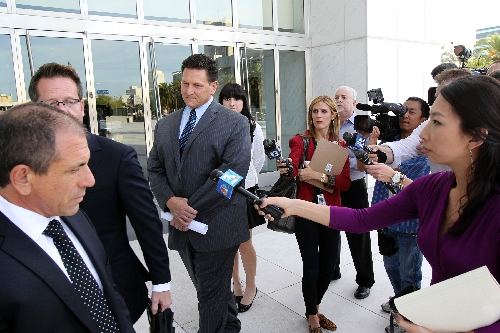



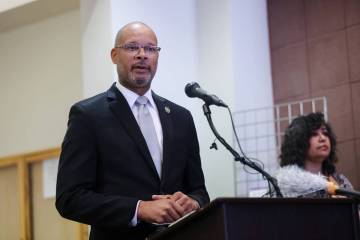

Longtime Family Court Judge Steven Jones pleaded not guilty Thursday to a slew of felony charges in what federal prosecutors are calling a $3 million investment fraud scheme.
After a brief hearing, U.S. Magistrate Judge Bill Hoffman released Jones on his own recognizance and ordered him to stand trial Jan. 8 with five other defendants charged in what investigators say was a decade-long conspiracy.
First Assistant U.S. Attorney Steven Myhre told Hoffman that despite the "serious nature of the charges," the government was not pushing to put Jones behind bars while he awaits trial.
A 20-count federal indictment against Jones and company was unsealed Wednesday, as FBI agents and Las Vegas police rounded up six defendants in three states. Agents raided the judge's Henderson home, seizing computers and paperwork. He surrendered to the FBI Thursday morning.
Jones, 54, was charged with using the power of his office to carry out the extensive scheme, which authorities alleged began in 2002.
Jones, first elected to Family Court in 1992, has taken a leave of absence and faces a state-mandated suspension from the bench with pay while under indictment.
Among those indicted with Jones was his former brother-in-law, Thomas A. Cecrle Jr., 55; Terry J. Wolfe, 57, of Henderson; Ashlee M. Martin, 38, of Las Vegas; Mark L. Hansen, 54, of Corvallis, Ore.; and Constance C. Fenton, 68, of Gig Harbor, Wash.
The six defendants face several charges, including conspiracy to commit mail fraud and wire fraud, securities fraud and money laundering.
Wolfe and Martin pleaded not guilty Wednesday, but Hoffman ordered them detained pending trial.
Hansen and Fenton were ordered to enter pleas in Las Vegas after being released in their home states. No court date has been set for Cecrle's initial appearance.
Jones entered a not guilty plea in court Thursday.
After ordering the judge's release, Hoffman imposed several restrictions on his freedom, including drug testing, surrendering his passport and confining his travel to within the United States.
Hoffman also ordered Jones to remove all firearms in his house within 24 hours of his release.
Jones, dressed in a dark gray pin-striped suit, refused to make a statement or answer questions from reporters as he left the federal courthouse.
His lawyer, Robert Draskovich, said the judge has been under investigation for "six long years" and looks forward to putting on his defense through an open legal process.
The indictment alleges that between September 2002 and October 2012 the defendants persuaded people to loan them money under the false guise of quick repayment with high rates of interest.
When investors became disgruntled and questioned the legitimacy of their investments, the indictment alleges, the defendants lulled them into a false sense of security by referring them to Jones, who used his stature as a judge in vouching for Cecrle and the investment scheme, knowing it was a fraud.
The judge is alleged to have met with investors "in chambers, over the telephone and elsewhere," and to have intervened on behalf of Cecrle to prevent or delay legal processes against him.
According to the indictment, Jones took calls from Cecrle in chambers, drafted and reviewed documents associated with sham investments, and received cash from the scheme at the courthouse where he heard cases.
Jones and Cecrle kept a joint bank account used to launder more than $250,000 in proceeds from the fraud, the indictment alleges.
Cecrle has a long history of legal problems involving drugs, domestic violence and questionable financial dealings. In 2006, he pleaded guilty to attempted possession of drugs and served six months in jail after violating probation.
The federal case appears to stem from a series of get-rich investment schemes Cecrle pitched to potential investors beginning a decade ago.
Court records and previous Las Vegas Review-Journal reports show that the touted investments included buying prime real estate on the Strip and World War I bonds funding humanitarian efforts backed by the White House.
Gene Isaacs in 2003 lost $800,000 investing in a Cecrle land deal.
Isaacs, who was in his 80s at the time, blamed Jones for using the power of his office to support the deal.
Jones drew up a legal note for Cecrle promising to pay Isaacs $2 million on the investment.
Isaacs and Cecrle signed the document in the judge's chambers, and it was notarized by Jones' judicial assistant.
Even with the document, Cecrle never paid back the debt.
Isaacs alleged Jones had a financial interest in the land deal and was the one who persuaded him to invest in it.
"Judge Jones said it was the real deal," Isaacs said in 2006 of Cecrle's scheme.
Through his lawyer, Jones denied at the time that he had any financial interest in the deal.
Cecrle's former criminal defense lawyer was also involved in a deal.
Jeanne Winkler in 2006 invested $500,000 into what she thought was a government program that funded humanitarian efforts throughout the world and was based on World War I bonds.
In an affidavit, Winkler said she was told "that a gentleman working directly for the President of the United States was involved in administrating the program."
Winkler alleged Cecrle conned her into dumping the $500,000 into the scheme. She was guided to the investment by Jones, court records show.
Winkler was disbarred in 2011 after allegations surfaced she used $233,000 from a client's trust fund to help fund the investment, which yielded nothing.
Winkler, who defended Cecrle in his 2006 methamphetamine case, faces theft and embezzlement charges after the failed investment.
Contact Jeff German at jgerman@reviewjournal.com or 702-380-8135. Contact Francis McCabe at fmccabe@reviewjournal.com or 702-380-1039.