



Health official reiterates hepatitis outbreak findings
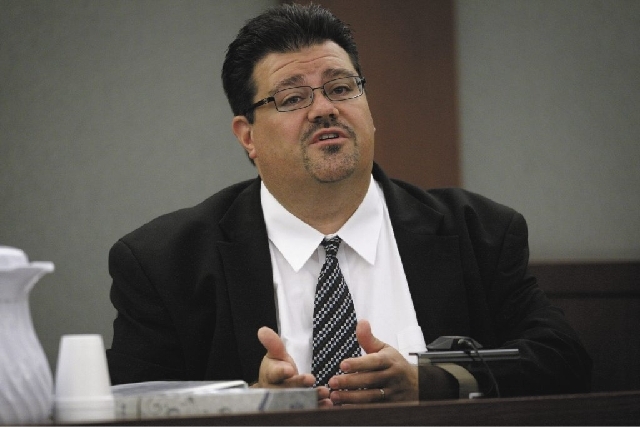


The Southern Nevada Health District’s senior epidemiologist stood firm on the witness stand Monday in his conclusion that the 2007 hepatitis C outbreak was the result of unsafe injection practices at clinics run by Dr. Dipak Desai.
Brian Labus, the health district’s top investigator for the past 11 years, testified that he hasn’t changed his opinion since he authored a 2009 final report on the outbreak.
The combination of reusing syringes in bottles of the anesthetic propofol on multiple patients spread the blood-borne virus, Labus said.
His testimony came as the high-profile trial of Desai and nurse anesthetist Ronald Lakeman entered its ninth week in the courtroom of District Judge Valerie Adair.
U.S. Centers for Disease Control and Prevention physicians, who assisted in the outbreak investigation, testified earlier this month that they shared Labus’ findings.
Health officials concluded that the double-dipping of syringes into the bottles allowed the deadly virus to be transmitted from patients infected with hepatitis C on two different dates in 2007.
Defense lawyers have maintained during the trial that the virus could have spread through the contamination of saline containers used on multiple patients or through flaws in the cleaning of scopes and biopsy equipment. Under cross-examination, Labus acknowledged that his “serial contamination theory” of how the hepatitis C outbreak occurred is unprecedented in medical circles.
He said CDC officials could not provide him with any published scientific articles to support the theory before the health district released his final investigative report in December 2009.
Labus denied that the theory has made him a celebrity in the field of epidemiology across the country but said he has given presentations on the theory at health conferences.
He acknowledged that months before his report was made public, he heard Desai being referred to as “Dr. Death” in an off-the-cuff remark at a gathering of health district officials here.
Since testimony in the trial began more than seven weeks ago, prosecutors have contended that a Desai-created work environment that placed profit above the well-being of patients led to unsafe injection practices and the outbreak.
Desai, 63, who gave up his medical license after health officials disclosed the outbreak in 2008, and Lakeman, 66, are facing more than two dozen charges, including second-degree murder, criminal neglect of patients, theft and insurance fraud.
The charges focus on the cases of seven hepatitis infections health officials linked to Desai’s now-closed Endoscopy Center of Southern Nevada on Shadow Lane.
One of the patients, Rodolfo Meana, died last year in his native Philippines of complications of the virus.
Today, prosecutors, who expect to rest their case next week, plan to show the jury a 90-minute videotaped deposition of Meana taken several weeks before his April 2012 death. At the time, Meana was too sick to complete the deposition.
Contact Jeff German at jgerman@reviewjournal.com or 702-380-8135. Follow @JGermanRJ on Twitter..


