RETRO COOL











They came on foot, by car and even by limousine. A few wore vintage outfits for the occasion.
The sold-out crowd of 250 who showed up to the Nevada Preservation Foundation’s second annual Vintage Vegas Home Tour May 8 was proof positive that enthusiasm for midcentury architecture is on the rise in Las Vegas.
And, it was a welcome sight for advocates anxious to get Valley homeowners interested in historic preservation, a subject that for some still conjures up images of bespectacled old maids poring over photographs in a dusty library.
“Not a lot of people think about residential architecture as something you need to preserve,” said Michelle Larime, 34, the foundation’s education director, as she turned away last-minute ticket-seekers from a registration desk at The Smith Center for the Performing Arts in downtown Las Vegas.
Larime hoped the lineup of retro-cool homes in this year’s tour would make the point. Spread across two neighborhoods, downtown and Paradise Palms, the 10 homes showed a range of approaches to restoration — from a gut remodel to a condo that appeared unchanged since the Atomic Age, complete with a General Electric push-button cooktop and “I Love Lucy”-style twin beds.
The variety of examples is important in a region where many historic homes’ original features have been lost to the ravages of time — or ripped out by overeager flippers.
“In the mid-20th century, this part of the country was still pretty much a blank canvas,” said home design blogger Pam Kueber in a lecture that kicked off the tour. “Then the houses started going up faster than ever in American history. For us architecture lovers, those houses were pretty darn awesome in a lot of ways.”
Kueber’s blog Retro Renovation and a companion site, SavethePinkBathrooms.com, have made her a minor celebrity among old-house aficionados. (A few fans of the blog had traveled to Las Vegas from as far away as Texas and San Francisco to hear her speak.)
Because the housing industry was less concentrated at midcentury, Kueber said, regional builders and material manufacturers competed fiercely to impress consumers with designs that captured “our American vernacular and our fast-changing way of life.” That resulted in unexpected features like glitter laminate countertops and record players that folded out from the wall — even in less-expensive homes.
“We old-house people really don’t own our homes; we’re just their latest caretakers,” she concluded.
NPF Executive Director Heidi Swank added some practical tips for the tour: “The restrooms in midcentury homes are often pretty cool and part of the display. So we ask that you don’t use them.”
Then they were off.
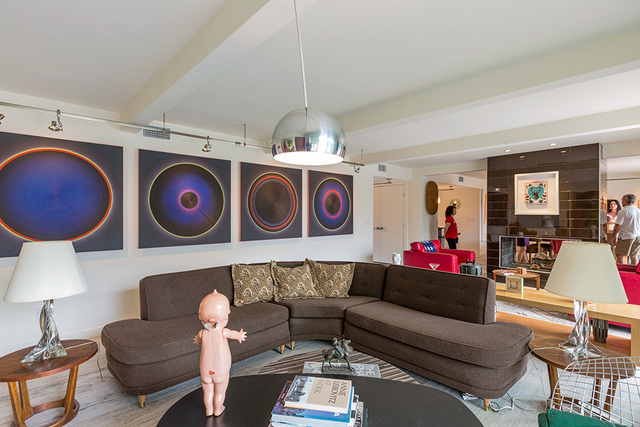
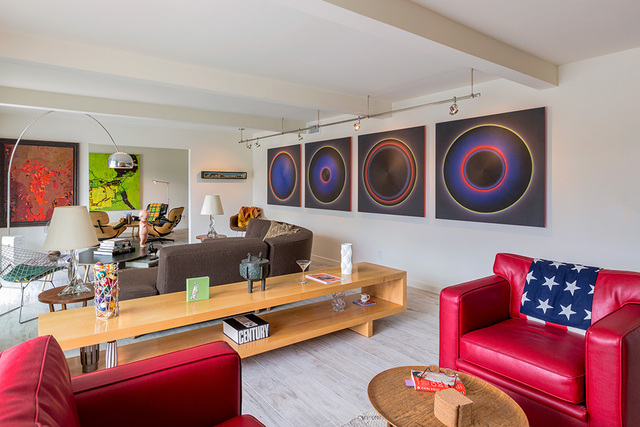
At one home on Ottawa Drive, tourgoers oohed and aahed over the minimalist, black-and-white interior of a 1963 Palmer &Krisel ranch home, which provided a perfect canvas for the owners’ collection of contemporary art, much of it by local artists.
A shadow box by the artist Abigail Goldman perched on one wall. Both whimsical and macabre, it depicted a series of crime scenes with characters in 1950s garb rushing about.
The main wall of the open living/dining space featured four acrylic paintings of multicolored discs by Angela Kallus. Resembling turntables or speakers, they were purchased at the much-beloved and now defunct Trifecta Gallery.
Ann Hillyer bought the house with her husband in 2012. “Flood had destroyed most of the features of the house,” she said. “There was no kitchen at all.”
Rather than go full-on 1960s, the two remodeled using more up-to-date finishes such as a wood-look tile floor. But the stark design played well with vintage furnishings, including a bling-encrusted lamp over the dining table that once hung in the Desert Inn casino.
“I have that bedroom set,” exclaimed a neighbor, Barbara Dahl, pointing to a sleek, rosewood buffet. “I’ve never seen another piece by that manufacturer.” Dahl had bought her piece in Brooklyn; Hillyer hers in British Columbia. The two exchanged contact information so they could compare notes on the furniture’s pedigree.
If Hillyer’s home was a marriage of old and new, the next house on the tour was a pure paean to Old Vegas. Its genteel, ivy-covered exterior masked a surprise: possibly the most baller master suite in all of Paradise Palms.
Drenched in mirrors, the approximately 300-square-foot bedroom housed a reflective fireplace and a hot tub crowned by an eyelet canopy, glowing red lights and dual brass shower heads.
There was even a chandelier in the attached water closet.
“You just don’t see it coming!” marveled one visitor, turning the corner from the hallway beyond.
Like any good old Vegas home, 2010 Ottawa came with some lore. A previous resident was a retired garment manufacturer from New York and liked to party, said owner Sandy Duffy.
“Supposedly, the Rat Pack partied here and he would hire prostitutes to come here in bikinis in cabs. Well, once they refused to pay and the pimp came and shot at them in the entryway.
’That’s why it’s mirrored, to cover it up.”
Duffy moved to Vegas to be close to her son, an Elvis impersonator. She’s a fixture at the Paradise Palms Social Club’s monthly vintage-themed cocktail parties, which residents say have become so popular that the waiting list to host one is years long.
Cocktail parties aside, preservation isn’t just for the middle class, insists the NPF, which organizes campaigns to protect historic neighborhoods and educates owners about remodeling and energy-efficiency. About one-third of people living in historic structures nationwide exist below the poverty line, Swank said.
In Las Vegas, living in a midcentury home can be cost-effective because the homes tend to be smaller, potentially driving down both the purchase price and owners’ energy bills.
Materials for period-appropriate renovations can be cheaper, Kueber pointed out — a laminate countertop as opposed to granite, for example.
When Realtor and preservationist Jack LeVine and his partner, Mark Adams, needed a new faucet for their 1954 custom home — also featured on the tour — they chose a $19 model from Home Depot.
“It’s the cheapest one Home Depot sells, but it’s appropriate to a 1950s bathroom,” Adams said.
Sometimes historic buildings can hide in plain sight, like another tour stop, the somewhat-dilapidated Skyline Villas apartment complex across Maryland Parkway from the Boulevard Mall.
Easy to drive by without noticing, the 94-unit community was built in the late 1950s, when it was known as the Fleur de Lis, and still boasts circular pools and concrete block walls with colored glass inserts.
The owners are adding tile backsplashes and new appliances to some of the rental units, while maintaining the generous closets and easy flow of the original floor plans.
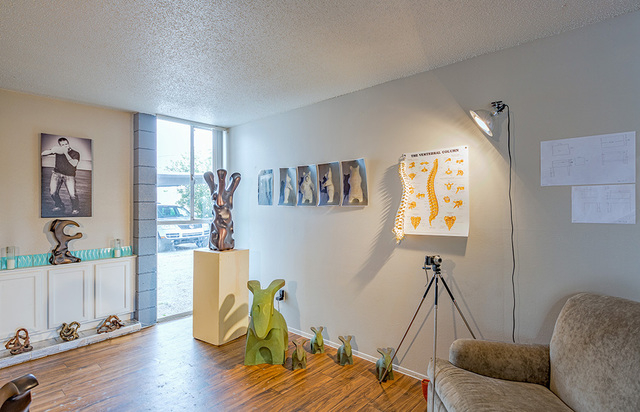
Surrounded by his bronze sculptures, artist David Hardy entertained a couple of lucky visitors by playing the conch shell in his airy, two-bedroom flat.
With windows on all four sides, the space felt both light-filled and private. Hardy said he felt a kinship with the craftspeople who designed and built his home, and others like it.
“They had more passion for it because they were on the cutting edge, trailblazing,” he said. “It wasn’t just about making money; they had a purpose.”