



Ahead of the Pack
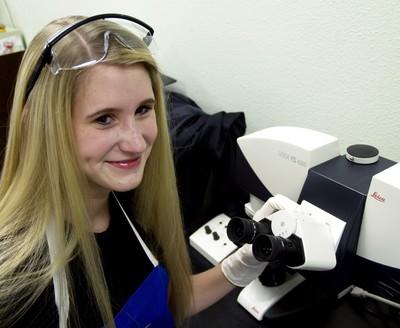
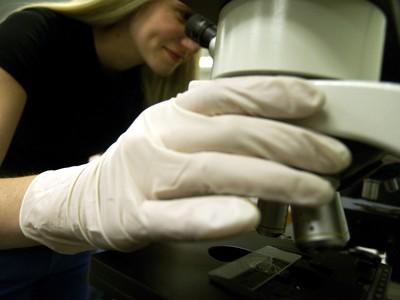


At 16, Advanced Technologies Academy senior Chalette Lambert is among the youngest to graduate in her class. In fact, when she starts school this fall at Duke University, where she'll major in biomedical engineering, Lambert will have just turned 17.
Lambert, however, is not your typical biomedical engineering student; some might say she just doesn't fit the stereotype. With long, Rapunzel-like blond hair, a friendly personality, and a modest, yet stylish, wardrobe, she certainly seems the last person one would picture analyzing the results of a spectrophotometer. This summer, though, Lambert will be conducting research on breast cancer cells, funded by a grant she secured through the Southern Nevada Section of the American Chemical Society.
Her research is based on an independent research project she submitted for competition in the Intermountain Junior Science and Humanities Symposium. The symposium invites high school students to conduct original investigations in the sciences, engineering or mathematics. Students submit their projects and later are chosen to either orally or visually present their findings at the symposium. At the symposium, Lambert gave a 12-minute long oral presentation on her project titled "Heat Shock Protein 27 Inhibits the Denaturation of Cytochrome C Bound to Gold Nanoparticles."
Heat shock protein 27 (HSP27) is found in all cells, but it has a higher concentration in breast cancer cells. Cytochrome C is a protein that can essentially kill a cell, but the high level of HSP27 in breast cancer cells protects the cell from denaturation. Lambert's research will explore the possibility of using targeting molecules to make sure Cytochrome C will denaturize breast cancer cells only, and not other necessary cells in the human body.
The American Chemical Society has awarded Lambert a $1,000 grant, and other corporations will match the amount. The money will pay for materials and other equipment necessary for her research.
Lambert conducts her research out of a private lab. A professor occasionally oversees her research and offers suggestions, but the project is essentially hers. This past summer, Lambert worked with a graduate student on a project about the toxicity of boron on bacteria. Through this project she became familiar with the lab and using research equipment much more sophisticated than her high school lab tools.
Because of her study on breast cancer cells, Lambert earned a spot to travel to the 45th National Junior Science & Humanities Symposium which took place in May in Huntsville, Ala.
In the past year, Lambert has won other awards in various science competitions. She was one of 300 semifinalists in the country in the Siemens Science Competition, and Nevada's sole semifinalist in the Intel Science Talent Search.
Her senior year, Lambert took advanced placement courses in calculus, English literature, biology and Spanish.
Spanish teacher Ann Brito is impressed by Lambert's self-motivation. Lambert took Spanish IV, her first language class, her senior year. She skipped a full year of Spanish through independent study.
"She's very well-rounded in music, language and science," Brito says. "In fact, I wouldn't be surprised if in the future, she won a Nobel Prize in science."
Longtime science teacher Andrea Sparks was Lambert's Biology II instructor. She says Lambert practiced her presentation on HSP27 in her biology class before the regional competition.
"She practiced her presentation and it was impressive. After she finished, the class was silent, completely stunned," Sparks says.
As for her musical endeavors, Lambert plays harp in several orchestras. She has been playing for half her life and owns three harps. She teaches harp lessons in her spare time.
Lambert says she wants to become a doctor and plans to continue her research as an undergraduate student. Her career decision has been largely influenced by her father's own career path. Her father, a cardiologist, has inspired her and sparked her interest in medicine. Lambert says she often discusses science and math with her father who is supportive about her own career goals.
At 16, Lambert's accomplishments have garnered attention and recognition within the medical and research community.
"I look forward to seeing her cure cancer someday," Sparks says. "She is a gem."
R-Jeneration


