An Unexpected Life






The results of a blood test contain numbers and letters that spell out a language understandable to few, save medical professionals. But in the 1980s, eight letters on a blood test read like a death sentence even to the illiterate: "Positive."
The word, referring to a diagnosis of acquired immunodeficiency syndrome, or AIDS, meant that it was very possible you were going to die, says Dr. Jerry Cade, the director of University Medical Center's HIV Wellness Center.
People were told to "go ahead and max out your credit cards, drop out of college, spend your savings, because you're not going to live," says Jennifer Morss, associate director of Aid for AIDS of Nevada.
Many did die. But advances in medicine brought about the development of better AIDS drugs, which has meant more life than death to many positive patients, Cade says.
Over time, the struggle shifted from the business of dying to learning how to live with the virus, Morss says. Many people gave up -- or lost -- their jobs, quit school and racked up debt, expecting to die. Those who didn't had to figure out how to make ends meet; how to pay for their medications and health care; how to handle the severe side effects caused by some AIDS drugs.
"Fortunately, they lived but they're starting their lives over at 40," Morss says. "They're asking, 'What do I do now?' It's a lot of work to live with AIDS. It's a full-time job that they work at every day, eating the right foods, controlling their wasting, controlling their uncontrollable diarrhea, vomiting. Their health is a full-time job."
The trait that stands out most among long-term survivors is a positive attitude, Morss says. They talk, act and live like people who are going to make it, no matter the circumstances.
Among the survivors are these Southern Nevadans, who recently shared their stories with the Review-Journal.
JIM ST. MARIE
He was supposed to be dead within six months of receiving a diagnosis of HIV positive.
That was in June 1990, but Jim St. Marie, 59, is alive and mostly well.
"I just decided I wasn't going to die," St. Marie says of his refusal to accept the worst-case scenario. "I decided I had to go by my own feelings. I refused to go quietly."
The difference between HIV and AIDS rests on the number of T-cells a person has in his bloodstream. T-cells are blood cells that play a major role in the immune system, helping to fight infections and illness. When the T-cell count of an HIV positive person falls below 200, he receives the AIDS diagnosis. Even if the count increases, as it can, the diagnosis stays.
Initially, it was believed that HIV positive people had to cope with dying when actually, many had to cope with living, St. Marie says.
"It's something that really affects the quality of your life. It puts a damper on your hopes and goals."
The retired accountant found the medications gave him the most trouble. Some of the drugs cause uncontrollable diarrhea, vomiting, fatigue and other hard-to-handle side effects.
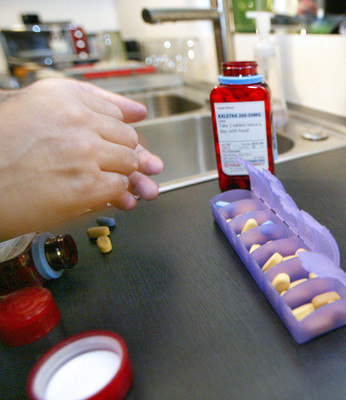
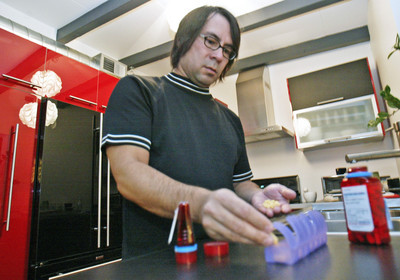
"That's why it was so hard for me to take them," St. Marie says. Still, he takes a total of seven pills twice a day, knowing they keep him well enough to live a quality life.
Since his health has always been relatively strong, St. Marie was able to work and earn a good living. He is atypical among those who test positive because he doesn't struggle to pay for medications, food or bills.
"I'm one of the few people who don't have the financial strain others go through," he acknowledges.
St. Marie has seen the illness devastate friends and loved ones, though. In 1998, his partner of 12 years died of AIDS, after struggling with infections and allergies to some of the powerful drugs used to treat it.
Nearly three years ago, St. Marie decided to start sharing his story with others by volunteering with the outreach group called the Holy Order of the Sin Sity Sisters of Perpetual Indulgence.
His philosophy of living with HIV?
"I don't really have one," he says. "I try not to make it a part of my daily life."
JENNIFER
It's the little things that bring joy to Jennifer's life.
A daughter and son working as nurses. Another daughter about to graduate high school with a 3.8 grade-point average. An 11-month-old grandson.
"That's my joy. These are things I didn't think I'd ever live to see," says Jennifer, 48, who was diagnosed HIV positive 14 years ago. "Every day I look around and say, 'My God, I'm still here.' "
Jennifer, who moved to Las Vegas from California a year ago, doesn't want to use her last name. She doesn't want to risk facing the stigma that positive people still encounter from friends, co-workers, strangers, even family, she explains.
Once, she dated a man who told her she was lucky that he even talked to her, implying that she was damaged goods because of her HIV status, Jennifer recalls.
"There's still a lot of stigma; some people don't want to deal with it," she says.
Her life hasn't been normal for a long time, she notes. It's lonely because, even though science long ago established that HIV and AIDS are unrelated to sexual orientation, people still think of it as a gay disease. It's difficult to find support in the heterosexual community, she says.
She contracted the disease from her husband, who didn't tell her he had AIDS, she says. He left her to raise three children; the youngest was 6 months old. At first, she worried she may have transferred the virus to her baby during birth, but two tests confirmed the child was negative. She is the healthy, 14-year-old high school student who gives Jennifer so much joy.
A former nurse, Jennifer's first reaction to her diagnosis was shock. She told her supervisor and immediately saw her patient load decline.
A year ago, her health declined and she had to go on disability. She lost her house.
Las Vegas brought with it the prospect of a fresh start. Once she moved here, Jennifer started volunteering with AFAN's speakers' bureau.
"I go out and tell people my story about living with HIV," she says.
Jennifer tells them about the anemia she suffers, the side effects that some medications cause. She tells them about the two pills she takes every day, and stresses the importance of medication compliance. So many people who are positive can develop resistance to medications by not taking them as prescribed, Jennifer says.
Most importantly, she tells them to get tested and, if they discover they're positive, to never give up.
"If it wasn't for my children, I would have given up long, long ago," Jennifer says. "But I'm a survivor and I go on."
TRACY SKINNER
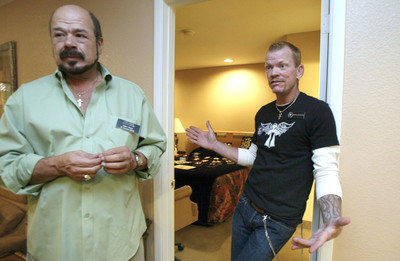
Tracy Skinner stands in the middle of the hotel suite, thermal sleeves pushed above his elbows revealing the muscular and veiny forearms of a natural fighter.
Skinner, 43, has a lean, wiry, boxer's physique that some men work hard for in the gym. His comes to him via AIDS.
He was diagnosed with AIDS in 1991 but wasting, the loss of fat and muscle that many positive patients suffer, has affected him for the past five years. Skinner is a steak and potatoes kind of guy and he never watches his calories.
"I eat everything possible," he says.
On a recent Friday, he greets fellow AIDS activists at a hospitality suite where they prepare for a convention. In between hugs and hellos, he tells his story.
Though his doctor told him there was nothing to be done for him, the first eight or nine years after his diagnosis were asymptomatic for Skinner. He worked as a baccarat dealer at Bellagio, earned a good living, bought a house, a car and saved for his future.
The outlook for people with AIDS in the 1980s and early 1990s was grim and, because so many people died shortly after being diagnosed, the general consensus was to quit school, stop dreaming and run your credit card bills up if you were positive, Skinner says. They were told they were going to die.
However many, like Skinner, didn't.
Now, he lives a normal life, but normal is so subjective, Skinner says. He has a boyfriend and an active social life, but he's not like the typical person with AIDS because of his allergies to sulfa-based drugs.
Many of the most effective AIDS drugs are sulfa-based, so Skinner must inject himself with another medication twice a day -- once in the stomach, once in the leg -- following a regimen that is rare yet necessary. It's similar to what a diabetic endures, only Skinner's shots leave him black and blue. But the injections are a far cry from the 60-plus pills he took daily during the 1990s, he says.
Like many long-term survivors, Skinner now draws disability, because AIDS has wreaked havoc on his body. An experimental drug trial in 1999 landed him in the hospital; he has had 14 hospitalizations since then. Small illnesses can turn into life-threatening ones for those with compromised immune systems.
It was difficult to adjust, incomewise; what he made in one week Skinner now makes in a month.
Most people face financial challenges, but for people with AIDS, it can be especially hard, Skinner says. His co-pay for one medication costs $1,100 a month. Sometimes, he has to forgo the drug, which helps him retain muscle mass and fat. Federal and state support programs cover the costs of AIDS drugs for some people, but once that aid runs out, there are few places to turn.
"With some people, it can be a choice between eating or buying your medication. Eating usually wins," Skinner says. "I made a choice to not work and try to live. The first year and a half (after losing his job) I went through a lot of struggles, thinking I didn't have a purpose for getting up in the morning, because I had nothing to get up for."
Eventually, Skinner found a reason: Helping others who were struggling with AIDS. He volunteered with Aid for AIDS of Nevada's speakers' bureau, going into the community and talking about his life, struggles and coping.
In 2005, Skinner started the Holy Order of the Sin Sity Sisters of Perpetual Indulgence, an outreach group in which the members dress in drag as nuns and take on ridiculous names. As its president, Skinner finds himself devoting much of his time to the order's business, planning events or talking to people about their diagnoses. It's his life's purpose.
"It's really amazing how people divulge things when you're in your habit," says Skinner, citing the costume and makeup as the reason people open up. "Their deepest, most secret things they'll tell you. It's really touching."
LANE OLSON
To paraphrase Forrest Gump, normal is as normal does.
Lane Olson wakes early and goes to work during the week. He works a part-time job on some evenings, hangs out with his friends, loves his family. He pays bills, eats and sleeps. By all accounts, Olson lives a normal life.
With AIDS.
"I hate saying normal because, what is normal?" asks Olson, 43. He has lived with AIDS for 19 years. "Everyone's going through something. But my life is pretty normal."
He received his diagnosis in 1988, only five years after HIV was identified and named as the cause of AIDS, or what many in the 1980s called "the gay cancer." Olson and a small group of friends had been tested as a dare to each other after reading about free HIV testing.
Then, it was a death sentence, he says. The illness made headline news because its effects seemed to be so swift and devastating.
When he went to the health district for his results, Olson suspected bad news, because he was kept waiting. Then the nurse burst into tears and ran out after escorting him into a private office, confirming the worst. Another worker who took over for the sobbing woman pushed a piece of paper toward Olson, then 24, saying only, "I'm sorry."
"I didn't even really think about it after the test," Olson says. "I really didn't understand it, and I didn't know enough about it."
A college student studying business and psychology, Olson decided to drop out of school.
"I was thinking, 'What's the use?' I had stopped dreaming, everything I had ever wanted I just put on hold," he recalls.
He worked in the counting rooms of casinos around town, until he became ill and was hospitalized in 1996. After that, he couldn't work and began drawing disability.
With time and the right medications -- Olson now takes three pills in the morning and two at night -- he regained his strength and some energy. A part-time job became feasible so Olson went to work for AFAN. Two years ago, he was able to get off of disability and now works full time in AFAN's education and prevention department.
Though Olson fills his free time with the things that bring him joy -- friends, family, hobbies -- he laments the devastating effect AIDS has had on his romantic life.
"I'm never really going to physically be intimate with someone. Even though it may sound stupid, it does mean something, especially when you've had it before and you've lost it," he says.
Still, Olson is optimistic about life. He looks at what life brings to him instead of what it takes away. He says he faces each day with gratefulness for what he does have and realizes life could always be worse.
"The life I've lived has been a true experience. It has enlightened me about people, my purpose and what life is," he says. "People ask me how come I'm always in such a good mood. It's because I don't want to be stuck in 1988; I want to be here, now, enjoying life and people instead of stuck in that room where I got that diagnosis. I consider myself blessed. No matter what, I really, truly feel that I will continue to be blessed."
Contact reporter Sonya Padgett at spadgett@reviewjournal.com or (702) 380-4564.
TRENDS IN THE DISEASE
AIDS and HIV by the numbers, according to Aid for AIDS of Nevada:
Half of all new HIV and AIDS cases worldwide are women
Half of all new infections are in people younger than 25
Women make up 27 percent of AFAN's clients
The highest growing population with HIV infection is between the ages of 19 and 25
UNINTENDED SIDE EFFECT
Advances in medicine have given hope to people with HIV and AIDS, helping many to live seemingly normal lives, says Jennifer Morss, associate director of Aid for AIDS of Nevada.
But that has led to an unintended side effect: A younger generation that is cavalier about the virus.
"They think, oh, you just take a vitamin every day and you're OK," Morss says. "What they don't know or see is that it's a difficult life, living with HIV and AIDS. It's a lonely life. Yeah, they're living longer, but there's still the stigma, the financial issues and the health issues."
People like Earvin "Magic" Johnson, the basketball player who announced he was HIV positive in 1991, give the impression that living with the virus is easier than it is, Morss says. There's the idea that, because people are living longer, the crisis is over and there's no need to practice safe sex or focus on AIDS anymore, she adds. And that idea is wrong.
"It's harder to live with AIDS than it is to die," Morss says. "It's more expensive to live 15 or 25 years with it."
The average patient who was recently diagnosed with HIV can live a basically normal life, says Dr. Jerry Cade, director of University Medical Center's HIV Wellness Center.
"HIV is not that different than having high blood pressure or diabetes," Cade says. "But that's what can give the younger generation the idea that it's OK to not be as careful."
The HIV virus is spread through blood transfusions, sexual contact or the sharing of needles and syringes with an infected person. An infected mother also can give the virus to her baby.
"With youth, I think this disease has been positioned as over, there's nothing to worry about," Morss says. "That message is so detrimental to our youth. Nothing puts a crimp in your social life like HIV. The youth don't see this. It's also still stigmatized as a gay man's disease. Scare tactics don't work, but we have to paint a picture of reality."
Though positive people can live normally, it is much better to avoid infection, Cade and Morss say, because life will be much more difficult.
Patients spend an average of $60,000 a year on AIDS medications. Over the years, that adds up, she says. Federal programs that were created to help positive people with their medical costs didn't take into account people living so long, she adds.
AFAN's average client is on disability, makes less than $1,500 a month and is enrolled in federal or state AIDS drug assistance programs. Many can't afford to keep cars, they visit the doctor frequently, may be in the hospital at least once a year and uses food vouchers.
By SONYA PADGETT