



Crafty Kids
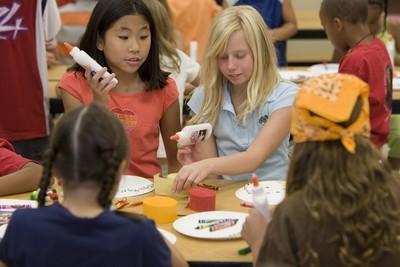
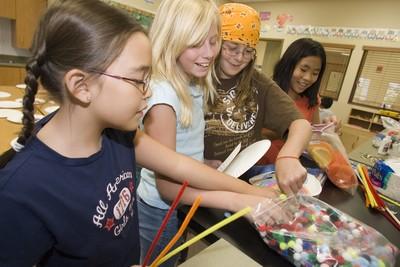


School's out, it's 110 degrees outside and you have a bored kid on your hands: What to do?
You could stick him in front of a video game and let him while away the hours blowing up aliens from outer space. Or, you could resort to an old-fashioned but tried and true method of stimulating a child's imagination while occupying his time: crafts.
Working on crafts can be a valuable way to help children stay sharp during the summer, say local crafts gurus.
"It gets their minds thinking, makes them more creative and open to new things," says Jesseca Zwerg, a kids' camp counselor at Veterans Memorial Leisure Center.
All of the cutting, drawing and writing helps them develop fine motor skills as well as improves their organizational skills, says Liann Tackett, a kids' camp site leader for the city of Las Vegas. Every summer, the city offers a variety of camps for children and they do plenty of crafts, Tackett adds.
"It doesn't have to be expensive, either," Tackett says. "Most of our crafts are made of recycled items."
Look around the house, Tackett and Zwerg say, and use your imagination to come up with ideas and materials. Empty paper towel or toilet paper rolls, egg cartons, paper plates and dry beans make great materials, they say. The uses for construction paper, glitter, pencils, buttons and string are infinite, too.
Tackett says she searches the Internet and magazines such as Family Circle for ideas.
No child is too young for crafts, Tackett says, but they should be age-appropriate and adult supervision is important.
"I've found that putting out a whole bunch of stuff, then giving them a theme is more fun for the kids than holding up a sample for them to copy," Tackett says. "They love tons of cheap stuff, egg cartons, paper plates, Popsicle sticks. The more you put out, the better, and they get to create what they want."
For instance, 1- and 2-year-olds can make butterflies out of coffee filters and a clothespin, while kids ages 2 to 6 can finger paint with pudding and wax paper. Just give them a theme to work with and watch them create, Tackett says. Cereal or candy on a string make great necklaces for 6- to 11-year-olds.
A hot plate, crayons, foil and white paper are perfect tools for youngsters age 8 to 15. Cover the plate with foil, turn it on low, draw on the foil with crayons, then press the white paper to the foil. The heat melts the colors and creates unique designs, Tackett says.
Glue two paper plates together with a handful of dry beans in the middle and you have a spaceship for kids age 5 to 9, Zwerg says. Or, they can be tambourines.
A few of the more popular crafts, such as making homemade play dough or silly putty, involve a bit of science. In a big bowl, mix cornstarch with a small amount of cold water. You have to eyeball the amount, Tackett says, to make sure it's not too dry and not too wet. Once it's mixed right, it will look like plaster of Paris. Pick it up and it melts. Let it fall into the bowl again and it will thicken. This is an entertaining experiment for kids ages 7 to 15, she adds.
"It's a lot of fun, but it's messy," Tackett says.
FINDING HELP If you need help with craft ideas or instructions, consider these options. The city of Las Vegas offers a variety of crafts classes for kids. Visit the city's leisure services Web site at www.lasvegasnevada.gov/ Find/recreation.htm for a list of upcoming events or call 229-6297. All Home Depot stores offer free how-to clinics for kids ages 5 to 12, every Saturday between 9 a.m. and noon. They make mailboxes, birdhouses and frames from prefabricated kits. Cost varies. Home Depot has multiple locations across the valley. Michaels crafts stores throughout the valley offer workshops for kids every Saturday. The cost is $2 per child. "It's just to give the kids something to do, which is great for Vegas because there's not much for kids to do in town," says Dave Limpin, the store manager of Michaels at 7321 W. Lake Mead Blvd. From now until July 28, kids can take part in Michaels' summer camps, Monday through Friday, from 9:30 to 11:30 a.m. and 1 to 3 p.m. The cost is $10 and kids will make things such as foam purses, wooden ships, birdhouses and paintings, Limpin says. Contact your neighborhood Michaels store for more information. Jo-Ann fabrics and crafts superstores, 2160 N. Rainbow Blvd. (646-2334) and 651 Marks St. (435-6358) in Henderson, offer a variety of classes for kids. Jewelry making and sewing are popular, says Michael Gribbin, a manager at the Rainbow store. Two upcoming classes: quilted wall-hanging, from 3 to 6 p.m. July 24, cost is $30; and jewelry making, from 1 to 4 p.m. Aug. 10, cost is $15. Review-Journal MAKE YOUR OWN ART MATERIALS Homemade Play dough Combine 2 cups of flour with 1 cup of salt and 2 cups of boiling water. Add 2 to 3 tablespoons of cooking oil and two packets of sugar-free Kool-Aid. Use whatever colors you want the clay to be. Let it cool and you have modeling clay. Making it is a craft and then playing with it is, too. "It doesn't taste good but it is edible; no one's going to get sick from this," says Liann Tackett, a kids' camp site leader for the city of Las Vegas. Homemade Silly Putty Combine half a cup of water with half a cup of Elmer's Glue. Mix in three drops of food coloring. In a separate bowl, add 2 tablespoons of Borax with 1 cup of water. Combine the Borax mixture with the glue mixture and let cool. "It should come out just like Silly Putty. You should be able to pick up newsprint with it," Tackett says. Homemade Gak: Combine 1 cup of white glue with 3 drops of food coloring. Slowly stir in 1 cup of liquid starch. It will start thickening and then turn into putty. Source: Liann Tackett, a kids' camp site leader for the city of Las Vegas.


