



DOWN TO A SCIENCE
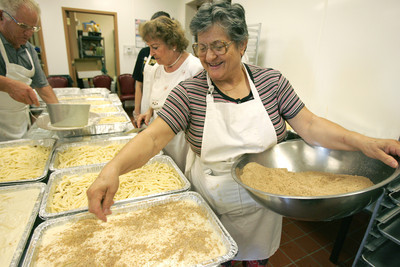
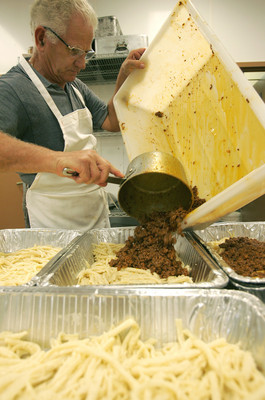


Georgia Kourlos stands near a translucent white tub, patiently waiting. Soon a man walks up with a commercial-grade colander containing 45 pounds of cooked long, tubular macaroni and dumps it into the tub. "One more," she says, and he brings another.
Kourlos immediately sets to work. Taking a pitcher from a nearby table, she pours a sauce over the macaroni, then bends over it and mixes it with her hands, adding more sauce until the consistency is just right. Two women standing nearby slide a large foil pan across a table toward Kourlos, who fills it with the first layer of macaroni that will form the foundation for the pastitsio, the layered macaroni dish that's sort of the Greek equivalent of lasagna. It is one of 250 pans that will be prepared.
It's that time again -- time for the 35th annual Greek Food Festival at St. John the Baptist Greek Orthodox Church, 5300 El Camino Road. From Thursday through Sunday, members of the church will be serving the fruits of their labors to a crowd projected at 35,000 to 38,000. (Admission to the festival is $5 for adults and free for children under 12.)
No, those zeroes are no mistake; they're hoping to top the 33,000 who attended last year. And all of the food is made by members of the church, who cook in quantity. Think volume -- lots of volume.
"You have to get started quite a bit ahead," says Marilyn Flangas, who handles publicity for the festival.
It's an operation that has the precision of a military exercise but smells a whole lot better. Captains are appointed to lead each of the major festival projects, and Sam Koutsulis heads the pastitsio team. Why? He's a five-year veteran of the team, and "I love to cook," he said. "My wife told everybody I like to cook, so they put me in charge."
Then again, it may be because Koutsulis has the bearing necessary to marshal the troops, and marshal them he must.
The volunteers prepare the pastitsio in batches of 50 of the big, deep, half-sheet pans. Each batch requires 60 gallons of sauce, made with 9 quarts of evaporated milk, 38 pounds of liquid eggs and 33 pounds of Romano cheese. The meat sauce for each batch requires 135 pounds of beef. When you work with numbers like that, you need organization.
Georgia Kourlos has been a pastitsio volunteer for 10 or 12 years, so she's got it down to a science. She casts a critical eye on the layer of macaroni and nods; the women move that pan away and slide another into its place.
Filled pans are moved to a table across the room, where more volunteers wait. Kourlos may be 83 years old, but she works fast. Soon the filled pans are backing up on her table. Time for Koutsulis to step in.
"Form a production line!" he says, and volunteers quickly position themselves to pass pastitsio pans in the manner of a bucket brigade.
But there's another holdup, and partially filled pans stand waiting on tables with buckets of sauce staged underneath.
"We need meat!" says Andrea Takas.
Another voice: "Who's doing the meat? We need meat!"
And then: "Here comes the meat," as volunteers roll up a cart carrying three vats filled with seasoned, cooked meat.
The volunteers near Kourlos' station have time for a break, and stand, conversing in Greek, as the volunteers at the other table use a pan to scoop meat from the tub and spread it atop the macaroni.
Another layer of macaroni is added, then the Bechamel sauce is poured on top, until Katsoulis yells, "That's it! That's it! That's it!" A volunteer shakes each pan to level it, and then the breadcrumb topping is sprinkled on. The scent of nutmeg fills the air. The pastitsio will then be put into the industrial oven with rotating shelves -- which can carry 48 pans at a time -- and then frozen until festival time.
The operation has come a long way. Rita Pappas, who's been involved since 1985, remembers when volunteers cooked outdoors, on barbecue grills.
"It was very difficult," she said. "We had to wear hats because of the sun."
Most of the time, the volunteers work smoothly, with little conversation. But at one point Kourlos pauses, the macaroni in her hands dangling over the tub, as she views a minor skirmish in the saucing area.
"My aunt taught me to go up and down and then across," Takas says. The woman pouring the sauce, however, has her own way of doing things.
"We have lots of bosses," Flangas says with good humor.
"We have different Greeks from different regions," Takas says later. "We just have to mind the elders."
And most of the volunteers are elderly. After a few hours of mixing macaroni Kourlos admits to being "a little" tired. George Kakavulias has been a volunteer for 33 of the festival's 35 years.
In many places, traditional church-made food is dying out along with the volunteer corps. Those coming after, it seems, are too busy working to spend hours in a church kitchen. But the St. John members vow that won't be the case.
For one thing, the church has some 3,000 members, about 1,000 of whom are active. Then there is the strength of tradition.
At 32, Maria Maliagros is probably the youngest volunteer in the kitchen during this pastitsio shift. She's confident her generation will keep things going.
"I think the parents have done a great job raising the kids, so that they'll take over when it's time," Maliagros said.
"We've got the young ones, too, but a lot of them work," Flangas said. "We have a lot of people who will be working on various things."
Several hundred children attend the church's Sunday School, she said, and many participate in a church dance group. The youth sells soft drinks at the festival, and three of Flangas' own grandchildren will be volunteering on the food lines.
"We pass down traditions," she said. "Capital T for the church."
"We love the church," Kakavulias said. "We all get together, work together like a family."
PASTITSIO
(Greek Macaroni Lasagna)
6 tablespoons butter (divided use)
3/4 cup finely chopped onion
2 cloves garlic, minced
1 1/4 pounds lean ground beef
1 can (16 ounces) peeled tomatoes, mashed
1/2 cup tomato sauce
1/2 cup water
1 teaspoon salt, plus more for pasta
1/8 teaspoon pepper
1/2 teaspoon cinnamon
1/8 teaspoon cloves
3/4 pound Greek macaroni (use long medium-size; do not use elbow)
1/4 cup butter, melted
6 large eggs (divided use)
1 cup grated Parmesan cheese
Bechamel sauce (recipe follows)
In a large skillet, melt 2 tablespoons of the butter and saute onion and garlic until golden. Add remaining butter and crumbled ground beef; brown well. Add tomatoes, tomato sauce, water, salt, pepper, cinnamon and cloves to meat mixture; simmer 20 minutes, or until most of the liquid has been absorbed. Mixture should be thick.
In a large saucepan, bring 3 quarts water to a rolling boil and sprinkle with salt. Break macaroni into thirds; add to boiling water and stir. Cook uncovered until tender, stirring occasionally. Rinse with cool water and drain thoroughly. Add butter and toss.
In a large bowl, beat 3 eggs well; add half of macaroni and 1/2 cup cheese. Toss well. Layer into a greased 9-by-9-by-2 inch baking pan. Top with meat mixture. Repeat as above to combine remaining macaroni, eggs and cheese; layer over top of meat mixture.
Spread Bechamel sauce over macaroni and bake at 350 degrees for 25 minutes, or until top is delicately browned.
Serves 6.
BECHAMEL SAUCE
6 tablespoons butter
6 tablespoons flour
2 cups warm milk
3 eggs, beaten
2 tablespoons sherry (optional)
1/2 teaspoon grated nutmeg
1/2 cup grated Parmesan cheese
1/2 teaspoon salt
Dash white pepper
In a medium saucepan, melt butter and blend in flour until smooth. Gradually add milk, stirring constantly, until thickened and smooth. Gradually stir in eggs; cook over a very low heat until thickened. Add sherry, nutmeg, cheese, salt and pepper.
KOURAMBIETHES
(Shortbread Cookies)
8 ounces unsalted butter
2 cups icing sugar (plus 3 tablespoons sifted icing sugar)
1 egg yolk
1 tablespoon brandy
1/2 cup finely chopped toasted almonds (optional)
2 1/2 cups flour
1 teaspoon baking powder
Whole cloves
Preheat oven to 350 degrees.
Melt butter until bubbles subside and sediment is golden; do not burn (this melting is nontraditional, but many Greek cooks do it). Pour butter into mixing bowl, leaving sediment in pan. When butter has solidified, add 2 cups of icing sugar and beat with electric mixer until light and fluffy. Add egg yolk and brandy and beat well. Remove bowl from mixer and stir in almonds, if used.
Sift flour and baking powder twice and mix lightly into butter mixture. Break into small pieces the size of a large walnut. Shape into crescents; or roll into balls, place on a flat surface and pinch tops twice, making four indentations and at the same time flattening them slightly. Insert a clove into the center of each cookie.
Place cookies on ungreased baking trays and bake for 15 to 20 minutes, until lightly colored. Cool on trays 10 minutes.
Sift 3 tablespoons of icing sugar onto waxed paper and lift warm cookies onto it. Sift more on top and sides. When cool, place in a container and sift remaining sugar on top of cookies. Seal and store for two days before serving to improve flavor. When serving, place each in a small paper cupcake cup.
TZATZIKI
(Yogurt-Cucumber Dip)
1 medium cucumber
2 cups plain yogurt
4 cloves garlic, minced
1 small onion, finely chopped
1 tablespoon olive oil
1 tablespoon white vinegar
1 tablespoon chopped fresh dill (or 1 teaspoon dried)
Peel cucumber, quarter it lengthwise and remove seeds. Grate cucumber and squeeze to remove excess moisture. Combine thoroughly cucumber, yogurt, garlic, onion, olive oil, vinegar and dill. Refrigerate for at least 24 hours.
Serve cold with chips or crackers.
-- Recipes from "Greek Cooking in an American Kitchen"
ON THE WEB Greek Food Festival


