



IN STITCHES (Factory Worker)
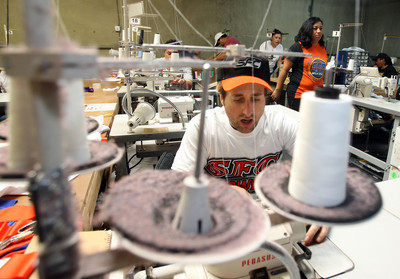
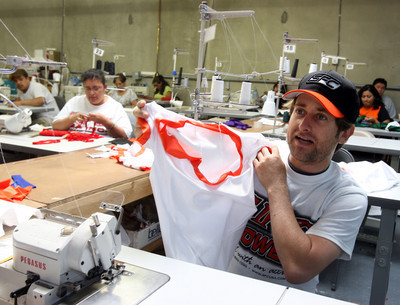


Manufacturing a shirt at Las Vegas' Supplier for Champions isn't as hard as I thought. In fact, it took me 10 minutes to master the job. Every time I swipe my two cut-outs of white nylon dazzle under the sewing-machine needle, they come out stitched together precisely at the edge.
I think I know why: genetics. My great-grandfather, Samuel Fein, was a master tailor. After emigrating from Poland in the 1920s, he made and fixed uniforms for the Merchant Marines, eventually sewing up the military market on Manhattan's West Side.
Or not. Hector Sandoval bursts my bubble like a giant sewing needle.
"It's because of the knife," my fellow sewing-machine operator explains.
Our Pegasus M700s are overlock sewing machines, which means they cut fabric immediately adjacent to wherever they stitch it. Every garment emerges trimmed to the edge, every time. Monkeys would not produce a different result.
However, skill is required to render the shirt even. And, as Sandoval points out, the left side of my shirt is a size medium, while the right pushes a small.
A wave of Spanish whispering envelops the second floor of the 18,000-square-foot factory, where 50 workers, the majority of them female, sit in rows resembling a teacherless classroom. I catch only the word "cabeza," which Yolanda Rodriguez utters while pointing a finger at her head and twirling it.
SFC, founded 37 years ago, is the largest athletic-apparel manufacturer in Nevada. Last year, it printed or assembled more than 2 million garments -- including 75,000 uniforms and T-shirts for the Clark County School District, 5,200 shirts for the University of Nevada, Las Vegas and 4,200 shirts for the Las Vegas Wranglers.
Although 3 million American factory jobs have been lost since 2000 -- mostly to low-priced competition from the third-world - approximately 15 million Americans still depend for their living on the operation of machines that put stuff together.
"It's a good job," says Sandoval, who earns somewhere between $8 and $15 per hour. (He asked that his salary not be revealed because his co-workers all earn different amounts.)
Born in Mexico City 30 years ago, Sandoval began sewing sports apparel at age 16, alongside his parents in an L.A. factory.
"I used to want to be a graphic designer," he says. "But I was going back and forth to Mexico so much, I didn't have time to go back to school."
There's no broken heart on Sandoval's to-mend list, however. He says he likes "everything" about SFC -- "the people, the company and the boss." In addition, he's says, sewing is neither boring nor repetitive. (Of course, he says these things while his boss, SFC Senior Vice President Tim Riechert, stands right behind him.)
"Oh my God," Sandoval says, trying to keep it to himself.
During a normal eight-hour shift, SFC's 100 employees can produce 35,000 pieces.
Today's shift is not normal.
I have just de-threaded the needle on my third sewing machine, which explains why my shirt's left sleeve refused to attach. Until now, I thought the speed control pedal beneath me was an on/off switch.
Down the sewing row I go again, like Mario in the original Donkey Kong. Each time, I unseat another sewing-machine operator who has to stop working and wait for my previous machine to be rethreaded.
"You have to go slower," Sandoval says.
He means with my needle speed. Slowing my work speed is not possible. For over an hour, I've been assembling a shirt that would have taken Sandoval four minutes.
The neck is a particular pain. It must be turned and revolved as it's fed -- while fingers keep the fold both intact and attached to the torso. (This explains the location of the majority of my shirt's holes.)
"Careful!" Sandoval screams, leaping a foot away from my machine.
It's not a good sewing day when you have to cut jammed fabric out of your Pegasus M700 with a scissor. Fortunately for me, it's not the worst possible day -- when your finger is what gets caught there.
Earlier, Sandoval remembered watching a lady sew through her fingernail a few years ago.
"She was screaming and tried to pull the needle out by herself," he said.
When she couldn't, she was rushed to the hospital (where she received, ironically, stitches).
Two more de-threaded sewing machines later, I finish. My co-workers sarcastically applaud.
"Bravo!" they scream as I hold the shirt up and bow.
This is when I notice that the front (at least I think it's the front) has somehow gotten sewn to itself. A seam crisscrosses the chest, like the one on Frankenstein's head.
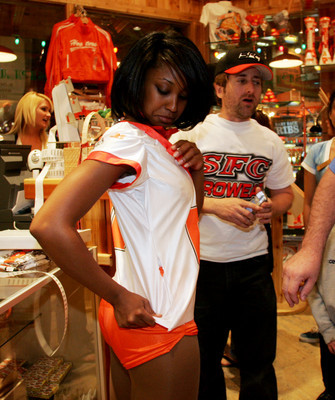
"Oh," says Hooters girl Sabrina Brown during one of many moments in my life when an attractive woman has tried sparing my feelings.
It is two days later, and I have just presented my shirt as a football jersey to the breast-obsessed restaurant and hotel chain. Each year, SFC manufactures enough orange and white shirts for 30,000 D-cups. (Incidentally, no extra fabric consideration is given to the chest region. I asked.)
The errant seam on the front is gone. (SFC had to remove it to avoid adding a $225,000 silk-screening machine to the list of broken equipment associated with inviting me aboard.) But the holes remain, dozens of them, a potential upside to screwing up that escaped me until now.
I explain to Brown, not unlike the narrator of a fashion show on E!, how the material is breathable, custom-tailored for the Hooters girl who overheats easily on the job (and whose body swoops inward more on the right than left).
Unfortunately, Brown insists on modeling it with another shirt on underneath.
View video of Levitan as a sewing-machine operator at www.reviewjournal.com/video/fearandloafing.html. Fear and Loafing runs every Monday in the Living section. Levitan's previous adventures are posted at fearandloafing.com. If you have an idea for Levitan, e-mail clevitan@reviewjournal.com or call (702) 383-0456.
COREY LEVITANFEAR AND LOAFING
Video


