Libraries become important spots for fun, help in tough times




We -- avid readers, music lovers, film and research fiends -- are a fickle lot.
We do our research at home via Google and our own Internet service provider. We buy our books from Amazon.com. We order movies through Netflix and music from iTunes.
Then, let the economy take an ugly turn and, suddenly, we're running back to our local public library, taking advantage of the research assistance, Internet access, books, movies, music and every other sort of media one can possibly imagine, all for absolutely free.
Not surprisingly, valley library officials say they've been seeing more and more of us take-the-library-for-granted-in-good-times Southern Nevadans over the past year or so, ever since this ongoing recession hit us like a Depression-era dust storm.
Take the Las Vegas-Clark County Library District, where circulation -- that is, books, CDs, DVDs and other materials checked out of the library -- is up about 12 percent over the past two fiscal years, according to Jeanne Goodrich, the district's executive director.
Also up over the past two years, Goodrich notes: Door counts, or the number of people who visit library branches, up about 12 percent; computer use, up about 25 percent; attendance at programs -- almost always no-cost programs -- the district sponsors, up about 10 percent; and, in a trend Goodrich calls "really interesting," reference questions, up about 23 percent.
"Every indicator we've got shows us people really are turning to their library for information, for (entertainment) materials, as a place to take families and kids to programs or to go to a lecture, and as a place to seek job information," Goodrich says.
It's the same throughout the rest of the valley.
At Henderson Libraries, where Executive Director Tom Fay says circulation has increased almost 38 percent districtwide over the past two fiscal years -- including the Henderson district's takeover of Green Valley Library last year would add another 18 percent to that -- and computer use has increased almost 49 percent.
At the North Las Vegas Library District which, Director Kathy Pennell says, has seen a circulation increase of about 16 percent as well as jumps in door counts, computer use and program attendance.
And at Boulder City Library, where Library Director Lynn Schofield-Dahl says circulation was up about 8.5 percent and computer usage up about 22 percent from July through November 2009 versus July through November 2008.
A recession-afflicted family can easily cut costs merely by taking advantage of the services libraries offer.
Goodrich notes, for example, that a new hardcover best seller can cost $30 "and be read in a day or two." So, she says, "I think people are (borrowing books) as a way of shaving a little bit of money from the budget."
Not to mention DVDs, CDs and audio books, all of which also can be borrowed for free. By the way, and for whatever it's worth: Pennell has noticed a demand lately for "do-it-yourself car repair, handyman-project types of (books) -- do-your-own landscaping, those kinds of things, that maybe, before, they were able to have someone else do for them."
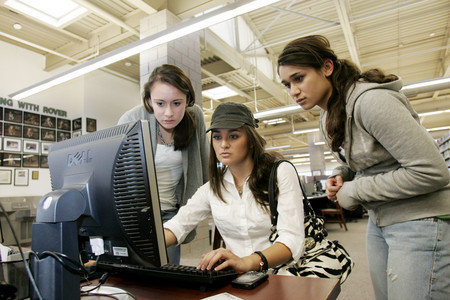
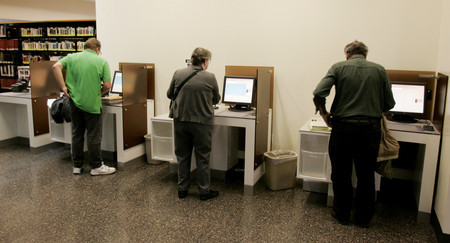
Meanwhile, library computer labs and Internet access afford laid-off and job-seeking Southern Nevadans a way to avoid the costs of computer ownership and at-home Internet access. Patrons, Pennell says, "do come in to file unemployment, to do resumes and look for jobs."
"So many jobs now require online applications," Fay notes, and "if you don't have (a computer and Internet connection) at home that's reliable to get that application in, you're dead in the water."
Fay even has seen patrons working on laptops in their parked cars when Henderson libraries are closed, piggybacking on the library's no-charge computer Wi-Fi service. "We don't stop people from doing that," he adds with a laugh. "We figure it's just one more use statistic."
Eva Armstrong of Las Vegas is a believer in the benefits of libraries. Armstrong says that, before last November, she hadn't had a library card for 17 years. Then, after a divorce, her daughter showed her how libraries offer the most affordable entertainment options in town.
On a recent visit, Armstrong left the Spring Valley Library with seven DVDs, while her daughter left with another seven (and a resume-writing guide). "It does help out a lot," Armstrong says. "I can check out seven movies for a week for free."
"This," she adds, "is saving massive money."
Armstrong and her family also regularly check out books and CDs at the library. Recently, after viewing "The Jane Austen Book Club" -- on a library DVD, naturally -- Armstrong checked out all six of Jane Austen's novels and, as of last week, had finished all but one.
"I've picked up a lot of books I haven't read since I was a kid or since I was a teenager," she says.
Elsewhere, Terrance Bolden was searching for job leads in the library's computer lab. In the fall, Bolden plans to begin studying to become an X-ray technician. And, while he has no computer at home, he regularly uses the library's, and already has completed one online course using the library's computers and Internet access.
Bolden says he also takes advantage of the library's book and movie collections and, at times, even springs for a used book at the library's used book store.
As a regular patron, Bolden says he has noticed telltale signs of creeping popularity at the library. "The lab has been so full, it's hard to get on a computer," he says, a situation he avoids by calling ahead to reserve computer time.
However, Fay says his district started detecting an uptick in usage numbers -- particularly computer usage numbers -- in mid-2008. And, ever since then, local library districts have been doing whatever they can to meet this newly increased demand for their services.
The Boulder City Library, Schofield-Dahl says, has increased the number of computers it offers to the public from eight two years ago to 10 unfiltered computers in the adult lab and two filtered computers for children.
In Henderson, Fay says libraries offer classes on resume writing and even (via the careers section of the district's Web site) a service in which an adviser will review a resume and return it with suggestions. And, he says, the district offers free online tutoring daily from 3 to 11 p.m.
In the Las Vegas-Clark County Library District, the Las Vegas Library recently opened a new computer lab with twice as many public access computers as it had previously. Also, some branches have increased the amount of time patrons can spend on computers, because, Goodrich explains, filing out online job applications "takes time." (The library offers one- and two-hour computers.)
In addition, Goodrich says, "we'll have some new financial literacy programs starting this calendar year to help people with foreclosure and managing their credit."
And, as another sign that patrons are turning to the library for help, Goodrich says viewings of the career resource guides the Las Vegas-Clark County district offers on its Web site are up 19 percent over the past two years.
Yet, this increased customer demand comes at a time when libraries are, themselves, dealing with reduced funding. It's an irony, Fay says, that "our business goes up at the very time public funding gets cut."
Libraries are funded largely by real estate taxes. The Las Vegas-Clark County district, for example, receives about 93 percent of its income from property taxes and consolidated taxes, according to Goodrich, "and of that 93 percent, 73 percent is the property tax, and we've all read about foreclosures and downward assessments."
Then, Fay says, "we don't get that much money in the broad scheme of local governments. So, yes, the challenge is how to continue to keep the services available.
"That's the part that gets trickier as the numbers get tighter and tighter because, at some point, you have to start cutting hours and people and customer service, which no one really wants. But zero dollars is zero dollars."
Schofield-Dahl says the Boulder City district has reduced its materials-buying budget "because the money isn't coming in as we had anticipated when we built the budget. When we were building our budget, we did build it with anticipation of lower tax monies, but we didn't realize it would be this low."
Fay says he doesn't yet know how severe funding shortages in the Henderson district will be in the coming fiscal year. "Our budget process has just started," he explains, "and, unfortunately, it's not looking pretty."
Goodrich says that, like every other district, "we're going to have to make some hard choices, but we're very mindful of what our community needs."
On the upside, could this recession-induced reintroduction -- or, even, introduction -- to libraries and the wealth of services they offer help to create a new generation of avid library users and supporters?
"I certainly hope so," Goodrich says.
Many people "carry a kind of old-fashioned notion in their heads," she says. "You meet people socially and they say, 'I haven't used the library since I was in school,' or 'since I took my kids for story time.'
"I say: 'Come back. We have all sorts of things.' "
Contact reporter John Przybys at jprzybys@ reviewjournal.com or 702-383-0280.