



Long Distance Family
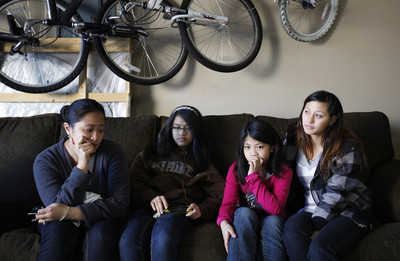
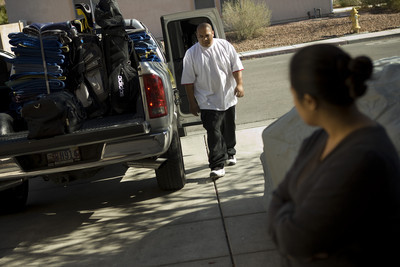


Jeffrey Moreno is done packing up his brother's Dodge Ram truck and can no longer delay the inevitable. He extends his arms wide enough to fit 12-year-old Liana and 7-year-old Jada.
"I'll call you every day," Moreno tells his daughters in the garage of their Southern Highlands home, the battle against his tears surrendered.
Moreno, 31, is moving out of Las Vegas. His family isn't. The economic meltdown is splitting them in two.
Moreno lost his job as a furniture warehouse manager in August, and could not find comparably paying local work. He's moving back to San Francisco, his hometown. He has lined up some furniture delivery business there, and will live rent-free with his grandmother.
To maintain their middle-class lifestyle, Moreno's loved ones must remain behind in the house they can't sell.
"Remember what I told you to do," Moreno's brother tells his sobbing nieces, "pray."
The Las Vegas economy, once trumpeted as recession-proof, is suffering from 9.1 percent unemployment, according to Dec. 2008 estimates from the Nevada Department of Employment, Training and Rehabilitation. That's up from 5.6 percent a year before and almost two full points higher than the national average of 7.2 percent.
"That's a significant difference," says Keith Schwer, economics professor at the University of Nevada, Las Vegas.
Two years ago, Moreno managed Bassett Furniture's Sahara Avenue and Sunset Road stores. His delivery company also was regularly subcontracted by the retailer. Things were going so well, the family decided to redo its kitchen and living room. The granite countertops, travertine tile and custom entertainment center cost $50,000 installed. The home equity loan -- which also covered some outstanding bills -- raised their mortgage on their four-bedroom house from $1,800 to $2,900 per month.
After Bassett laid Moreno off and his freelance deliveries dried up, the only jobs he could find were on craigslist.org.
"They would have cost more for the gas than they paid," he says.
One of the first costs cut by financially strapped consumers, Schwer explains, is travel. Because all Las Vegas industries ultimately rely on this one industry, they're all suffering more than they are nationwide.
"On the other hand," Schwer says, "people are still eating. So there may be declines in farm-producing cities in Iowa, but they're not nearly as significant as what we have here."
Adding to the whammy, Schwer says, valley businesses were spoiled by an influx of about 5,000 new residents per month that more recently shifted to a net loss of 800.
"People were anticipating that (the growth) would continue," he says, "so they invested in an expectation of that happening in the future."
Every Sunday since August, Siddharth Sharma flies to Baltimore. He stays in a hotel there until Thursday or Friday, when he returns to McCarran International Airport.
"It's a nightmare," he says. "It breaks my heart."
Sharma, 40, is married with two daughters, 7 and 5.
"They don't make too much of a fuss about it," he says, "but they miss me a lot."
Last August, Sharma left his job as information technology director at the Nevada Cancer Institute. The day before, the institute laid off 50 staffers, citing a decline in donations.
"The long-term prospects for my job were not very good," Sharma says.
He applied at every IT recruiting company in town. The only opportunity he found in his specialty, Oracle ERP software, was 2,500 miles northeast: subcontracting his services as an IT consultant to IBM. Sharma formed his own company in Las Vegas.
Although Sharma earns 50 percent more than he did at the institute, it's still not enough to settle his family into a comparable life in Baltimore. (Maryland's 9 percent state taxes amount to thousands more per month than his weekly flight and hotel bills, and home prices there are much higher.)
Nobody in the family is happy about the arrangement.
"My daughters are very attached to me, and my wife has challenges raising them at home alone," Sharma says. (His wife is an accountant for McGraw-Hill in New Jersey, from where they relocated in 2006. She telecommutes.)
The worst part, Sharma says, is not even being able to bid his children goodnight by phone.
"They go to bed at 9, which is midnight for me," says Sharma, who wakes up at 6 a.m. for work. "So I have to say goodnight to them at 5."
Schwer describes the Morenos and Sharmas as "caught in a hole."
"They really don't have degrees of freedom to work with," he says. "If they had rented, it would be much easier to move. Because they're caught in a house whose price is dropping, they're caught in this adjustment period."
After Moreno lost his job, his wife, Laurie -- a legal secretary for a downtown law firm -- asked mortgage lender Countrywide to reduce their 8 percent interest rate. She was told the family's income was too low to qualify for anything other than a short sale. Since then, she has been paying the mortgage with her 401K.
"I wish there was some other choice," Laurie says. "But we have a nice life in Vegas, and I don't want to huddle in some one-bedroom apartment with my children."
Moreno met Laurie in fourth grade in San Francisco.
"I sat in the back and he went to sharpen his pencil," Laurie says. "He called me four eyes, and that was it."
The longest they haven't seen each other since, Laurie says, is "probably a week."
Ultimately, Moreno hopes to get his Bay Area business going strong enough to hire employees to run it there while he lives back here.
"But we don't really know what's going to happen," Laurie says.
Sharma seems to have more of an out. If things don't change by June, he says, he's moving his family and business east -- probably back to New Jersey -- and winging the future.
"It's just not worth the money," he says.
Back at the Morenos, the Dodge Ram begins its nine-hour journey northwest. Laurie and the kids turn back toward their empty-seeming house, walking like a funeral procession over the travertine tiles.
The malaise is cut by the sound of skidding tires, then a honking horn. The Ram is once again parked outside.
"We're back!" Moreno yells out the passenger window.
He adds: "Just kidding!"
Everyone smiles, if only for a minute.
Contact reporter Corey Levitan at clevitan@reviewjournal.com or 702-383-0456.


