



PICTURE THIS (SONOGRAPHER)


Another week, another governing trade body to hide from.
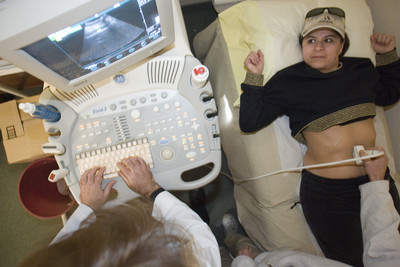
Today, the regulations I violated belong to the American Institute of Ultrasound in Medicine. I've just told Albertina Salguero, a Las Vegas waitress and mother of four, that the vessel providing blood to her brain looks healthy.
"Don't worry," I said during my day as a sonographer for Lions Health First, a charity arm of Lions Clubs International that provides free preventive health screenings to the disadvantaged.
Of course, I can't tell the difference between the formless gray blob I was told to label "corroded artery" on the computer screen and the one I labeled "aorta." But I know that sonographer Ron Walraven told me there was no plaque evident in the sonograms he helped me take.
"It looks good," I informed Albertina, suggesting that she use anti-plaque toothpaste to keep it that way.
Unbeknownst to me, Walraven's comment was not meant for me to share. Any discussion of a sonogram image with a sonogram subject is forbidden by the institute because it "represents the practice of medicine, and therefore is the responsibility of the supervising physician," according to the group's statement.
This rule, combined with the risk of being sued for misdiagnosis, renders most sonographers unwilling even to tell expectant parents if it's a boy they're staring at, or a girl who has somehow learned the thumbs-up sign.
Walraven's job is not only to map a patient's blood vessels, but to prevent them from bursting by not reacting to anything he sees -- even though he often sees some pretty bad stuff. (Of the 148 patients screened by Lions Health First so far, for instance, 27 have major corroded-artery blockages.)
Standard procedure is to call the radiologist as soon as the patient leaves. If the radiologist concurs, the patient's doctor will be contacted.
"You keep a poker face," said Walraven, who also teaches in town at the American Institute of Medical Sonography. "The other day I had a corroded (artery) on a patient that was completely occluded on one side." (An emergency angiogram was ordered.)
Walraven should have an Oscar on his mantel for once having ignored a liver occupying the entirely wrong side of a patient's body. (And there's "no way" the patient knew, according to Walraven, or he would have said something beforehand.)
"It's a rare condition," Walraven said. "I forgot what you call it." (I suggest "being a Vulcan," which is incorrect.)
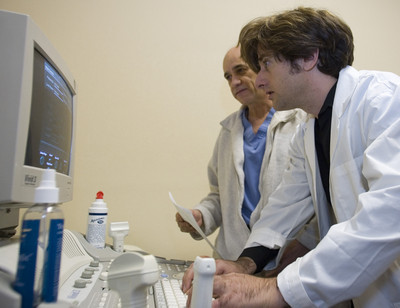
"Photograph that," Walraven tells me.
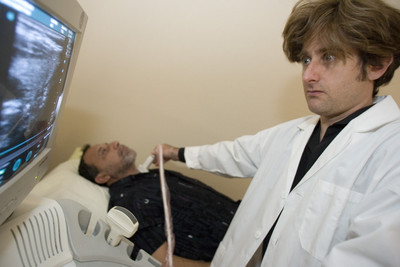
I press the "freeze" button on the keyboard attached to the $60,000 GE Vivid 3 Expert Echo Vascular machine, which -- much like bats, whales and my uncle George -- uses the reflections of sound waves to mimic vision.
The fuzzy motion on the monitor converts to a fuzzier still frame. I type in the text Walraven dictates, so the radiologists will know what they're looking at.
"You're taking an inferior picture," Walraven says.
He means that I'm looking at the inferior thyroid artery (inferior being closer from the heart than superior). Nevertheless, I hope for Albertina's sake that Walraven plans to re-take these sonograms after I leave.
"Don't worry," he says. "You're not missing anything. I'm making sure."
Walraven, 53, is a former computer programmer who took a retirement buyout from ARCO.
"I was living in Florida and saw this ad for ultrasonographer," he said. "I didn't even know what it was. I called the guy and asked how much it paid."
Sonographers earn anywhere from $20 to $45 an hour. After they complete two years of school and pass a national physics and anatomy exam, most get hired by hospitals and medical centers. Others, like Walraven, work when, where and for whom, they want.
"There's a lot more stress in a hospital, because you're on call 15 nights out of 30 a month, so you're up all night doing ultrasounds," said Walraven, who worked at Desert Springs and Spring Valley hospitals after relocating to the valley in 1999.
There are drawbacks to hanging your own sonography shingle, however, such as having to find your own clients and pay for your own health insurance (which, incidentally, does not cover preventive sonograms of the type we're taking today).
For the next procedure, I ask Albertina to roll on her left side. She shivers as the cold probe makes contact with the gel on her abdomen. There is more shivering than there should be, and I apologize. The pancreas is the Guam of organs. You kind of know kind of where it is, but it's hard to say exactly.
After Walraven mercifully guides my hand to the correct position, I realize what he meant by keeping a poker face. The pancreas is no formless grey blob. It has a head, a body and a tail.
"Is everything OK?" Albertina asks.
Well, Sigourney Weaver was technically OK until the aliens hatched.
Originally, Walraven wanted to be a priest.
"I had the calling," said the Detroit native, who spent two years at a seminary in Corpus Christie, Texas.
"But it just wasn't for me," Walraven said.
His current gig incorporates his favorite part anyway: the confessional.
"You have no idea how many heads of corporations tell me their darkest secrets once they lie on the table," Walraven said. "Married women talk about their affairs, old men talk about their sex lives.
"I think it's just because I listen without talking," he guessed. "But it's part of my job to do that."
The one exception occurs while Walraven scans testicles and breasts.
"They don't talk much then," he said.
Albertina's half-hour exam is through, and all she wants to do is talk. Concerned perhaps by my reaction to her pancreas alien, she corners me for questions.
"I have this pain that goes down my neck," she tells me.
Although I've tried explaining that I'm only a reporter, Albertina does not seem to understand.
"Sometimes a lot of pain, sometimes nothing," she continues.
Sonographers play an important role in diagnosing.
"You're basically making the call here," Walraven said earlier. "If you miss something, then the radiologist doesn't see it."
But this statement applies only to real sonographers, not me. And even they can't offer the type of medical advice Albertina seeks.
"I tried Aleve but it doesn't work," she tells me.
I advise my patient to talk to a real doctor about her neck pain.
I only play one in the paper.
Watch video of Levitan taking sonograms at www.reviewjournal.com/columnists/levitan.html. Fear and Loafing runs Mondays in the Living section. Levitan's previous columns are posted at fearandloafing.com. If you have a Fear and Loafing idea, e-mail clevitan@reviewjournal.com or call (702) 383-0456.
VIDEO


