



Students face challenges when parent teaches at their school
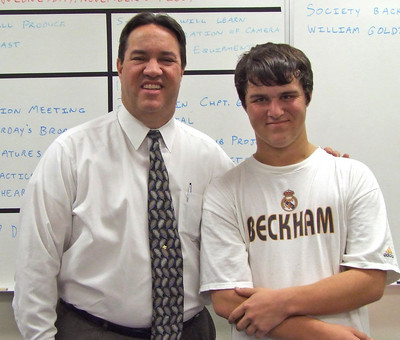


Zach Clark's teacher noticed that he wasn't turning in all of his homework assignments.
The teacher e-mailed a co-worker about the missing assignments.
When the third period bell rang, Zach was approached in the school hallway about his failure to turn in his homework.
It was his dad, Mike.
"I'm having a bad day," Zach sighed.
Mike Clark, a teacher at Coronado High School, has taught at the same school that four of his children attended.
His son Zach, a sophomore, goes into his father's class during lunch break and eats with him every day. The father and son say that going to the same school has brought them closer together.
"It's not that bad having my dad at school," Zach says. "I'm always getting comments like, 'Your dad is the best teacher.' I'm just lucky my dad isn't the teacher that everyone hates."
But it's not always so rosy.
When a parent teaches at the school where one of his or her children is enrolled, there are even more challenges inherent in the already rough-and-tumble high school experience.
If Zach talks a lot in class, the teacher usually threatens to get his father. Once, a teacher marched him into Mike's class demanding that he have a chat with his son.
Mike just laughed.
He admits that it's been awkward in the staff lounge when a teacher and his kids don't like each other.
It can be even more discomfiting when the two share a class with another.
During Zach's freshman year, he was put into his dad's English class, and Mike didn't immediately tell the rest of the students that Zach was his son.
A few days after Zach had been in the class, Mike broke the news.
"In case you haven't noticed, that is my son," he remembers saying. "If you have a problem or think he's being treated differently, let me know."
Mike says he didn't get any complaints the whole year.
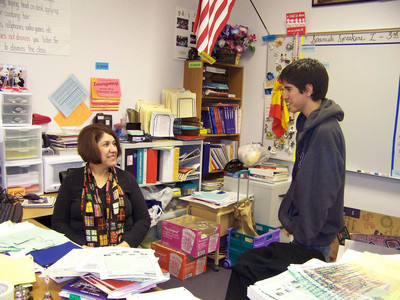
Likewise, Mary Clair, a foreign language teacher at Liberty High School, works at the school where her son, Jose Clair, is a junior.
Mary started off as a kindergarten teacher, because that was the grade her first daughter was in.
As her daughter grew up and went on to different schools, Mary followed her.
She has six children who all have gone to the same school where she has been employed.
She says she feels that her kids did better in class knowing that she was always there when they needed her.
Now, five of her kids are in college and she stays in the same school as her youngest son.
Jose says having his mom work at his school has its pros and cons.
"If I ever need money or a signature, etcetera, she's right there," he says. "However, the cons include sometimes staying until 3, 4, 5 o'clock waiting on her to finish grading and preparing for the next day."
Even though the family shares the same work environment, the home life remains as normal as any other family.
Not that their day-to-day lives are devoid of drama.
There was a time when Mary was the cheerleader coach, and one of her daughters was on the team. She became captain, which could have raised cries of nepotism. But she had the same opportunity as everyone else -- all the girls just voted her into her position.
"Cheer time was at practice," Mary says. "Never would I go over routines with my daughter at home."
Mary finds it more difficult to teach her own children, because she feels the need to be more strict on them, to make an example.
One year, her son was enrolled in her class, and she requested a schedule change so that he had a different teacher.
School officials say there are no policies regarding teachers instructing their children.
Every student is randomly selected to be in a class. Sometimes the child has a parent as a teacher. All students can request a certain instructor, and the school is always willing to take a child out of a class if they don't want that teacher.
"I have never had a member of my staff ask for their child to be placed in their class," says Lee Koelliker, principal at Coronado High School. "However, staff members usually apply for zone variance forms so that their child can go to the same school they work at for transportation convenience."
Overall, many parents and children enjoy being a part of the same school community.
"I remember the day my daughter Mandi graduated," Mike Clark recalls. "She had written a speech for the class of '03. I was sitting on the stage as a faculty member and thought, 'This is a moment I'll never forget.' Many parents don't get the joy of being on the exact same stage as their child on their graduation."
R-Jeneration


