



THE SKY’S THE LIMIT
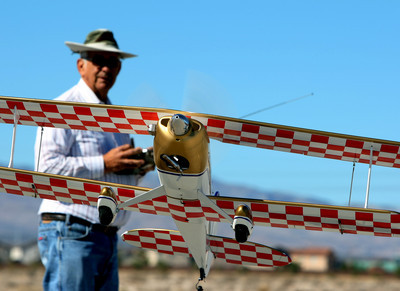




To Harold Williams, flying airplanes is like being in love.
The smell of fuel is perfume to him; the engine's roar, a sweet melody. And when his airplane soars through the blue Las Vegas sky, his knees shake like a teenager's on his first date.
Never mind that his aircraft is a 5-foot-long, radio-controlled model; this is a genuine love affair.
"My days off, I'm just waiting to fly," says Williams, 56, who works at The Mirage.
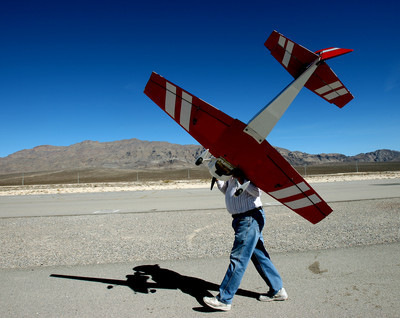
It's a recent Monday morning and Williams stands on the runway at the Willie McCool Regional Park in North Las Vegas, guiding his model airplane through loops and stalls 400 feet in the air. The flight will keep him pumped for days, he says.
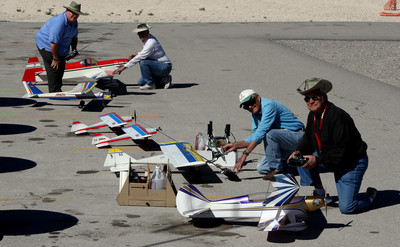
As lovesick as Williams sounds, he's not alone in his passion. He's one of about 10 people who have come to the park on this sunny morning to engage in their beloved hobby and one of many who share a universal love of flying.
Model airplanes are an outlet for mankind's basic desire to be involved in aviation, says Darryl Stubs, president of the local flying club Rebel Squadron.
"It's thrilling," says Greg Clemensen, vice president of the local chapter of the Academy of Model Aeronautics. That's the national nonprofit that promotes model aviation as a sport and hobby, as well as provides members with liability insurance. Locally, there are about 1,000 members.
Clemensen, 55, started flying model aircraft about five years ago, as a way to do something with his 80-year-old father. Forty airplanes and thousands of dollars later, he's a little more exuberant about it than his dad. His wife insists he has a compulsion.
But that's what happens when people get bit by the model-flying bug, Stubs says.
"It just amazed me," says Williams of the first time he saw a radio-controlled airplane fly 25 years ago.
At the time, he was serving in the Air Force but didn't work with aircraft. He immediately took up the model plane hobby and can't imagine a time when he'll have to give it up.
It's not the easiest thing, to guide a small plane through a vast and cloudless sky, as it is on this Monday. The pilot -- and make no mistake, they are pilots -- cannot take his eyes off of his aircraft; if he does, it will be lost, Williams says.
"There's too much sky up there," he explains as he watches his plane zip through the air at about 80 mph.
Top speed for most radio-controlled planes is about 100 mph. Radio-controlled jets, which are becoming more popular, can exceed 200 mph, says Frank Kelly, president of the local flying group, Propnuts.
That's fast, no doubt, but it's not like these hobbyists are in the aircraft, traveling at those speeds. So what's the allure of remote-controlled flying?
It's a lot like the real thing, Stubs says. Believe it or not.
Stubs flew his first model airplane in 1967, the same year he was drafted into the Army. He flew helicopters during his service and then as a civilian, retiring for good 12 years ago.
He misses it, he says, but his hobby helps fill the void.
I think; therefore, I am: That's Stubs' reason for flying.
"It's just one of those things," he says. "All my life, all I ever really wanted to do was fly. The urge or need to fly never leaves you."
Stubs enjoys teaching others to fly, as well. Rebel Squadron offers free lessons one Saturday a month, providing the model plane, fuel and instruction to anyone who wants to try their hand at it.
He cautions people before they take the receiver, though. The hobby is infectious.
The cost often turns beginners off. The majority of fliers are older because they're the ones who can afford it, Stubs says. The initial investment is $300 to $500 and includes a trainer airplane, radio receiver, transmitter, batteries and fuel. Liability insurance is a requirement before flying at local fields. The annual fee for joining the academy costs $20. Then there are maintenance fees, fuel costs and, for competitions, entry fees. Some aircraft cost thousands of dollars.
But the return on your investment makes it all worth it, says Matthew Dillon, 17.
"I cut a lot of grass for my first airplane," Dillon says of the $350 he spent to get started eight years ago.
Now, he competes in aerobatics competitions, flying a $1,200 Cat 232 with a gasoline engine.
"I like it just because when you go up into the air you don't have to think about anything going on at school or anything like that," says the 10th-grader from Northwestern Career and Technical Academy.
When he graduates, Dillon plans on joining the Air Force to be a jet technician.
A salesman at Hobby People, Dillon says many of his customers are in their teens or mid-20s, just starting out. Most of them are more interested in the new scene in radio control, Dillon says: electrics. Their engines are quiet, compared to fuel-based engines, and they're easier to operate, making them ideal for beginners.
You won't find a lot of them at the local air parks, however. A lot of young beginners fly at regular parks, at schools or just anywhere they can find an open field, Clemensen says.
Contact reporter Sonya Padgett at spadgett@reviewjournal.com or (702) 380-4564.
PREPARE FOR TAKEOFF
If you are interested in joining the Academy of Model Aeronautics or one of the local chartered clubs, contact vice president Greg Clemensen at electricgreg@cox.net. Each club has its own focus, whether it's flying for fun or competition.
Las Vegas Soaring Club Inc. meets the second Saturday of every month at 10 a.m. For location, contact President Rick Stone, 360-5654. lvsoaring@peoplepc.com, or through the Web site, www.lasvegassoaring.org. The club's interests are in sailplanes, electric airplanes and helicopters.
Rebel Squadron meets the second Wednesday of the month at 7 p.m. at the North Las Vegas Airport. Contact President Darryl Stubbs at (435) 229-8871 or cs2004s@aol.com, or visit the Web site at www.rebelsquadron.org. The club flies all model aircraft and offers free training once a month at Willie C. McCool Memorial Model Air Field, 4400 Horse Drive, North Las Vegas.
Propnuts meets the fourth Wednesday of the month at 7:30 p.m. at the North Las Vegas Airport. Visit the Web site at www.propnuts.org or contact President Frank Kelley, 876-4891 or fjkelley@cox.net. The group's focus is on competitions.
Las Vegas Radio Control Club meets the third Saturday of the month at 8 a.m. at Apache Joes, 5040 Broadbent Blvd. Visit the club's Website at www.lvrconline.com or contact President Keith Hedge at 898-9259 or khedge@cox.net. The group flies all radio control aircraft and helicopters at William Bennett Radio Controlled Airfield, 6800 E. Russell Road. The field is on the north side of Sam Boyd Stadium.
CATCH A SHOW
If you're interested in seeing model aircraft in action, check out the Las Vegas Soaring Club's upcoming "Superfly 6" Nov. 10 and 11 from 9 a.m. to 4 p.m.
The event, at William Bennett Radio Controlled Airfield, 6800 E. Russell Road, is open to the public.
Admission is free.
There will be a variety of flying contests, manufacturer demonstrations and model aircraft on display.
For more information, call Bill Winchester at 240-9900.


