



Diagnosed with dense breast tissue: What exactly does that mean?
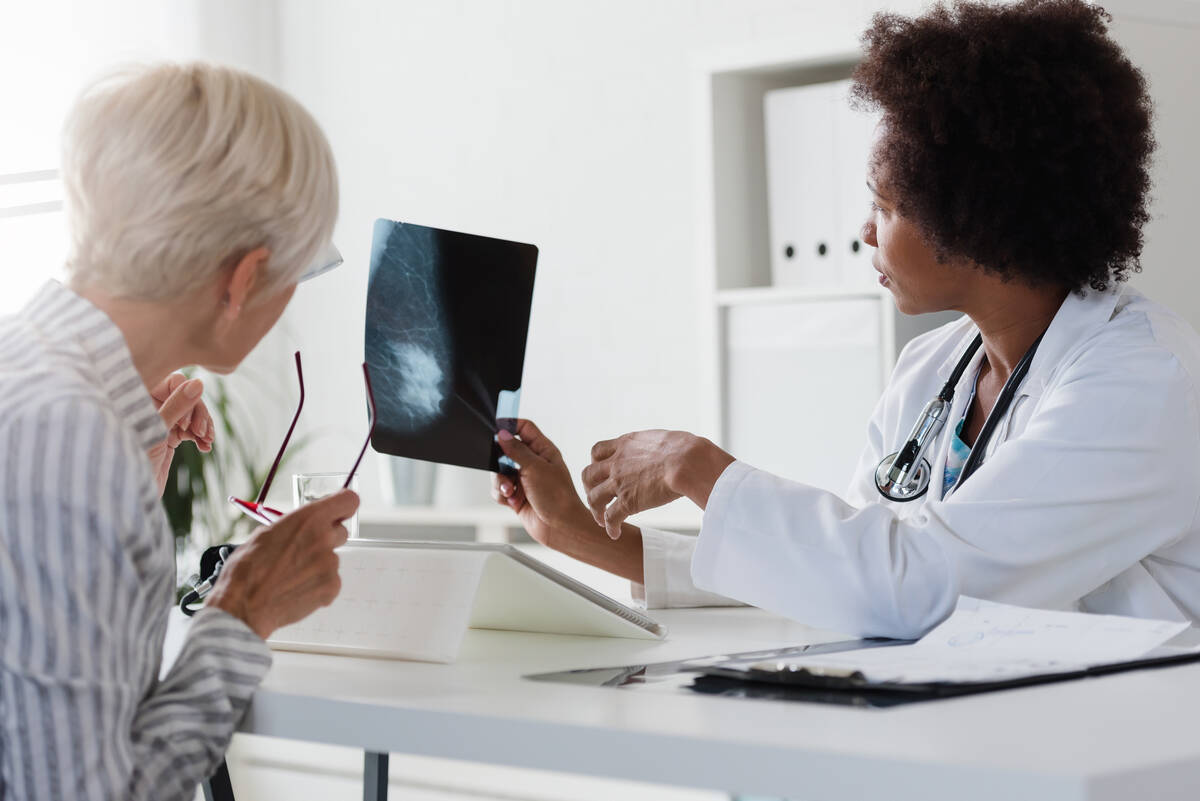


Question: I just had a mammogram, and I was told that I have dense breast tissue. What does that mean?
Answer: About half of women are considered to have dense breasts, based on the appearance of their breast tissue on a mammogram. The main concerns about dense breast tissue are that it makes breast cancer screening more complex and increases the risk of breast cancer. Here are some answers to questions you might have:
What is dense breast tissue?
Breast tissue is composed of milk glands, milk ducts and supportive tissue, which make up dense tissue. Breasts also include fatty tissue, which is nondense tissue. When viewed on a mammogram, dense breasts have more dense tissue than fatty tissue.
Nondense breast tissue typically appears dark and transparent on a mammogram. In contrast, dense breast tissue appears as a solid white area, which makes it difficult to see through.
Levels of density
The radiologist who analyzes your mammogram determines the ratio of nondense to dense tissue and assigns a level of breast density. These levels are determined by results from the Breast Imaging Reporting and Data System from the American College of Radiology.
The levels of density are designated by letters:
A. Breasts are almost entirely composed of fat. About 1 in 10 (10 percent) women have this result.
B. Scattered areas of density, but most breast tissue is nondense. About 4 in 10 (40 percent) women have this result.
C. Heterogeneously dense indicates some areas of nondense tissue, but most breast tissue is dense. About 4 in 10 (40 percent) women have this result.
D. Extremely dense indicates that nearly all breast tissue is dense. About 1 in 10 (10 percent) women have this result.
What causes dense tissue?
It’s not clear why some women have a lot of dense breast tissue and others don’t. Dense breasts are more likely if you:
Are younger. Your breast tissue tends to become less dense as you age, although some women might have dense breast tissue at any age.
Have a lower body mass index. Women with less body fat are more likely to have more dense breast tissue compared with women who are obese.
Take hormone therapy for menopause. Women who take combination hormone therapy to relieve signs and symptoms of menopause are more likely to have dense breasts.
Why does density matter?
Having dense breast tissue won’t affect your daily life. But it increases the chance that breast cancer might go undetected by a mammogram, as dense breast tissue can mask a potential cancer. It also increases your risk of breast cancer, though health care professionals aren’t yet certain why.
Screening recommendations
Women with dense breasts but no other risk factors for breast cancer are considered to have a higher risk of breast cancer than average. Dense breast tissue makes it more challenging to interpret a mammogram, as cancer and dense breast tissue both appear white on a mammogram. This may increase the risk that cancer won’t be detected on a mammogram.
However, mammograms are still effective screening tools. The most common type is a digital mammogram, which is more effective at detecting cancer. It saves images of your breasts as digital files, allowing for more detailed analysis.
Different tests
Other tests carry both risks and benefits, although MRI and molecular breast imaging have demonstrated superior cancer detection in women with dense breasts.
Supplemental tests for breast cancer screening can include:
3D mammogram, also known as breast tomosynthesis: Tomosynthesis uses X-rays to collect multiple images of the breast from several angles. A computer synthesizes the images to form a 3D image of the breast. Many mammogram centers are transitioning to incorporate 3D mammograms as part of the standard mammogram technology.
Breast MRI: MRI uses magnets rather than radiation to create images of the breast. This option is recommended for women with a very high risk of breast cancer, such as those with genetic mutations.
Molecular breast imaging: This imaging uses a gamma camera to record the activity of a radioactive tracer. The tracer is injected into a vein in your arm. Normal tissue and cancerous tissue react differently to the tracer, which can be seen in the images captured by the camera.
Every test has pros and cons. Talk with your health care professional about your breast cancer risk factors. Together, you can decide whether additional screening tests are right for you.
Dr. Cameron Leitch is a radiologist with the Mayo Clinic Health System in Eau Claire, Wisconsin.


