Longer stays, increasing population plague county emergency shelter for children
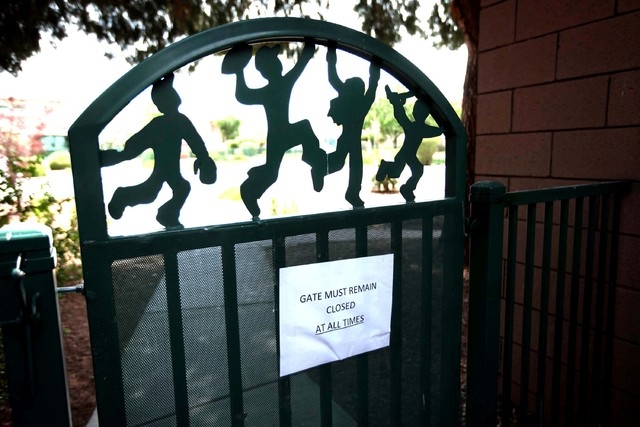






Abused and neglected children are staying longer and showing up in greater numbers at a Clark County-run emergency shelter, causing it to surpass its licensed capacity and raising concerns among child welfare advocates who question what’s behind the trend.
In the past, such trends have raised federal concerns, although the current number of children at the Clark County Department of Family Services’ Child Haven campus hasn’t risen to the level reached in 2006 when it had 164 residents waiting to return home or to be placed in foster care.
As of Tuesday, there were 56 children staying at the shelter on Pecos Road near Bonanza Road, according to Kristi Jourdan, Family Services spokeswoman. That number hit 83 in mid-April.
The shelter’s capacity is 56, according to Latisha Brown, a child care licensing program manager with the state Department of Health and Human Services. The average number of children at Child Haven is usually about 25. The county is working with the state to expand the shelter’s capacity.
“I’m shocked that they are at that number,” said Bill Grimm, senior attorney for the Oakland, Calif.-based National Center for Youth Law. “What’s happening to their efforts to recruit and retain foster parents? Does this signal that they are not recruiting and retaining good foster parents?”
The population at Child Haven fluctuates during spring break, summer and the holidays as some foster parents look for temporary care to take time off or vacation, according to Jourdan.
“This has contributed to the recent increase in the number of children on campus,” Jourdan said, adding that at times it’s difficult to place children with challenging behaviors or special needs.
The average length of stay is usually about two days, but that increased to about six days in March and April, according to Jourdan.
But holidays and vacation breaks for foster parents aren’t the only thing driving up the population at Child Haven. The agency is also serving more children as a result of a spike in child abuse and neglect reports and investigations, according to Jourdan.
In January, the agency received 1,780 abuse and neglect referrals and conducted 881 child protective investigations, statistics show. In February, the agency received 1,672 abuse and neglect referrals and conducted 813 child protective investigations.
Those figures soared in March, with the agency receiving 2,210 abuse and neglect referrals and conducting 959 child protective investigations. The numbers remained high in April when the agency received 1,851 abuse and neglect referrals and conducted 961 child protective investigations.
Family Services’ officials said the maximum capacity at Child Haven could change and Family Services could work with state licensing to license more facilities on campus. The maximum capacity was reported as 96 in 2008.
“We don’t have the ability to turn children away,” Jourdan said.
Child Haven’s capacity dropped to 56 in August 2013, Brown said. Family Services in April submitted paperwork to the state and began the process to expand the capacity up to 74, she said.
“They obviously saw there was a need,” she said.
Family Services is also working with the Las Vegas Fire Department and the state’s Health Division to get their approval to expand the capacity, Brown said. Once Family Services gets approval from those agencies, it will obtain approval from child care licensing.
Whenever such entities go “over capacity, there’s an automatic noncompliance,” she said. If a facility remains in violation, its license could be suspended or revoked, Brown added.
Brown said Child Haven was not written up because county officials notified the state about the shelter being over its capacity.
“They’ve been open with us so we want to help them,” she said.
Grimm, whose organization has an ongoing lawsuit against the county involving child welfare issues, and Donna Coleman, a longtime child advocate, questioned whether Child Haven has appropriate staffing to supervise the children.
“Who is watching the kids at Child Haven?” Coleman asked. “I thought they had decreased the staff there?”
Family Services is able to augment staff based on population needs, according to Jourdan.
Child Haven “should be a stop-off point between foster care and/or going back home,” Coleman said.
Grimm wasn’t overly concerned by the length of stay for children at Child Haven. Years back, children were just rushed out of the shelter within 24 hours so they wouldn’t count as a resident, he said.
Before officials made good placement decisions, the children would be “dumped” in the community without considering whether a foster home was appropriate, Grimm said.
Oftentimes they weren’t.
“Child Haven became a revolving door,” Grimm said because the children would return.
However, he said if the children are just being “warehoused” at Child Haven and staff are not assessing placements for them, then that’s concerning.
Family Services’ response to the increase is to recruit more qualified foster parents and continue supporting its current caregivers, Jourdan said. Some children remain in the home with a safety plan in place.
“Overall, this points to a need for more foster-care providers,” Jourdan said.
Grimm believes the agency is not recruiting and retaining good foster parents. If it were doing so, he said it wouldn’t have the need to keep recruiting.
“It’s a broken record,” he said of agency officials who claim they are always recruiting foster parents.
Family Services is concerned with getting more quality foster parents, according to Jourdan.
Family Services is also in the beginning stages of creating a “foster friends” program to increase its continued support for foster parents, according to Jourdan.
Contact Yesenia Amaro at yamaro@reviewjournal.com or 702-383-0440. Find her on Twitter: @YeseniaAmaro.