



Freeway will link capital, interstate

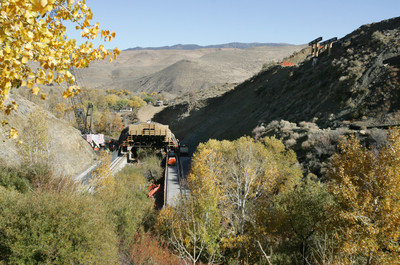


CARSON CITY -- One of the most complex and challenging road construction projects in Nevada history is under way to link the capital city to the nationwide interstate freeway system.
The 8.5-mile stretch of the four-lane freeway from Reno south to the Washoe Valley is the final piece of a project that has been in the planning stages for decades.
The route will feature spectacular views of the Pleasant and Washoe valleys and a drive over what will be the longest concrete cathedral arch main span in the United States.
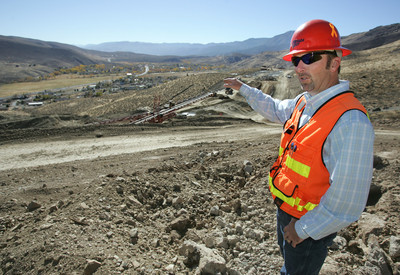
On a recent tour of the project, officials with the Nevada Department of Transportation talked about the issues involved in building a stretch of freeway that for much of the way is along a mountainside.
About 150 workers with the main contractor Fisher Sand & Gravel Co. and its subcontractor have been busy all along the route, crushing basalt rock found on the site for concrete, doing preparatory work for the biggest span over Galena Creek and working on other bridges. They are about 25 percent of the way through the job.
Nine bridges make up much of the project, which is being built at a total cost of $393 million. With about $50 million for right-of-way costs and another $50 million paid to a previous contractor that walked away over safety concerns, the total cost is about $500 million.
When complete in mid-2011, the freeway segment will connect Carson City to the interstate system. The city is one of the few remaining state capitals in the nation that does not have such a link. Reno and the capital city now are linked by U.S. Highway 395.
Transportation Department Resident Engineer Brad Durski said he and his crew of 50 are enjoying the challenge of overseeing such a complex project. One element of the job will require the contractor to move 4 million cubic yards of mountainside to create the freeway path.
"We're working 10 hours a day," he said. "It's something we will be able to point to and tell our grandkids about."
But the final segment is not coming about without problems and challenges.
A contractor hired to construct the 1,719-foot-long concrete Galena Creek bridge, with its 690-foot arch, and three of the other smaller bridges walked off the project in May 2006 citing safety concerns.
The concerns, countered in studies offered by the Transportation Department, centered on the wind danger to workers building the Galena Creek Bridge, which will stand more than 300 feet above the tiny stream, which tumbles east out of the Sierra Nevada.
Rather than engage in a potentially protracted legal fight and further delay the project, the state Transportation Board, led by then-Gov. Kenny Guinn, worked out a resolution with the company, Edward Kraemer & Sons, letting it walk away. The board then rebid the project.
In November 2006, the board awarded a new contract to Fisher to complete the Galena Creek Bridge, the other bridges and the entire stretch of freeway at a cost of $393 million. The work stared in early 2007.
Durski said the Interstate 580 project has a number of elements that make it a challenge, including the size and height of the Galena Creek bridge, moving tons of dirt off the side of the mountain and geothermal activity along a part of the route.
The safety concerns expressed by the original contractor about building the Galena Creek bridge have been circumvented in a unique way by the new contractor, he said. Rather than use cranes to erect the structure over the void of the Galena Creek canyon, Fisher and its bridge subcontractor, CC Myers Inc., are using a different approach.
A reinforced concrete tunnel is being constructed over the part of the creek directly below where the bridge will be built. The tunnel will be covered with 380,000 cubic yards of earth taken from elsewhere along the freeway alignment, filling the canyon to a point where a safer and more traditional process can be used to build the structure.
The tunnel will be dismantled, the fill removed, and the creek area will be restored after the project is complete.
Drivers probably will face their own challenges when the new piece of road opens -- from wind, snow and ice.
But the conditions have been taken into account in the planning, said department spokesman Scott Magruder. Automatic deicing equipment will be installed on four of the bridges, and a wind warning system will be used to tell motorists driving high-profile vehicles when they will be required to take the old road instead.
The deicing equipment, at a cost of $1 million per bridge, will spray a non-harmful saline solution on the spans when they hit a certain temperature. The cost of this driver safety feature is part of the overall contract.
Wind warnings, indicated with flashing yellow signs, are used now on the existing Washoe Valley section of the U.S. 395 highway.
Contact Capital Bureau writer Sean Whaley at swhaley@reviewjournal.com or (775) 687-3900.
ON THE WEB
For more details on the Interstate 580 project, go to the Nevada Department of Transportation Web site
freewayextension.com


