



Legislators hear appeals for increases, not cuts, in government services





At 16 years of age, John Clark was a homeless high school dropout. Then he turned felon.
He got his life back on track thanks to fatherhood and financial stability from a job as a union iron worker.
Now, Clark and his wife, Tara Burbank, fear that life is about to fall apart.
They both are unemployed construction workers, retraining for new careers while raising three children, ages 5 to 14, who need special help at school for learning and behavioral problems. The Las Vegas couple is attending the College of Southern Nevada to earn professional degrees -- he in nursing, she in accounting -- so they can rejoin the work force.
"My family's entire future rests with the education opportunities in this state," Tara Burbank said as she and her husband pleaded Saturday with more than two dozen Nevada lawmakers not to cut state education funding.
If colleges and universities raise tuition and fees to make up for proposed budget cuts from Gov. Brian Sandoval, the couple said they will have to choose between paying for their classes and feeding their children something besides Ramen noodles.
"We're talking about, literally, choosing between tuition and groceries," Burbank said.
Clark added, "If I have to choose one, my kids are going to eat."
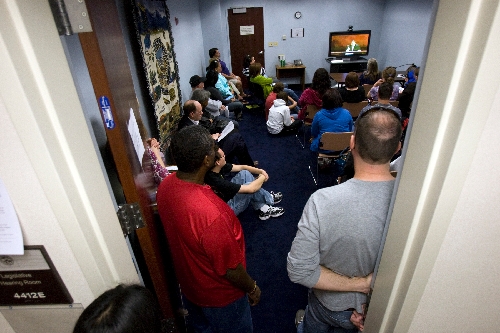
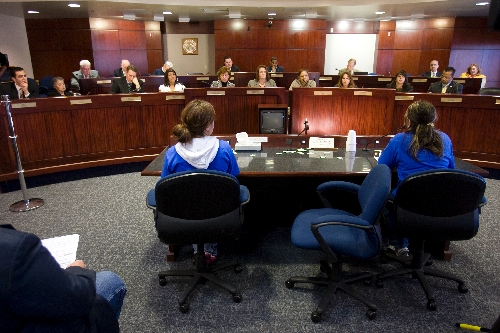
The couple's story of potential new hardship was one of dozens Nevada legislators heard Saturday during a town hall hearing arranged by Democratic leaders who oppose the GOP governor's $5.8 billion budget proposal, which deeply cuts education. It's part of a strategy to highlight the consequences to Nevadans a week before the Legislature starts on Feb. 7. Over 120 days, lawmakers will review the budget and come up with their own plan, which could include new taxes and fees.
Sandoval promises to veto any new levies, arguing that struggling residents and businesses can't afford to pay more in a recession.
So Democrats and progressive activists, teachers, union members, students, public employees and others are loudly protesting, giving lawmakers more ammunition to argue for raising revenues.
"The Legislature is going to do what the people want," said state Senate Majority Leader Steven Horsford, when asked whether the hearing was part of a Democratic strategy to put pressure on Republicans and Sandoval. "I agree with the governor that Nevada's best days are ahead, but they are ahead if we put resources into the classroom, not if we gut education."
Horsford said the couple who lost construction jobs are the perfect example of the retraining Nevadans need. Of 200,000 jobs lost in the state in recent years, 80,000 came from construction.
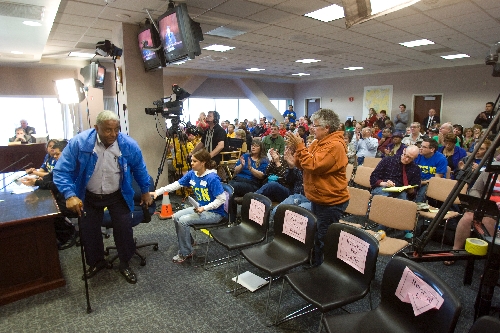
The six-hour hearing in Las Vegas attracted 800 people, some outraged, others tearful. A hearing at the same time in Reno drew 600. Led by teachers, students and unions who packed the hearing rooms, nearly all of the 126 people who testified in Southern Nevada protested cutting education and social services at a time of greater need.
Nevada is experiencing 14.5 percent unemployment, record bankruptcies and a housing foreclosure crisis.
Only a few people argued for spending cuts and holding down taxes, including Woody Stroupe, 72, the first to testify. He said more school spending won't necessarily lead to better student performance. His remarks were met with jeers and scattered laughter, prompting Horsford to ask the audience to "respect everyone's opinion, whether we agree with them or not."
Outside the hearing, about 100 protesters from both sides gathered. Activists supporting the Clark County Education Association, the teachers union; College of Southern Nevada and University of Nevada, Las Vegas students; and a progressive group, the Nevada Values Coalition, were the most organized with tables of literature and sign-up sheets.
"The End of Education is Near," one sign warned.
In answer, conservatives and members of the Tea Party movement backed Sandoval's move to trim spending.
"I Support Budget Cuts! No New Taxes!" said one sign.
Cathie Lynn Profant said conservatives know they are battling powerful groups in backing Sandoval against unions and teachers who have more money and more experience in organizing citizens. Profant recently worked for Republican Sharron Angle, who lost to Democratic U.S. Sen. Harry Reid, whose campaign was perhaps the best in the country.
"We know what it's like to fight hard against a political machine," Profant said.
Profant lost her chance to testify because she was too far back in line as the Legislative Council Bureau gave out 125 tickets for people to speak.
Sandoval's $5.8 billion budget would cut general fund spending by 6.4 percent, school support by 9 percent, and higher education by 17 percent if the loss of federal stimulus money is included. Sandoval said the cuts, coupled with reforms to make education more competitive and with more local control of spending, are necessary because of tight revenues.
During the town hall, high school students told tales of broken desks, crowded buses and classrooms, and textbook, paper and supply shortages. They said schools would only get worse with less money from the state.
University students complained they already can't get into limited class offerings. Teachers and professors said their colleagues were becoming disillusioned by slashed salaries and the constant threat of layoffs.
"The good teachers are going to leave," warned Susan Williams, a teacher in Clark County for 14 years.
John Zetzman, a teacher at Durango High School, said only four of the 29 students in his advanced placement class plan to attend college in Nevada because they think out-of-state universities are better.
"They believe Nevada doesn't care about them," Zetzman said. "If you want Nevada to recover, you need the best and brightest to stay. These cuts are unacceptable."
Nathaniel Waugh, a College of Southern Nevada student who said he wants to be governor one day, said businesses aren't sharing any sacrifices and should be taxed to raise revenue instead of taxing students through tuition increases.
"Businesses don't want to come to a state where education takes a back seat," Waugh told lawmakers.
During his testimony, Ruben Murillo, president of the Clark County Education Association, sliced an apple to demonstrate the series of budget cuts education has taken since the economic downturn began. He cut the apple in half, than a quarter and then down to the core, saying that is what Sandoval's proposal would leave.
"Eventually this core's going to rot," Murillo said, holding it up. "How much more can you cut? You can't cut education as the way to increase student achievement."
Sandoval also has proposed counties take on more social services, which could mean reductions there as well.
Mothers, fathers and grandparents begged to continue government services for disabled and autistic children.
Seniors said they feared they would be left on their own without help that keeps them out of nursing homes. And social workers said their caseloads were so high they neglect clients, including abuse victims and children.
"I wish I could have given her 30 more minutes," Clark County social worker Heather Richardson said after telling the story of a 14-year-old sex abuse victim who recently ran away after seeming sad during Richardson's last 45-minute visit.
Vanessa Lindsey, a family services worker, said she helps caregivers who take in relatives and need financial aid from the county to make ends meet. Not too long ago, she settled five children, ages 1 to 15, with grandparents who are 70 and 76, only to discover the couple didn't have enough money for food until government services kicked in.
"They were eating bananas for dinner in order for the children to eat," Lindsey said.
Lindsey then got $400 from a government fund to help pay for groceries.
"During the whole shopping trip, the grandmother cried and I cried, too," Lindsey said. "She was so grateful."
Review-Journal reporter Richard Lake contributed to this report. Contact reporter Laura Myers at lmyers@reviewjournal.com or 702-387-2919.


