Reid evolves into anti-war advocate
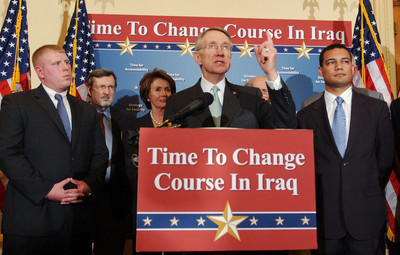


In life, Harry Reid believes, "You don't have many epiphanies."
What you have are dawning realizations. And of those, the Senate majority leader from Nevada has had a big one over the past year when it comes to the biggest issue facing the United States: the war in Iraq.
"Things usually take a while to build up in a person's mind," Reid said in an extensive interview last month. "I don't go to conclusions very quickly. I don't think most of us do."
And yet Reid, whose decision-making process as he and others describe it is gradual, intuitive, pragmatic and deeply internal, has come to conclusions that are a long way from where he was when he began his term as the most powerful man in the U.S. Senate just eight months ago.
Reid has turned from conservative pro-war Democrat to one of the staunchest senators on the anti-war left.
He has gone from saying in December he would "go along with" President Bush's troop surge in Iraq to co-sponsoring a bill to cut off war funds that got fewer than 30 votes in May.
To Republicans, it's craven. To fellow Democrats, it is surprising. To his constituents, it may be confusing. To the Democrats' liberal base, it is satisfying, although Reid continues to frustrate them at times.
What is it to Reid? How has he, who never has been among Congress' leading experts on foreign policy, oriented himself to become the front man in the biggest foreign policy debate of our time?
To Reid, the turnabout was the belated realization that he was in charge and he had the ability -- nay, the duty -- to be out front rather than safely behind on the war issue.
"I think I helped lead the Senate and the country in catching up with the American people," Reid said. "You know, this hasn't been easy for me. I've had a lot of people criticizing me for my statements about the war. But it's been the right thing."
After Labor Day, Congress will reconvene; in mid-September, Gen. David Petraeus is scheduled to brief Congress on where the situation in Iraq stands.
It will be up to Reid to decide how the Senate proceeds, and he says he will do what he did before: push to set deadlines for the withdrawal of U.S. troops, the sooner the better.
Republicans say Reid has gone too far. They say he has been too aggressive.
"Harry Reid was right when he said a timeline was the wrong way to go," said Paul Lindsay, a spokesman for the Republican National Committee. "He changed his tune in order to appease the liberal left wing of his party.
"There's no doubt this is an unpopular war, and many Americans are frustrated with the progress," Lindsay said. But progress is being made, he said, and Democrats "are overplaying their hand, and it's going to come back to haunt them in 2008."
Last week, Reid signaled he might be shifting away from his unwavering stance that led him to hold the Senate in an all-night session in July to debate troop withdrawal, and toward a compromise with Republicans on the war.
"I remain absolutely committed to changing course in Iraq and bringing our troops home," Reid said in a statement. "There are a number of different ways to do that legislatively."
"I don't think we have to think that our way is the only way," Reid told the Washington Post.
WALTER REED
The story Reid tells about his evolution on the war centers around Walter Reed Army Medical Center, which treats many U.S. soldiers returning from battle.
But it doesn't start with his now-famous March 28 visit, the one he would repeatedly cite in recent months to explain why he went from opposing a timetable for troop withdrawal to demanding one, to even, in a shock to his colleagues, supporting a cutoff of war funding.
It starts more than three years ago, with a visit to the hospital before Reid was the Democrats' leader, early on in the war.
"It was difficult to go, but war is hell and I understood that at the time," Reid said.
Reid remembers the last person he saw on that visit, a "tall slim man," who had one leg cut off at the ankle and the other up in traction.
"That was when we were still talking (in Congress) about getting better armor for our vehicles," when the debate about the war was focused on outrage about families sending their sons and daughters store-bought bulletproof vests.
"And he said, '(expletive) that new armor,'" Reid said, leaning in close, speaking in a near-whisper. "He said, 'It doesn't make any difference.' He said, 'I was in the best we had. It blew me through the top of there. Look at me. Killed everyone else in it.' He said, 'It's not more anything. You've got to get us out of there.'
"I listened to him, and it really made an impression on me," Reid said. "But then, there wasn't much talk about getting us out of there."
Then, in 2004, Senate Minority Leader Tom Daschle, D-S.D., lost his re-election, and Reid moved into the position. As minority leader, it was his job mostly to try to block the Republican majority.
Then, in 2006, by the margin of a few votes in Virginia, the Democrats took the U.S. Senate, and Reid became majority leader.
In March, Reid went back to Walter Reed.
The debate on the war had changed. Polls increasingly showed Americans had lost patience with it and with President Bush. The 2006 election was seen as mostly a referendum on the war -- a rejection of it.
Yet Reid was still urging caution. He said forcing a pullout by setting deadlines for military withdrawal was the wrong approach.
"And so I go ... (to Walter Reed), and here are these people sitting in a place that they've kind of tried to set up like a living room," Reid said.
"There are many pictures I have in my mind, but two that I have trouble getting out of my mind."
One was a woman who had spent 22 years in the Army, had two master's degrees and had done mathematical analysis at the Pentagon. She'd never had her skin pierced by a bomb, she said, only knocked down a bunch of times.
"And she said, 'I don't even know my own phone number anymore.' She said, 'I have to have my husband do everything for me. I can't do anything. My mind is scrambled.' That's her words, not mine."
The other was a big, strapping 20-year-old "kid" who said his problem was not that he'd been shot in the stomach.
"He said, 'I've had my best friend vaporized,' is his word, 'next to me.' He said, 'I wake up in the middle of the night sweating. I'm afraid. I become violent. I've kicked in walls.' ... He doesn't know where he is lots of the time."
After that, Reid started telling people he could not stand to see one more drop of American blood spilled or one more brain injury sustained for the cause of this war.
It is telling that for Reid, famous for his humble roots in a Searchlight hovel without indoor plumbing, the brain injuries were what hit him hardest.
It was mental toughness that lifted him out of that household, with a mother who didn't finish eighth grade and an alcoholic father who would eventually commit suicide.
If Reid has one guiding principle, it is that "the role of government is to give people an opportunity to use their talent," said Sen. Jack Reed, D-R.I., who has become a close adviser to Reid on military matters. "He has not forgotten where he's come from."
VOTING FOR WAR
"I have no military background," Reid said. "As a result of that, I have over- compensated in making sure that I do everything I can to be supportive of the military."
He blamed that over- compensation for his vote in favor of the Iraq war. The evidence of weapons of mass destruction was "confirmed by someone who I have great admiration -- had great admiration for, Colin Powell."
Back in 1991, Reid was the first Democrat to come out in support of the Gulf War.
"I have no doubt that that's the reason that President Bush No. 1 got enough votes to have the approval of Congress to go to war," Reid said. "After I came out, Al Gore came out. Bob Graham, Richard Bryan, John Breaux, others -- a handful, but enough to make it possible. And I have no regret having done that. ... Saddam Hussein was a very bad man. He had invaded Kuwait, and this would have led to a real destabilization of the Middle East."
Reid does not use the word "regret" to describe his 2002 vote authorizing the current war.
Such terms have become fraught with meaning for the many Democrats who voted for the war but now oppose it.
"I don't think my vote was a mistake," Reid said. "The fact is that I relied on the facts of people who I respected."
Faced with the same facts again, he would be less trusting. But knowing what he knew at the time, his decision was the right one, he says.
Reid said it "wasn't for some time that I realized" that he'd been "misled, lied to." He realized that "the invasion of Iraq is the worst foreign policy blunder in the history of our country. ... So I've watched this happen, and I have continued my total support of the military, but also have come to the realization that I have to do everything within my power to change the direction of the war in Iraq, and I've done that."
Plenty of Democrats, however, think enough information was available that the war should not have been authorized.
Among the presidential candidates, former North Carolina Sen. John Edwards has apologized for his vote, while Illinois Sen. Barack Obama prides himself on having opposed the war while not yet in office.
Daschle said, "I regret deeply that I voted to authorize the war now," saying the vote "was a mistake." But he said Reid's turnaround showed a commendable lack of stubbornness.
"It would be foolish for any public official to simply hold a position for no other reason than that he's held it before," Daschle said.
Jack Reed of Rhode Island voted against the war, but he is careful not to criticize Harry Reid.
"I thought the president's strategy was flawed and the information was not compelling in terms of intelligence," Reed said. "That was the judgment I made. But many of my colleagues in good faith made a different judgment."
REID DOCTRINE
Reid traces the origins of his foreign policy views to when he first went to Washington, as a member of the House of Representatives elected in 1982. He was "terribly interested" in foreign policy and succeeded in getting a seat on the House Foreign Affairs Committee.
"I traveled a lot of the world as part of my responsibilities, and I tell people it was like being in school and not having to take the tests," Reid said.
Nonetheless, Reid has never been thought of as a foreign policy expert in the Senate. His reputation is primarily as a canny master of procedure whose ability to horse-trade made him an extremely effective right-hand man to Daschle for six years before Reid assumed the Democratic leadership.
These days, Reid meets regularly with a working group of Democratic senators on the war composed of Joe Biden of Delaware, who chairs the Foreign Relations Committee; Carl Levin of Michigan, who chairs Armed Services; leadership members Charles Schumer of New York and Dick Durbin of Illinois; Patty Murray of Washington, John Kerry of Massachusetts, Russ Feingold of Wisconsin and Reed of Rhode Island.
"Particularly on the topic of Iraq, in these small meetings of colleagues, his talent is for not only bringing people together, but also being decisive," said Reed, a former Army Ranger and former West Point professor.
Unlike the neoconservatives some blame for concocting the war, Reid, in his own telling, learned foreign policy on the job; he didn't come to federal office with theories learned in academia or think tanks.
"In a way, I think that's a strength, because his view of foreign policy, his view of the world, came from when he started traveling the world," said Tessa Hafen, who worked closely with Reid for eight years until she left as his press secretary to run for Congress a year and a half ago. "He'd gone farther than his parents just by graduating from high school. He didn't have preconceived notions of how the world is or should be. He formed his views through direct contact."
There probably is not a Reid Doctrine, Hafen said. Reid himself couldn't articulate a set of abstract principles when asked.
Instead, Hafen said, Reid is "pragmatic" and "strategic."
"I think he would say his first concern is the safety of the country, defending the country," Hafen said.
GOING FORWARD
In Washington, Reid is not known for his rousing speeches, but he is infamous for occasional bursts of inflammatory language.
Rhetorical excesses, such as calling President Bush a "loser" and a "liar," haunted Reid before he took his current position. But since he became majority leader, "the microscope I found myself under is something I didn't anticipate, because I thought I'd already been through that."
In the last few months, Reid stirred up controversy by referring to Gen. Peter Pace, outgoing chairman of the Joint Chiefs of Staff, as "incompetent," saying Bush will be remembered as "the worst president we've ever had" and implying he views Iraq as a political wedge, saying, "We're going to pick up Senate seats as a result of this war."
But nothing compares to the furor Reid caused when he said in April, "This war is lost."
The comment caused such an uproar that Vice President Dick Cheney held a news conference to denounce Reid.
Reid has since qualified but not repudiated the statement. It has been explained as "shorthand" for the idea that military efforts can no longer save Iraq, but that a political solution is necessary, or that history will look back on this time and see that by 2007 it was already too late.
Reid also says he will continue to say what's on his mind because he is a plainspoken guy -- "not scripted very well" -- with no plans to change.
But the gaffe, which prompted Washington Post columnist David Broder to call Reid an "embarrassment," "amateurish" and "inept," will not go away. It continues to be brought up as proof of Democrats' purported defeatism.
Sen. John Ensign, R-Nev., has a policy of not criticizing Reid by name, but he says the Democrats' moves to end the war legislatively "have been incredibly irresponsible" and "demoralize our troops."
Ensign said Democrats are in a position of hoping, for political reasons, for failure in Iraq.
"I'm praying for our country's sake that things go better in Iraq," Ensign said. "I think it helps our party, but I'm much more concerned about it for our country. I like the fact that I'm hoping for good things for our country that happen to benefit us (Republicans) politically. I'm not sure the other side can say the same."
Ensign criticized Democrats for speculating about future moves in Iraq before Petraeus makes his report.
"We need to see what General Petraeus, in the report, in the conclusions, in the recommendations, says in September," Ensign said. "Everybody's speculating. I don't think the other side is being responsible. They're playing politics while we're at war, and I think it's wrong."
Jack Reed said the Democrats' goals haven't changed.
"Frankly, I don't think we have to wait to hear from General Petraeus," Reed said. "I was in Baghdad recently, and I think there's not more he's going to tell us that we didn't know then. But to move forward with changing policy, the reality is, we need Republican support, and they say they want to wait for the report from General Petraeus. ... We're not waiting."
Reid said he expects Petraeus to point to signs of limited progress, such as increased security in Iraq's Anbar province. But pacification in one part of the country has only "pushed the bad people" to northern Iraq, Reid said, and the fact remains that American troops are the No. 1 target of al-Qaida forces in Iraq.
"Getting Americans out of Iraq will lead to more stability," Reid said. "In Iraq, we have American troops trying to protect the Sunnis, the Shias and the Kurds, and we have every one of those groups trying to kill our soldiers. Al-Qaida, which is mainly made up of outside people, who is their No. 1 enemy? It's the United States. ... So let's get us out of there, and leave a contingency dealing with counterterrorism, force protection and continual training of Iraqis."
Reid acknowledged the Iraqi factions are also fighting one another, but said they will settle their differences once the Americans are gone, perhaps by dividing into a three-part federation with a weak central government, as Biden has long suggested.
"It's time they took over their own country," Reid said. "It'll take a little time, but it will stabilize."
Reid said he is waiting to hear what Petraeus says, but "I think we're back where we have to set a timeline to get our troops out of there. I think that we have to have a redeployment of our troops within the next 60 to 90 days."
Reid is hoping more Republicans will cross party lines to support a timeline. If not, he is considering other alternatives.
"Each day that goes by, quite frankly, is a day less that we have to deal with the Bush administration," he said.
But Reid said he is not resigned to waiting Bush out.
"We're going to continue to push. It's not going to be a wait without focusing on the failures in Iraq."