Hockey in the Heartland



GRAND FORKS, N.D.
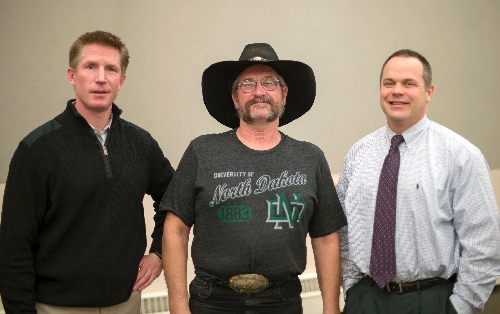
The best part: His name is Loyall.
He runs heavy equipment for a construction company in Casselton, an ant of a town 90 miles south of here, and makes the round trip three, four times a week.
He didn't attend the University of North Dakota, didn't compete for any of its athletic programs, didn't know much at all about the school until his stepson decided to play football there in 1994.
"I don't limit my trips for hockey games," Loyall Jahnke said. "It's not just about that. It's not just about a team. It's a community, a family, from the university president down to the guy who takes your tickets at games. No one is better or worse than the next person. I just can't stop coming here. It's not so much playing hooky from work, because they know where I'm at.
"From the moment I experienced it for the first time, I asked myself: 'How could anyone not want to be part of this?' "
It might not be about just hockey, but the heartbeat that fuels this remote snowdrift of a city nestled 145 miles from the Canadian border, does so along a 200-foot sheet of ice.
•••
"The opportunity to go to school is a gift of immeasurable proportions that the University of North Dakota gave me. Life teaches that it is neither right or just to forget those who have reached out and helped you along the way."
- Ralph Engelstad
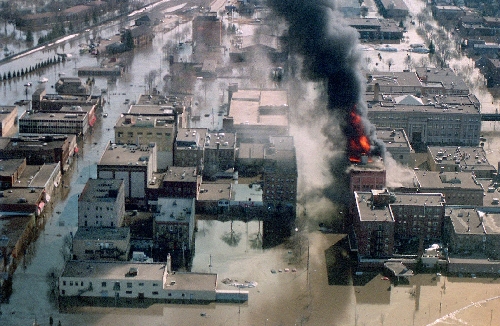
The story begins with a flood.
It was the most severe of its kind since the 1800s, a torrent that rose along the Red River, the result of abundant snowfall and extreme temperatures. It reached more than three miles inland and crested in town at 54 feet, causing an evacuation of more than 50,000 and a bill for damages throughout the region that reached $3.5 billion.
That's a mighty expensive rush of water.
It occurred over April and May of 1997, and when it came time to rebuild, to breathe life back into a community nearly destroyed by nature's wrath, Engelstad chose to invest in a way that would pay dividends for generations to come.
Hockey would be the tool by which to restore faith in those who had little left, and a magnificent building the epicenter in which to heal them.
Before he opened a Grand Forks-based construction company in the 1950s, before he bought the Flamingo Capri in Las Vegas and renamed it the Imperial Palace, before he was co-developer of Las Vegas Motor Speedway, before he showed off his collection of renowned automobiles, before he was accused of being sympathetic to Nazism because of a collection of memorabilia, before the family foundation gave UNLV $12.6 million to fund scholarships years after his death, Engelstad was a goalie for North Dakota.
He played only 14 games in net from 1948 to 1950, but his No. 23 is retired.
No one loved the university and its hockey team more.
Engelstad would fund a $104 million jewel of an arena and oversee the project from Las Vegas, but in using only architects and labor from the Grand Forks area, he greatly fortified the town's economic recovery from the flood. It was a project that spun off generations of related wealth for countless businesses, one of the arena's untold stories.
It took all of 22 months to build, opening in 2001 - a little more than a year before Engelstad died following a lengthy battle with lung cancer.
"I think one missing component to stories such as this is that, to me, the Engelstads are one of the great philanthropic families in the history of our country and always will be," said Tim O'Keefe, a former North Dakota hockey player and now vice president of the school's alumni association and foundation. "We are in the major leagues of college hockey because of that arena. As we watched it being built, it looked like the Colosseum in Rome. I still pinch myself every time I drive up to it. You can't put into terms what it means for our hockey program and university and state.
"After the flood, Ralph could have just given a certain dollar amount. But he chose this instead."
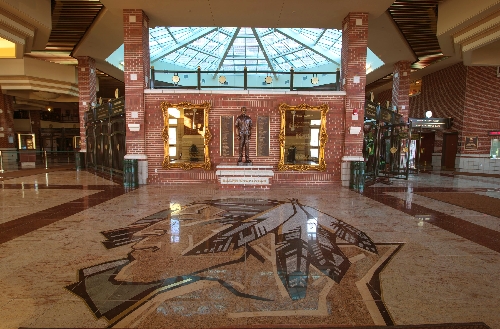
It is known as the Taj Mahal of hockey, an 11,643-seat palace of granite and cherry wood and pieces of history that's as close to perfect as the imagination could conjure.
Think about it: What other arena boasts a club section along one concourse whose bar area is built around an organ that once belonged to the King of Belgium?
•••
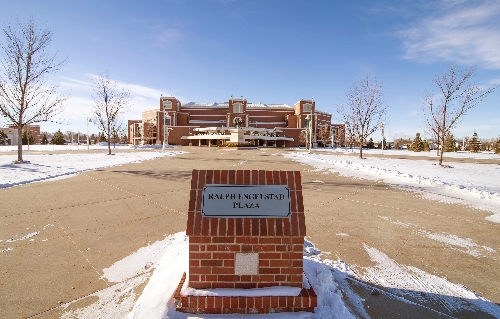
It sits a slap shot from the blue line off exit 141 of Interstate 29, next to the bookstore and a short breakaway from the North Dakota campus. Ralph Engelstad Arena - "The Ralph," to all who make its acquaintance - is unrivaled nationally for its attention to detail and eclectic craving to impress.
Which it does with every inch of Italian marble flooring and glass-encased memories of the program's past and present.
"Ralph didn't want to build it once and have to do a face-lift 10-15 years later," said Chris Semrau, the arena's event director and the first person Engelstad hired when deciding to build the facility. "He wanted to build the best we could. This is our 12th season, and it still looks like we just opened.
"When you hear someone spent over $100 million to build an arena in North Dakota, most would say, 'Gee, that's a lot of money for a college facility,' but Ralph wanted to build something spectacular, to do it right and to do it one time."
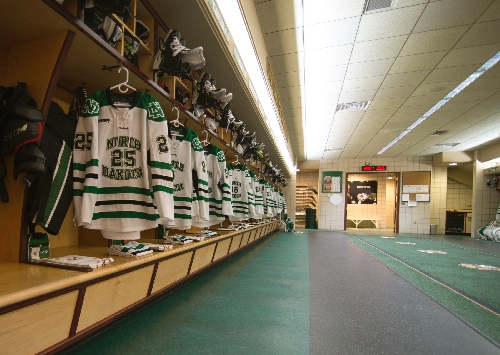
It is a stunning piece of work, from a 10,000-square-foot weight room that has wowed players from the National Hockey League, to the leather-upholstered arena seating, to the life-sized murals and a Hall of Fame that chronicle past glories, to a television production studio, to 50 plush suites for which there is a waiting list longer than an adjacent Olympic-sized rink that is used for practice and other events.
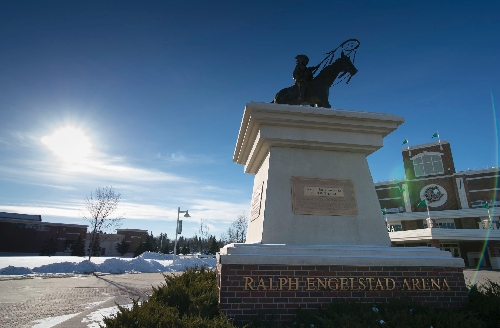
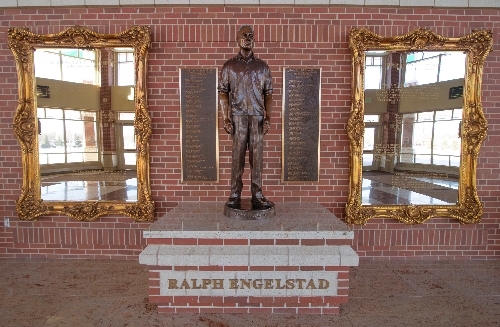
The arena welcomes those who step inside with a statue of Engelstad, and some of his favorite quotes are engraved on nearby walls.
And, boy, do they step inside.
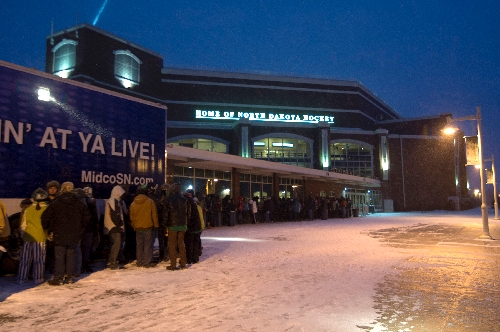
In green-and-white droves, with season-ticket holders from 35 states.
The average annual snowfall here is close to 45 inches, and temperatures as low as 43 degrees below zero have been recorded, but not even the harshest elements keep the faithful away.
As the NHL was battling its players at a bargaining table during the recently concluded lockout, North Dakota hockey became the most followed team in North America and ranked fourth in the world with an average attendance of an over-capacity 11,730.
There is a reason the men's hockey program supports nearly 80 percent of the school's athletic department budget. It's life-and-death stuff here.
"There is really nothing else in these parts to compare it to," said Holy Cross coach Paul Pearl, whose team lost two games to North Dakota this month at The Ralph. "You have a combination of unbelievable teams, history, an ability to maintain excellence, a remote location where it is the only thing to root for - all the things that add up to a great program. You get people whose great-grandfather and grandfather and father all grew up on it, passed from generation to generation.
"And being able to play in such an arena sure doesn't hurt when it comes time to recruit players."
Crazy. There was a time during construction when Engelstad threatened to pull his funding.
The reason: As you walk up to The Ralph and its red-brick exterior, you immediately notice a statue of Sitting Bull, the Sioux tribesman who led his people during years of resistance to government policies.
The statue is a symbol of what Engelstad felt was "a lasting value and immeasurable significance of our past, present and future." It also is a reminder of a controversy that divided North Dakota families and stripped the university of its flagship nickname.
•••
The logo is on everything.
Magnets. Sweatshirts. Hats. Golf bags. Mouse pads. Bumper stickers. Necklaces. Socks. Key chains. Mugs. Trash cans. Water bottles. Money clips. Jerseys. Picture frames. Flags. Bottle openers. License plates. Dog collars.
Dog dishes.
Yes. Max can enjoy his walk and dinner thinking of the Fighting Sioux.
It's as if North Dakota - or at least the gift shop inside The Ralph - is pointing a foamed middle finger directly at the NCAA and the state Board of Higher Education.
Merchandise will continue flying off shelves until they are empty, the license to manufacture apparel having ended in 2011. You get the feeling they prepared for that eventuality by filling warehouses with the stuff.
The controversy dates to 2005, when the NCAA listed 19 schools with American Indian nicknames, logos and mascots as "hostile and abusive." Some schools received enough tribal support to keep the nicknames. North Dakota did not.
The NCAA threatened sanctions if North Dakota teams continued wearing the Indian head logo. After the lawsuits and legislation and threats from all sides were finished, a settlement was reached while voters across the state last year rejected by 67 percent the latest efforts to preserve the moniker.
In the end, all Fighting Sioux signage outside the arena was removed, while inside references remain, including a massive logo on the main lobby floor.
The controversy was hardly lost on the Engelstad family, whose foundation in 2010 released a statement of disapproval on how the matter was being handled.
"I think it all would have been very disheartening to him," Kris Engelstad McGarry said of how her father would have reacted to the final decision. "He considered himself a Sioux. His quarrel, in general, was never with the Indian nation. It was more with the school administration and the NCAA.
"What are you going to do? The purpose is to have a thriving hockey program and bring revenue to the area. No one was happy this happened. In general, I just think the community grew tired of fighting. At some point, it's not healthy for anyone."
It is a large chunk of North Dakota history that, while almost gone, is never forgotten, proven by the thousands who pack The Ralph for hockey games.
Each time the team is introduced as, "The University of North Dakota," the crowd follows with a raucous "Sioux!"
In the end, however, it's still about what follows.
About the hockey.
•••
If children in Indiana grow up playing on rusted driveway hoops as the summer sun sets over farmhouses, a basketball carved into their spirit, they do so here skating on outside slabs of ice in the dead of winter.
You can't drive more than a few miles without seeing another makeshift neighborhood rink and the small nets at which young boys and girls shoot pucks, bundled up to stave off the chill but insistent on getting in a game or two.
North Dakota fans adore their team, which plays in the Western Collegiate Hockey Association, is ranked fifth nationally, has won seven NCAA championships and has advanced to the Frozen Four 19 times.
"I don't think you ever get used to it," senior forward Corban Knight said. "The love people have here for Fighting Sioux hockey will never die. It will live forever."
If this isn't the end of the earth, you can see it from the arena's upper concourse, staring through large glass windows and into the darkness of another frigid evening.
But there is something mystical about the place, something incomparable to other college sports and programs and towns.
"I've had so many people ask me about the connection, about what makes it so special," said Dave Hakstol, in his eighth season as North Dakota's coach. "My answer is, 'It's something different for every person, every family, everyone who is part of this program, from players to coaches to fans.' I know what it means to me. I know it's a great responsibility and tremendous opportunity to come to work here every day, to help carry on the history and tradition."
It quickly becomes evident: North Dakota fans enjoy their hockey and beer, which is why local bars offer shuttle service to and from games, school buses lined up outside The Ralph to ensure that those who spend a few hours cheering the team safely find their way back to their rightful stool for a nightcap or six.
They're drunk, sometimes literally and always figuratively, on the program.
There is a picture among those that line the walls of The Ralph that shows a North Dakota goalie from decades ago. It is during a stoppage of play during a game at The Old Barn, the original home of Fighting Sioux hockey.
It was so cold inside - snow flurries often would fall through cracks in the metal roof and onto the ice - that the player's breath can be seen as he exhales.
The building wasn't heated, but when a capacity crowd of 4,000 could be drawn, the temperature inside might rise to near 20 degrees.
Yes. That cold.
But it is a snapshot that best encompasses this faraway town 145 miles from Winnipeg and tucked under seemingly constant storm clouds perched above power lines, this sport, this program, this sort of devotion most would have a difficult time fathoming.
It is so simple, and yet says everything.
Somewhere, you have to believe Ralph Engelstad approves.
"(My father) started the plans for the arena knowing he had cancer and that it was going to be terminal," Engelstad McGarry said. "It was the last thing he wanted to do and make sure it got completed. If he were alive today, he would be very, very happy with the progress of the arena.
"When it opened, he walked to the edge of the ice with my son, who was 7 at the time, and tricked him into going out to throw the puck. It was maybe one of three occasions where I saw my dad tear up, just standing there.
"It is exactly the way he envisioned it."
Las Vegas Review-Journal sports columnist Ed Graney can be reached at egraney@reviewjournal.com or 702-383-4618. He can be heard from 11 a.m. to 2 p.m. Monday through Friday on "Gridlock," ESPN 1100 and 98.9 FM. Follow him on Twitter: @edgraney.