Local runners caught in Chicago Marathon fiasco


About the worst thing that can happen when throwing a big party is to run out of food or drink.
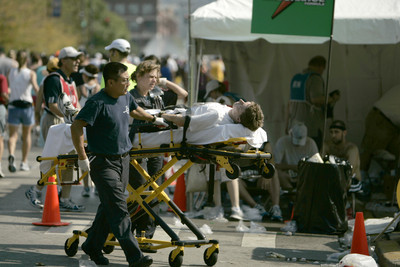
The Chicago Marathon, one of the most respected events of its kind, threw its 30th anniversary bash Sunday. But the party quickly turned bad for many of the 35,000 runners, including dozens of Southern Nevadans in the race.
Las Vegan Todd Radivan, a veteran of nine marathons who was running Chicago for the second time, was among thousands stung by the shortage of water and fluids in the race's early stages as the temperature soared to 88 degrees, coupled with thick humidity.
Radivan, 47, was among the majority of the field forced off the course when the race was stopped about 11 a.m., three hours after it began.
"The race only had 15 water stations for the whole course," said Radivan, who started well back in the pack based on his personal best time of 4 hours, 28 minutes and needed 25 minutes just to cross the start line. "At the first station, there was water. But the second (about 3 miles in) had no water. And the third station had water, but no cups."
That was around the 6-mile mark, and Radivan did what many others were forced to do -- take a detour to find fluids.
"I went into a little deli to buy a bottle of water," said Radivan, who was wearing a fanny pack and was carrying a little money.
Radivan was behind two other runners in line, set to pay for what was quickly becoming liquid gold. But a compassionate customer stepped in.
"A lady was sitting there eating lunch, and she saw what was going on," Radivan said. "She bought all the water bottles they had and started handing them out."
Radivan finished off his bottle but continued to carry it throughout the race, using it again at the 9-mile mark.
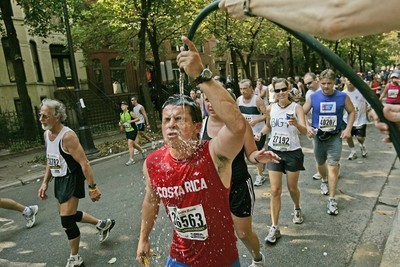
"I stopped at Lincoln Park and waited in line to fill my bottle in the fountain. It was a 15-minute wait," he said. "Wherever they had fountains ... people were dunking their heads just anywhere they could get wet."
Fortunately for Radivan and many others, there were many more people like the woman in the deli.
"The crowd itself was great," he said. "They were hosing runners down where they could, and people were going into their houses and bringing out pitchers of water."
Race organizers sent an e-mail to runners three days before the race, warning of the expected conditions.
The event increased its number of drink servings from 1.6 million to 1.8 million, and even though approximately 10,000 registered runners opted against competing, the 35,000 who did quickly depleted fluids at the first few stations.
"It's usually so well organized," Radivan said. "I don't know what the hell they were thinking this time."
Fellow Las Vegan Laura Carrington also suffered through the heat, but she had a much different experience. Competing in her 10th marathon and for the third time in Chicago, Carrington is a solid runner with a personal best of 3:32:28 -- set in Chicago in 2005.
As a seeded runner, she began her race close to the front of the field, crossing the start line within about 30 seconds of the gun going off. Carrington ended up with her worst time at 4:21:17, walking much of the last several miles, but she never lacked for fluids.
"I didn't see any stations running out," said Carrington, 35. "But it was so hot that people were taking five or six cups and dumping them on their head and body."
That ultimately led to shortfalls for the thousands of runners farther back.
Las Vegas Marathon race director Terry Collier was well aware of the problems in Chicago. He has experienced similar issues in his 23 years working with the Los Angeles Marathon, though it has yet to happen during his three years of Las Vegas involvement.
"The contingency plan was present in Chicago, but it seems there was a problem with the execution," Collier said. "I'm still trying to understand what went wrong. It's an organizer's nightmare."
Collier said the Las Vegas Marathon has a contingency plan -- putting spigots on fire hydrants near each aid station. In addition, there are 25 stations, with water at every station and Gatorade at every odd-mile station.
"We train during the hot months, so we have experience with that," Collier said. "We've planned well in advance, and everybody is ready to go into action."
Despite the heat, Radivan said, many more runners could have finished if fluids had been available.
His race ended after three hours and roughly 17 miles, as scores of runners were directed to start walking back toward the start/finish area.
"Nobody could believe it. A lot of people were very angry -- they'd been training for months," he said.
Carrington walked most of the last 9 miles, trying to make the best of a miserable day by talking to fellow worn-down entrants.
"I turned my stopwatch off," she said. "Once I changed my attitude and expectations, I really had a good time. I did a cartwheel at the 26th mile, just to get the crowd going. I had enough energy to do that.
"I'll go back next year. I feel I need to go back to redeem myself."
Race organizers probably will be looking to do the same.
Contact reporter Patrick Everson at peverson@reviewjournal.com or (702) 383-0353.