Serena ‘shocked’ by comeback, Open title
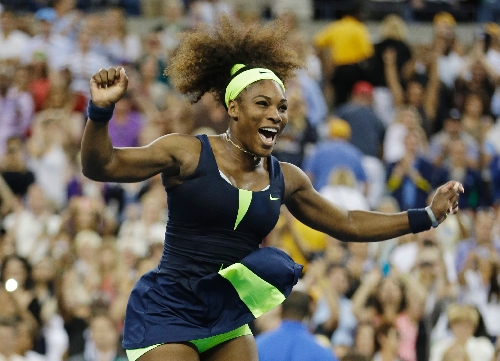


NEW YORK - Finally tested - even trailing - at the U.S. Open, Serena Williams turned things around just in time.
Two points from defeat, Williams regained her composure and her strokes, coming back to win the last four games and beat Victoria Azarenka 6-2, 2-6,
7-5 on Sunday for her fourth championship at Flushing Meadows and 15th Grand Slam title overall.
"I honestly can't believe I won. I really was preparing my runner-up speech, because I thought, 'Man, she's playing so great,' " Williams said during the trophy presentation after the 2-hour, 18-minute match, adding: "I'm really shocked."
She might be the only one.
After all, what really was stunning was that the top-ranked Azarenka made things as interesting as they were, given that she came into the day 1-9 against Williams.
Add in that Williams hadn't dropped a set in the tournament, losing only 19 games through six matches before Sunday. All part of a tremendous run she is putting together in reaction to her loss at the French Open in late May, the American's only first-round exit in 49 career major tournaments. Since then, she is 26-1, winning Wimbledon and the London Olympics.
"I was miserable after that loss in Paris. I have never been so miserable after a loss," Williams said. "I pulled it together. ... Sometimes, they say, it's good to lose."
There hadn't been a three-set women's final in New York since 1995, and Williams came through with a late charge to become the first woman to win Wimbledon and the U.S. Open in the same season since a decade ago, when - yes, that's right - she did it.
"She never gives up," said Azarenka, who managed only 13 winners, 31 fewer than Williams. "She's definitely the toughest player, mentally, there is and she's got the power."
While Azarenka, a 23-year-old from Belarus, doesn't have the name recognition of Williams, she did win the Australian Open in January and was 32-2 on hard courts in 2012. She also hadn't dropped a three-setter all season until Sunday, going 12-0 in matches that went the distance, including victories over defending U.S. Open champion Sam Stosur in the quarterfinals and 2006 champion Maria Sharapova in the semifinals.
As Sunday's third set commenced, Williams' mother, Oracene Price, told her from the stands, "Settle down."
That didn't happen right away.
"Well, she's a human being, you know, who has two feet, two legs, two hands," Azarenka said. "It's understandable."
When Williams double-faulted, slapped a bad backhand into the net and pushed a forehand long, Azarenka broke at love for a 4-3 edge, then followed that up by holding for 5-3.
One game from the championship.
"I never, never quit. I have come back so many times in so many matches," Williams said. "I wasn't too nervous."
Azarenka was two points away at 30-all in the next game with the fourth-seeded Williams serving, but couldn't convert. And when Azarenka served for the victory at 5-4, she showed the jitters that probably are understandable given that this was only her second career Grand Slam final, 17 fewer than Williams.
Azarenka made three errors in that game, including a forehand into the net that let Williams break her to 5-all. Williams contained whatever excitement she might have felt, face straight as possible, while her older sister, seven-time major champion Venus, smiled and clapped in the stands.
That was during a key stretch in which Williams took 10 of 12 points to go ahead, 6-5. She then broke again to win, dropping onto her back on the court when Azarenka sent a backhand long to end it.
"Feels like there is no room for a mistake," is the way Azarenka described trying to deal with Williams' game. "There is no room for a wrong decision."
Azarenka slumped in her changeover chair, a white towel covering her head, as Williams kept saying, "Oh, my God! Oh, my God! Oh, my God!" while scurrying over to share the joy with her mother and big sister.
"Being so close, it hurts deeply," Azarenka said. "To know you don't have it. You're close; you didn't get it."
Williams, who turns 31 on Sept. 26, is the first 30-year-old woman to win the U.S. Open since Martina Navratilova in 1987.
Williams is dominating the game right now. And she's been dominant, off and on, for more than a decade.
She won her very first major championship at age 17 at the 1999 U.S. Open. Winning titles 13 years apart at the same Grand Slam tournament represents the longest span of success in the professional era, which began in 1968. Navratilova (Wimbledon, 1978 and 1990) and Chris Evert (French Open, 1974 and 1986) had the longest previous spans of 12 years.
"Yeah, three decades - the '90s, 2000s, 2010s," Williams said. "That's kind of cool."
After her first-round loss at Roland Garros to a woman ranked 111th, Williams went back to work, getting help from Patrick Mouratoglou, a coach who runs a tennis academy in France. She's 14-0 in Grand Slam matches since then; the Wimbledon trophy ended a two-year drought without a major title.
Worries about a potentially dangerous storm led the tournament to postpone Williams-Azarenka, making this the fourth time in the last five years that the U.S. Open women's final was pushed from Saturday to Sunday.
When they got started, Williams was good as can be, compiling a 16-2 advantage in winners through the first set.
She pounded big serves - she finished with 13 aces, at up to 125 mph - and big returns; smacked forehands and backhands out of Azarenka's reach; even tossed in a terrific backhand lob to break for a 2-0 lead at the outset.
Both women had issues with the officiating - though nothing compared to Williams' misadventures in the past.
"This is the first year ... in a long time," Williams said, "I haven't lost my cool."