After the fire: reseeding hope on Mount Charleston
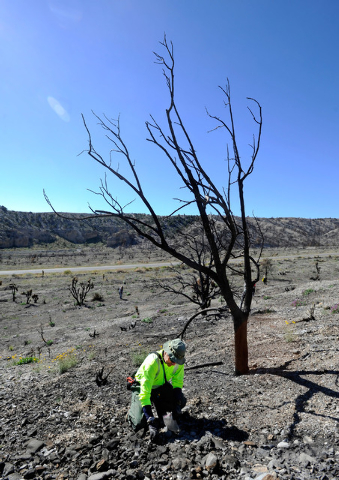
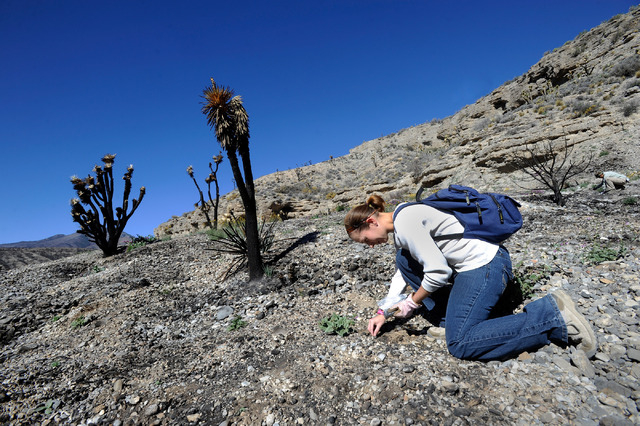
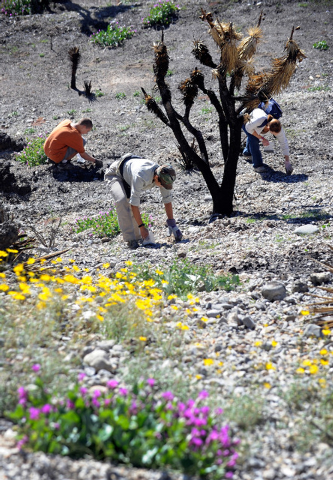



Vivid purple and yellow flowers dotted the otherwise dead-looking landscape near Harris Springs Road Saturday as volunteers planted thousands of Joshua tree seeds in the Carpenter 1 Fire burn area.
GO Mt. Charleston, a non-profit organization based on a partnership between the U.S. Forest Service, Great Basin Institute and Southern Nevada Conservancy, planned the day’s project to celebrate National Public Lands Day.
For 20 years, National Public Lands Day has been observed to promote education and volunteerism on the country’s public lands. This year, an estimated 180,000 volunteers nationwide did service projects. GO Mt. Charleston chose to focus its efforts on a burned area along Kyle Canyon Road, also known as state Route 157.
Cody Dix, 24, is an employee of the Southern Nevada Conservancy and is also GO Mt. Charleston’s volunteer program specialist.
“Hopefully, people will care a little bit more and take steps forward in helping out,” he said, adding that such events may lead people to visit, learn about the area and volunteer in the Spring Mountains.
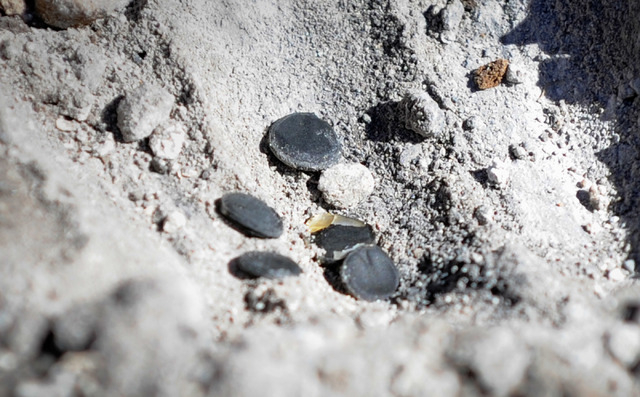
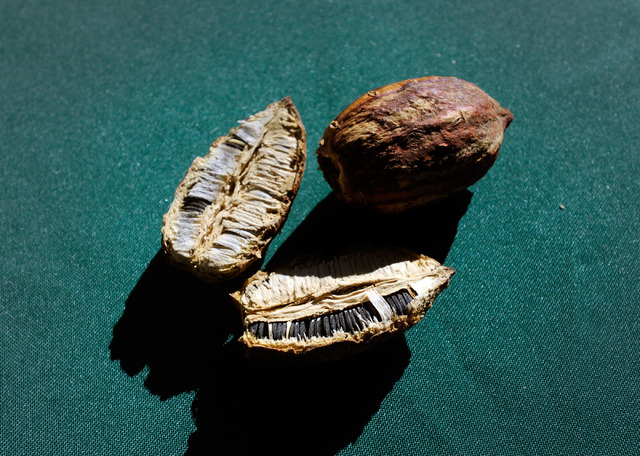
Saturday’s event was the second phase of a project started in August. Then, volunteers harvested over 450 pounds of Joshua tree seed pods, which Dix described as “tiny, black watermelons.” The pods hold anywhere from 40 to 70 seeds.
Saturday, each volunteer received a bag of those seeds to replant in a Carpenter 1 burn area where not much survived the blaze.
“You plant one for the ground squirrel, one for the crow, one for the ants and one to grow,” singsonged Jennifer Brickey, a Spring Mountains botanist, as she demonstrated the planting process.
Volunteers split into groups and moved slowly across the charred desert landscape, making a hole every four steps and planting four seeds in each one.
Volunteer Ron LaPointe is well-acquainted with the area. He has lived in Las Vegas for 20 years and refers to Mount Charleston as his second home. He is an avid hiker and volunteer, and was part of the seed-harvesting project in August.
“The fire just wiped it all out,” LaPointe said of the surrounding area.
Brickey pointed out plants along the way as she stooped to plant seeds. Some, like small shrubs and flowers, can bounce back quickly.
Some of the bigger trees should also make a comeback, with the possible exception of the Bristlecone pine. Little is known about regrowth of that tree, said Brickey. About one-fifth of the area’s Bristlecone pines were within the burn area.
“It’s just a matter of wait and see,” she said.
As soon as burn area erosion control projects, like last week’s helimulching, are completed, an extensive assessment will be made about which trees and plants will regrow on their own, which will need the aid of projects like the one held Saturday, and which will be more of a struggle to rehabilitate.
There are already positive signs. Lizards crawled and bees buzzed around flowers near Harris Springs Road on Saturday, and some of the fire-damaged Joshua trees already have small sprouts at the base of the trees.
“You get the right rain at the right time, and almost anything can come back after a fire,” Brickey said, “Even in the Mojave.”
Contact Annalise Porter at aporter@reviewjournal.com or 702-383-0264.