An extraordinary occasion
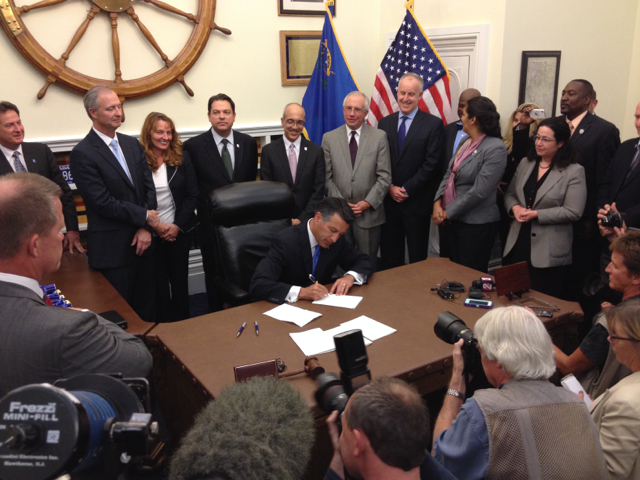




CARSON CITY — Gov. Brian Sandoval was even more upbeat than usual in his office late Thursday night, as he gathered amidst a throng of reporters and state lawmakers to sign four bills passed in a two-day special session granting Tesla Motors more than $1.3 billion in incentives for moving to Nevada.
“I think we can all go home with our conscience clear: We made history tonight,” Sandoval told the large crowd in his office in the Capitol building. “As time moves on, I think we’re going to look back very proudly on this day.
Who knows? Maybe Sandoval is right, and this will be the moment the state changed from a sleepy backwater of business (other than gambling, of course) to a leader in manufacturing for clean-energy technology. Maybe this huge benefit package for Tesla — hammered out over negotiations stretching back nine months, besting four other states that were also seeking to build Tesla’s 5 million-square-foot electric car battery “gigafactory”— will put Nevada on the map.
That’s an unanswerable question, predicated on things we don’t know now, including whether consumers will embrace a less expensive ($35,000) model Tesla, whether lithium ion battery technology will remain the industry standard and whether the company will remain committed to Nevada for the long haul.
For now, however, we have more urgent questions, also with no answers: How is the state going to absorb the hits to its budget that will come from giving Tesla property, payroll and sales tax exemptions, lasting from between 10 and 20 years? How will it make up for $195 in tax credits that Tesla can sell to other businesses? And is this kind of (entirely legal, thanks to the Legislature!) bribery the only way we can get businesses to move to Nevada?
Sandoval made a point in his Thursday news conference to thank the Legislature for its “leadership” on the issue, although the real leadership was Sandoval’s, who with his staff (especially Steve Hill, director of the governor’s Office of Economic Development) hammered out the agreement over nine arduous months and talked Tesla down when the company tried to reach for even more. And Sandoval praised the two-day special session process, saying “it was absolutely critical that every question be answered, throughly and fully.”
But the fact is, not every question was answered, or even asked. Lawmakers delved into the details of what they were given, asking about the mechanics of tax breaks, abatements and incentives that had been handed to them. Some tried to defend other tax breaks (such as the film tax credit) that were hollowed out considerably to pay for Tesla’s ostensibly more profitable deal. But nobody once asked whether we should be doing this in the first place. In fact, the absence of a single no vote shows that lawmakers were either supporters of the plan in the first place, or easily able to assuage any lingering doubts with two days of hearings.
If that question had been asked, it may have been answered thus: Nevada shouldn’t have to engage in this kind of barter with companies that have market capitalization nearly five times as large as the state’s general fund budget. But the state has failed to heed the warnings of people in its past, who encouraged a bigger investment and higher expectations from the state’s education system, from kindergarten through college. If we had done that when we should (read — decades ago!) we may not be in this position now, and could offer a large, educated workforce to any high-tech company looking to move here.
(Or maybe not; California has obvious educational advantages over Nevada, and no shortage of workers, but Tesla rejected setting up its factory in the Golden State.)
There was optimistic talk as the special session ended that leaders would finally address themselves to the question of fixing Nevada education. (State Sen. Tick Segerblom said the event was evidence that the state would never pass a tax package through the legislative process, and he urged a vote for The Education Initiative in November.) But others — seeing the rise of clean energy development at both ends of the state; Nevada’s designation as a testing site for unmanned aerial vehicles; the recommendation of of a new Southern Nevada medical school; and now the construction of a high-tech manufacturing plant — think a sea change may be on the horizon.
Consider me a skeptic, however. While we’ve witnessed legislation introduced, debated, passed and signed into law in a single day (online poker) and the largest incentive package in state history approved in two days (Tesla), we’ve waited decades for any sign the state intends to take the drastic steps necessary to really fix Nevada’s schools. Giving tax money away and catering to large industries is easy; raising taxes is virtually impossible. The last time it was seriously attempted, in 2003, it took two special sessions and a Supreme Court lawsuit to resolve.
Sandoval insisted Thursday, as he did when he announced the deal a week prior, that it was good for Nevada. He insisted that he’d never have moved forward with it otherwise.
Who knows? He may be right. But in the meantime, it seems the only thing that’s really changed is the number of zeros on the checks the state is willing to write to attract businesses here, since that’s the only way we know to do it.