Former housewares company made popular by past celebs


What did Charlie Chaplin, Japan's Emperor Hirohito, Babe Ruth and Ginger Rogers have in common?
Aside from their obvious notoriety, all owned cars built by the Pierce-Arrow company. They were joined by some of the most famous and wealthy people of the early 20th century who visibly demonstrated their power and influence by driving or riding in one of these impressive vehicles. Names like Vanderbilt, Rockefeller, Woolworth and Carnegie all possessed Pierce-Arrow pink slips at one time or other.
As was the fashion of the day, the decision to purchase a car made by Pierce-Arrow was only the beginning. Once the rolling chassis was in place, customers would often select the coachwork and various interior finishings. Suffice to say, you didn't buy a Pierce-Arrow off the lot. The cars would then be constructed to the buyer's exacting specifications. There was a price. In the 1920s and 1930s, a few of these cars cost upwards of $30,000 (although most were priced considerably lower), the equivalent of 25-30 years salary for the average worker. In the Golden Age of motoring, cars such as the Pierce-Arrow represented its zenith.
Not only were Pierce-Arrows luxurious, but their huge-displacement eight- and 12-cylinder engines made them fast. In the 1930s, a V-12-equipped car actually broke the speed record at Utah's Bonneville salt flats.
Like many future auto entrepreneurs of that era, George Pierce did not begin as a producer of horseless carriages. At the turn of the century, his Buffalo, N.Y.-based company was manufacturing a variety of household items, including ice boxes, bicycles and bird cages. But with a growing public thirst for motor vehicles, it seemed natural for the company to venture into this potentially lucrative arena.
In 1902, Pierce produced his first car, called the Motorette. By 1909, the Pierce-Arrow label was being attached to all the company's cars, which were produced for those well-heeled fortunates who could afford such extravagant toys.
Henry Ford's success with his "everyman's" Model T spelled eventual doom for many smaller car producers. But Pierce, who stuck to the high end of the market, continued to flourish. Prior to World War I, his company produced three distinct models, including one with a monstrous 825-cubic-inch engine (about 14 liters). There was also a commercial division that would ultimately produce hundreds of trucks that were shipped overseas to help the war effort.
The beginning of the Roaring '20s brought peace and much prosperity to the land, particularly for Pierce, whose cars continued to be popular with the Gatsby set.
However, by the middle of the decade, Pierce-Arrow sales had taken a downward turn as luxury cars from Packard, Cadillac and Duesenberg began carving out increasingly larger shares of the market. Despite creating a less expensive line of cars, the company was rescued by Studebaker, who controlled the company from 1928-'33.
Under Studebaker, the company's fortunes dramatically improved, mainly due to newer engines and more contemporary styling. But, by the early Dirty '30s, the entire North American continent was in the Great Depression's ever-tightening grasp, and Pierce-Arrow sales went flat again.
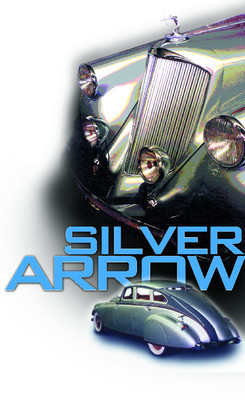
With the upcoming 1933 World's Fair in Chicago, an opportunity presented itself for Pierce-Arrow to showcase its lineup of luxury vehicles. Philip Wright, a 25-year-old stylist, proposed a highly streamlined concept vehicle for the exposition. The car, called the Silver Arrow, was a far cry from the usual conservative and conventional Pierce-Arrow look. Wright's design featured swept-back styling with just a hint of a rear window, recessed door handles, headlights integrated into the front fenders and a spare tire hidden inside each of the car's flanks.
Running boards were noticeably absent. There was also acres of wood trim to complement the lushly padded passenger compartment. Each of the five Silver Arrows was fitted with a 7.5-liter (462 cubic-inch) V-12 engine that churned out 175 horsepower and could propel the car to a top speed of 115 mph. The price of this automotive extravagance was set at $10,000, more than 10-times the cost of a run-of-the-mill Ford or Chevrolet.
The first Silver Arrow prototype was built in just eight weeks, with all five taking three months to finish. The car was first shown to rave reviews at the January 1933 New York Auto Show, a few months prior to going on display in Chicago.
But as spectacular as it was, the Silver Arrow failed to make an impact on steadily dwindling sales. After Studebaker went into receivership later that year, the Pierce-Arrow name was purchased by a group of Buffalo, N.Y., investors who kept the company going for another five years before shutting the factory doors for good.
By that time, many other American luxury marques such as Cord, Duesenberg, Stutz, Franklin and Auburn had also suffered a similar fate.
It is estimated that 80,000 Pierce-Arrow vehicles were produced during the company's lifetime. Of those, about 2,500 are known to exist today, including three of the five Silver Arrows that tried, but ultimately failed to save this remarkable brand from extinction.
Malcolm Gunn is a feature writer with Wheelbase Communications. He can be reached on the Web at www.wheelbase.ws/mailbag.html. Wheelbase supplies automotive news and features to newspapers and Web sites across North America.