Residents express irritation with insects along Sloan Channel





Sunrise-area resident Morris Gianetto held up a sign coated with insects stuck in tape that he said were collected in his yard in a 24-hour period.
"We live, breathe, eat, sleep in it," Gianetto said. "Our kids play in it, our grandparents walk in it. They built that new walking trail, and none of the seniors can use it."
Tempers ran high among approximately 50 residents who attended a Feb. 28 meeting of the city of North Las Vegas Utility Advisory Board at the North Las Vegas City Council chambers, 2250 Las Vegas Blvd. North. While the regularly scheduled meeting dealt with a number of issues, it was complaints about bugs along the Sloan Channel that made up the entirety of the public comment period.
In addition to the clouds of insects outside, residents complained of insects in their homes that seem to enter through the smallest of crevasses, an influx of spiders and bats drawn by the new food source and dangerous distractions as motorcyclists contend with the swarms of bugs.
According to David Frehner, who lives several blocks away from the channel, around 600 feet as the crow (or midge) flies, the insect problem has economic consequences, too.
"I've lived near the Sloan Channel for 45 years," he said. "Now, because of the bugs, I can't run my swamp cooler, which saves me over $100 a month during the summer."
Initial plans called for the effluent from North Las Vegas' new $224 million water reclamation facility to run through pipes in a regional pipeline, which would have carried treated wastewater from each of the valley's sewage plants to a spot at the bottom of Lake Mead.
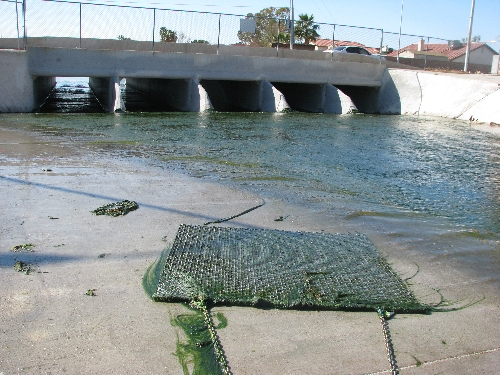
When the regional Clean Water Coalition put the pipeline project on hold, North Las Vegas officials decided to release the treated wastewater directly into the Sloan Channel, a normally dry channel designed to handle storm water.
Clark County and the city were already in litigation over the issue on June 9, 2011, when the city began releasing the effluent.
Within a month, residents along the Sloan Channel began complaining about clouds of nonbiting midges and mayflies, which don't present an immediate health hazard but cause a diminished quality of life for affected residents.
"You can't open your mouth if you're outside," said Melissa Cyphert. "The bugs are terrible. You can't barbecue. You can't have neighbors over."
While city officials initially questioned whether the effluent was a source of explosive insect growth in the channel, that doesn't seem to be in dispute anymore. At the Feb. 28 meeting, the advisory board members could do little more than hear the grievances of the residents as their hands are tied by the lawsuit between the city and Clark County over use of the channel.
"We've been pushing back legal proceedings and trying to work something out," said Clark County Commissioner Tom Collins, whose district B includes the most greatly impacted section of the Sloan Channel and a large portion of North Las Vegas. "Unfortunately, it looks like working things out is going to take some time."
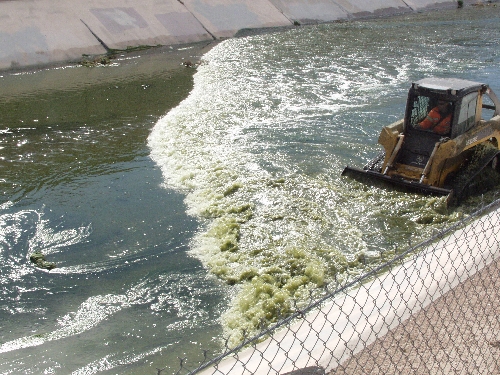
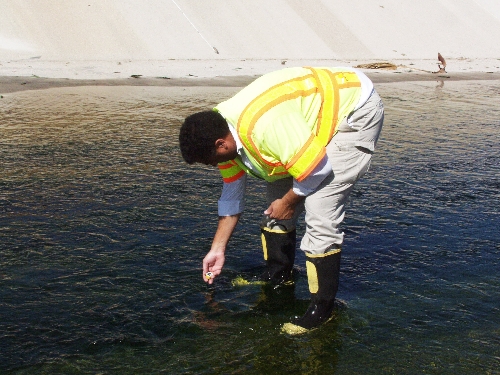
The county isn't waiting. Clark County Vector Control supervisor Chris Bramley's team has been fighting the insects since the swarms began. He said initially the plan was to treat the water monthly in conjunction with a program of algae removal. That solution wasn't aggressive enough. There were several outbreaks of midges and mayflies over the past few months, particularly during unseasonably warm days. The county has stepped the program up to every other week.
The county employs street sweeping trucks, an all-terrain vehicle pulling a drag mat, a compact tractor with a shovel loader and hand brushes and shovels for the mechanical removal of the algae that the midge larvae develop in. Bramley's team is still working out the combination and volume of pesticides and algaecides to do the job efficiently and safely. Apart from the sweeper trucks, he and his staff of two do all the work.
"This is the perfect storm to create the problem," said Bramley. "In this channel, the water is heated. It's highly enriched and oxygenated from the treatment process. It's like a smorgasbord for midges, mayflies and fungus mats."
The channel is also in direct sunlight almost all day, which also promotes algae growth.
Some of the complications come from the different lifecycles of the insects. Cleaning the mud and algae removes the nursery for the larval midges, called bloodworms, but young mayflies, called naiad, can swim well enough to avoid the scrubbing .
Last fall, the city released about 2,000 gambusia affinis, commonly called the Western mosquitofish, into the Sloan Channel. North Las Vegas utilities director Reed Scheppmann said they have no immediate plans to release more.
Bramley said the number was too small to make a real difference.
"You'd need to be something closer to 50,000 fish in there to do the job," Bramley said. "That's something to help with the gnats, and they shouldn't be a problem until the weather warms up. It's even possible we won't see them in the area this year."
Chris Giunchigliani, Clark County commissioner for District E, which includes most of the channel, said the county is hoping to get to the point where the city of North Las Vegas will take over the maintenance but keep it to the standards outlined by county vector control.
"We're looking at having the city pre-fund the operation so it continues regardless of what happens with the city," Giunchigliani said. "When this all started, they didn't have a good plan, period, and unfortunately it's the constituents who suffer."
While Collins contends that the city of North Las Vegas has a history of poorly planned projects, he's aware that some of the challenges presented by the water treatment facility were out of the city's control.
"A lot of it comes down to bad luck," Collins said. "Nobody thought the economy was going to get this bad. The city of North Las Vegas just rolled the dice and it came up craps."
Contact Sunrise/Whitney View reporter F. Andrew Taylor at ataylor@viewnews.com or 380-4532.