[an error occurred while processing this directive]

Las Vegas Review-JournalDonrey Newspapers
Review-Journal Online
HOME PAGE

HEADLINES
SECTIONS
NEWS
SPORTS
   Betting Line
BUSINESS
LIFESTYLES
NEON
   Dining
   Showguide
   Nightlife
   Movies
   TV Listings
OPINION
   Columnists
OBITUARIES
CLASSIFIEDS
   Auto Guide
WEATHER
REAL ESTATE
Subscribe to the RJ
  Archive
Fun Stuff
  Crosswords
  Kids Area
  Gallery
Extras
  Newspaper Subscription
  Contact Us
Tuesday, November 16, 1999
Copyright © Las Vegas Review-Journal

Scientist's story hurt tobacco industry

DeNoble says he was not on a crusade

By Jan Moller
Review-Journal

      The man who knew too much -- and whose testimony helped bring the tobacco industry to its knees -- insists he does not hate his old employers at Philip Morris Corp.
      Dr. Victor DeNoble is not a zealot.
      "I was never an opponent of the tobacco industry," he said Monday before speaking to a group of local executives. "Nor a proponent. I think people have a right to smoke if they want to. I think the industry needs to stop marketing to kids, and make a safer product. End of story."
      Not quite.
      Many will recall the April day in 1994 when seven tobacco company executives simultaneously swore an oath and then testified before the House Energy and Commerce Committee on the addictive properties of their product. It made for arresting television, and signaled the start of a campaign against the industry that has resulted in billions of dollars in public and private settlements.
      But few people know the story behind the story.
      DeNoble tells his story in about 200 speeches a year these days; describes how he was hired away from a post-doctoral fellowship at the University of Minnesota to go work for tobacco giant Philip Morris in Richmond, Va., in 1980.
      These days, besides giving speeches, he is a flight instructor in Newark, Del. -- fulfilling a long-ago promise to himself that he'd never hold the same job longer than five years. He wanted to chart a different path for himself than his plumber-father, who spent 47 years working the same job.
      Just how different a path DeNoble could not have imagined when the tobacco company asked him to work at a secret lab to develop a safer cigarette.
      At the time, smoking was still acceptable in virtually every corner of society, from airplanes to boardrooms. DeNoble says the tobacco giant knew that nicotine was addictive and that it helped cause heart disease. His job was to find a nicotine alternative -- a substance that could keep smokers just as addicted, but without causing heart problems.
      Working on a restricted-access floor, the windows painted black, DeNoble and partner Dr. Paul Mele went to work. Fewer than 50 people in the entire company knew what they were up to.
      "Taking (the nicotine) out was the easy part," he said. "Finding a man-made drug to replace it" proved more difficult.
      After a year of trying, the scientists struck pay dirt with a new molecule, 2-prime methyl nicotine, that held the same addictive properties as the real thing without constricting blood vessels and producing heart disease. Another year passed before they had developed a new cigarette to deliver the molecule.
      "And that's when everything hit the fan."
      DeNoble and Mele traveled to New York to present their findings to top company executives. The response they got was not encouraging. After 30-plus years of denying tobacco's addictive properties, the company wasn't eager to expose the fallacy of that position by introducing a safer cigarette. Doing so would put the company at risk.
      Instead, the company sat on the information for two years, before finally closing down DeNoble's lab on April 5, 1984.
      It would be 10 years until the public learned of the research that had taken place on the restricted floor at company headquarters. In the meantime, DeNoble says, Philip Morris hired private detectives to follow him around, making sure he never violated the secrecy agreement he signed before starting his job.
      The moment of opportunity would arrive once word leaked out that Congress planned to depose the heads of seven major tobacco companies. DeNoble says he and Mele sent an unmarked packet detailing his research to an official at the Food and Drug Administration in Bethesda, Md.
      "Timing was everything," DeNoble says. "Paul and I waited for the opportunity" to share what they knew. "Had we sent (the information) earlier, nothing would have been made of it."
      Once the FDA learned of the secret lab, it set in motion a series of events that would prove disastrous for the tobacco industry.
      After FBI officials tracked down DeNoble and Mele as the source of the information, it made its way to Rep. Mike Synar, D-Okla., who surprised the tobacco executives by asking about the secret lab.
      Under bright television lights, Synar made the industry executives release DeNoble and Mele from their secrecy agreement.
      Two weeks later, on April 28, 1994, the two scientists told a congressional panel about their safer cigarette -- and four decades of industry denials had finally been exposed as a lie.
      DeNoble could gloat about his role in the industry's plight, but he doesn't. Instead he spends his free time speaking to schoolchildren -- and employers -- about the addictive properties of tobacco.
      As a former scientist, he views cigarettes like any other drug addiction, and believes it should be treated as such.
      "My objective here is to raise awareness," he said. "That this is truly a drug addiction. We should stop thinking of this as a bad habit and treat it like a medical issue."


E-mail this story to a friend:
Your friend's e-mail address:

Your e-mail address:


Give us your FEEDBACK on this or any story.

1999 BEST OF LAS VEGAS RESULTS

Fill out our Online Readers' Poll
Printable version of this story


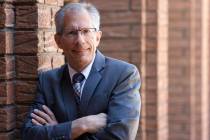
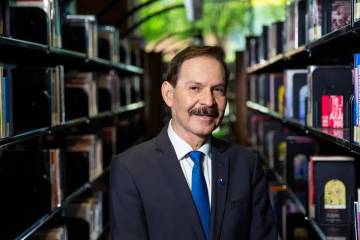
Dr. Victor DeNoble, a former Philip Morris scientist and key witness in the federal government's case against the tobacco industry, speaks to a lunchtime audience Monday at Drai's Restaurant.
Photo by Christine H. Wetzel.

[an error occurred while processing this directive]

[News] [Sports] [Business] [Lifestyles] [Neon] [Opinion] [in-depth]
[Columnists] [Help/About] [Archive] [Community Link] [Current Edition]
[Classifieds] [Real Estate] [TV] [Weather]
[EMAIL] [SEARCH] [HOME]
Brought to you by the Las Vegas Review-Journal.   Nevada's largest daily newspaper.

[an error occurred while processing this directive]