| Click for printable version Click to send to a friend

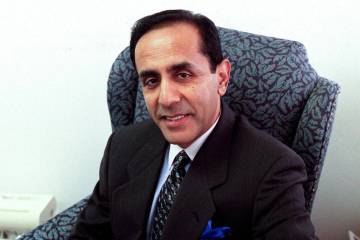
Mel Hallerman of Henderson was the chief programmer 20 years ago for the International Business Machines team that introduced the IBM personal computer. Observers say that although IBM's machine was neither the first PC to market nor the most sophisticated, it was the machine that spread to offices everywhere to revolutionize business. Photo by Craig L. Moran. | Monday, September 03, 2001 Copyright © Las Vegas Review-Journal COMPUTING: BIG BLUE PERIOD Henderson resident was part of team that helped bring personal computers to masses 20 years ago By MATTHEW CROWLEY REVIEW-JOURNAL Mel Hallerman's not a ghost, or a legend, although he is a walking link to computing history. And though he's alive and well and living in Henderson, last month he was missing as far as Bill Gates knew. When the mind behind Microsoft presided over the 20th anniversary party for the IBM personal computer in San Jose, Calif., Hallerman, the chief programmer behind Big Blue's historic little box, wasn't there. Hallerman said he heard from a friend that Gates had wondered why. "Bill said, `Where's Mel?' " Hallerman said, shrugging as he told the story. "I was right here. All of the IBM people knew where I was." In July 1980, he was in Boca Raton, Fla., part of the team that helped put together the original IBM PC. IBM's PC wasn't the first PC; the Apple II and Commodore 64, for example, came earlier. Nevertheless, the IBM PC was the machine that achieved critical mass, designed to be cheap, accessible and useful everywhere. The PC marked its two-decade anniversary Aug. 12. Hallerman began preparing for a life with computers long before such preparation was common or widely possible. As a youngster, he attended Bronx High School of Science, a school which, luckily for Hallerman, had a user agreement with Columbia University, which did have a computer: an IBM 650. That model, Hallerman recalled, employed a rotating drum for memory and ran with programmed punch cards. The high school students could use the machine at odd hours, such as weekends, or the wee hours of the morning. Times never bothered Hallerman; he seized the chance to learn the machine. Hallerman, 57, joined IBM in 1964, after earning a mathematics degree at the City University of New York (there were no computer degrees then because the university had no computers). He said he chose to work at IBM because it was the best computing company there was, and because it was a big enough organization that if one task didn't suit him, he could find another that did. He transferred to Boca Raton in 1975. And, in 1980, when the chance came to join the PC project, he jumped. "They told us we had a year to put it together, but just a year," Hallerman said. It would take 13 months. Hallerman said he and his colleagues were ready to make the PC happen. There were sages, experienced programmers like Hallerman with years at IBM, and starters, new college-hired talent. Hallerman said the kids helped; they had bodies that could handle around-the-clock wakefulness and spirits uninhibited by fear of failure. "When the college-hires interviewed with us, they didn't ask whether or not (the project) was impossible and we didn't tell them," Hallerman said. Hallerman said everyone toiled tirelessly. He was working 80 hours weeks and spending 20 hours a week reading material to contribute to the project. His eyes didn't close much, but he didn't care. "We all worked that much because we wanted to," he said. "Nobody told us to." Hallerman did a little of everything. He met with software vendors and landed the programs that would come bundled with those first PCs: Easywriter, a word processing program, and Visicalc, a spreadsheet, and accounting software from Peachtree Software, among others. He contracted with Microsoft to get the operating system, DOS. And, he wrote the manuals for that first PC, approaching every page and instruction as if he were a novice with no computing knowledge. When the original IBM PC debuted, it featured a 16-bit, 4.77 megahertz Intel 8088 processor, 64 kilobytes of random access memory, expandable to 256 kilobytes, and a 5.25-inch diskette drive. IBM touted the PC as an everyman machine. Its ad campaign featured a Charlie Chaplin character using the machine to improve workings at a bakery and other ventures. Intel's Web site reports the 1981 model, monochrome PC cost approximately $3,000, which it calculated as the equivalent of $5,700 in today's dollars. David Bradley was one of the engineers on the PC project. He created the machine's basic input-output system, which ran the keyboard and diskette drive. He said the PC was the right machine at the right time. "In the long view, everything worked amazingly well," Bradley said. "There was no last-minute panic, no hardware bugs in the machine. Everything went really well." How well was shocking, Bradley said. IBM officials predicted 200,000 sales of PC over a five-year span. Instead, the first model sold 3 million units. Hal Berghel, a computer science professor at the University of Nevada, Las Vegas, said the PC's ease of operation, and inclusion of bundled applications, made it instantly useful; one didn't have to be a technical wizard to make it work. "The IBM PC was ready to deploy in any business or home application right out of the box." Berghel said. "The IBM PC was neither first to market nor technologically advanced. It was simply the most useful desktop computer on the market." Jerry Herron, the director of American Studies at Wayne State University in Detroit, said IBM and its PC team were to computing what Henry Ford and his assembly line teams were to transportation. Both Ford and IBM made a life-changing device affordable and accessible to the masses. Herron said mass use of personal computers hasn't improved students' literacy or writing abilities over the years. Students, he said, are no more or less literate now than they ever were. But, he said, the PC and its descendants have spawned a new sort of visual literacy. Companies now create products with a style and look in mind, knowing they'll end up on a computer screen for a Web site, Herron said. And, the look of magazines and periodicals has changed, with page after page of images inspired by and generated with desktop computers. "In terms of design culture, things can't get away with looking mindlessly stupid anymore," Herron said. Lisa Napoli, who covers the Internet for MSNBC, said the PC has become almost an afterthought; they are expected everywhere. "You wouldn't set up a house without microwave or a TV, and you wouldn't set one up without a PC," she said. "They're an essential part of our lives and the Internet has only made it moreso." IBM no longer makes personal computers. But an everlasting symbol of Hallerman's legacy still exists on the Compaq and Dell machines that are the IBM PC's descendants: the three-fingered get-me-out-of-here keyboard combination: control-alt-delete. The reboot salute came out of necessity, Hallerman said; the machine needed a shut-off system. "We chose those keys because it was an obscure combination," he said. "We wanted to make sure it was a (key) combination people couldn't hit by accident. People act as if it's some great invention, but it's just a function." Hallerman's home features few references to his place in computing history. The biggest reminders seem to be the license plates on his convertible, which read: "IBM-PC," and a "How To Do DOS" book he pulled, still dusty, from deep in a bookshelf in his upstairs office. He said he has files from the birth-of-the-PC days, but they're tucked away. Hallerman said he didn't think much about the 20th anniversary of the PC until Bradley sent him an e-mail relating the story of Gates at the San Jose fete. But, looking back, Hallerman says unflinchingly he knew he was changing the world. "I definitely felt like a pioneer," he said. "It's one of those things where if you're lucky you get to do it once in your life." |