Home Subscribe
Jobs Cars Homes Shopping Travel Weddings Golf Best of Las Vegas Photo
.
Member Center

Recent Editions
TWThFSSuM
>> Search the site
.
.
.
.
NEWS
.
.
.
.
.
.
.


Monday, December 08, 2003
Copyright © Las Vegas Review-Journal

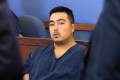
ELABORATE CON ALLEGED: Man pretended to be a doctor, prosecutor says

35-year-old indicted on charge of practicing medicine without license at Henderson office

By GLENN PUIT
REVIEW-JOURNAL


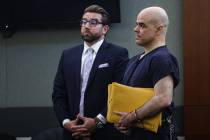
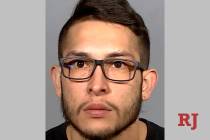
Andrew Elias Michael
Scheduled to go on trial in February in District Court

At his Henderson medical office, Andrew Elias Michael told his employees he was an esteemed surgeon capable of performing complex operations.

In this capacity, authorities allege, Michael supervised numerous patients while they received injections during medical procedures.

And he also gave medical advice.

But the Nevada attorney general's office says Michael was never a doctor, just an old-fashioned con man.

"In short, (his) entire academic credentials are founded on fraud," Nevada prosecutor Gerald Gardner wrote in legal papers stemming from Michael's arrest earlier this year.

There's no mention of any motive in Michael's court file. Prosecutors have declined comment, as have Michael's Las Vegas attorneys, Bill Terry and Linda Norvell.

In October, a Clark County grand jury indicted the 35-year-old on a charge of practicing medicine without a license. By that time, he was already out on bail after his initial arrest. After the indictment, Michael turned up in Kentucky as a fourth-year medical student accompanying physicians on hospital rounds for cardiothoracic patients.

When a media outlet in Kentucky reported on Michael's pending criminal prosecution in Nevada, Michael was dismissed from the medical student program at Central Baptist Hospital in Lexington.

"We have been here for 50 years, and this is the first time we've ever had a problem," said Ruth Ann Childers, a spokeswoman for Central Baptist. "We have since changed our policies."

Michael has pleaded innocent to the charge, and he is scheduled to go to trial in February in District Court. He is currently free on bail.

According to court records and grand jury transcripts, Michael was the president of a Las Vegas company called North American Medical Company in 2001 and 2002. The company ran Meadows Diagnostic Medical Imaging Center, 35 S. Gibson Road in Henderson.

Listed phone numbers for both businesses are now disconnected.

Appearing before the grand jury in October, local radiologist Deborah Dort said she was hired at Meadows Diagnostic by Michael in 2002.

"He told me he was a surgeon, a cardiothoracic surgeon," Dort said. "Specifically, he told me he had done his surgical training at Johns Hopkins University."

A cardiothoracic surgeon performs heart surgeries such as bypasses and T-valve replacements.

Dort said that during her job interview, Michael also claimed to be a former military pilot who was on the verge of obtaining a law degree. Dort said Michael produced a business card identifying himself as a doctor and a member of the Fellow of the American College of Surgery, an esteemed organization for surgeons.

Another radiologist hired by Michael, Douglas C. Howard, told a similar account.

"He held himself to be a cardiothoracic surgeon and trained at Johns Hopkins," Howard told the grand jury.

After being hired at Meadows Diagnostic, the radiologists noticed some curious behavior by Michael. In one instance, Dort said, Michael was present as she read a chest X-ray of a patient.

"I said, `Would you like to see the chest X-ray?' " Dort recalled. "And I put it up, and he made some statement about, `Oh, she's the patient (with) such and such mass in her lung,' which she did not have.

"This was my first week there, (and) I thought, `Oh, he's got her confused with someone else,' " Dort said. "But it did strike me that a chest surgeon wouldn't know how to read an X-ray."

Howard said Michael once came into the office to have his own chest X-rayed.

"He did not know how to position himself to take a chest X-ray," Howard said. "Kind of basic."

Dort said on certain occasions, Michael actually supervised patients.

In December 2002, she said Meadows Diagnostic was going to have to cancel a CAT scan on a patient because a doctor would not be present to supervise a special type of injection necessary for the procedure.

The injection, in extremely rare cases, can cause an anaphylactic reaction, heart attack or even death.

Dort said Michael later showed up and supervised the injection.

"He showed up with a stethoscope around his neck," Dort said.

In another instance, during a doctors' meeting, Dort questioned why Meadows Diagnostic did not have a radiology nurse on staff.

"He (Michael) mentioned that if we ever got in a severe situation ... and we called 911 and the patient is crashing, that I can always call him for guidance on what to do before ... the ambulance arrive(s)," Dort said.

Another employee of Michael's, Gayle Raveling, told the grand jury she was scheduled to undergo a medical procedure on her heart in November 2002 at another facility. She said Michael spoke to her about her heart condition and actually produced a replica of a heart for reference as he discussed the upcoming procedure.

"He was advising me that my left coronary artery appeared closed, 90 percent closed," Raveling testified. "My cardiologist hadn't told me that much information.

"He said, `Yeah, you do need to have this procedure,' " Raveling said.

Gradually, employees at Meadows Diagnostic became suspicious. Dort said a private investigator in January showed up in the business parking lot and told an employee Michael wasn't a doctor.

Dort said she checked with Johns Hopkins and found Michael had not studied there, according to court documents. She immediately called the Nevada State Board of Medical Examiners, and the agency started an investigation.

Lynnette Krotke, chief licensing specialist for the board, told the grand jury that the requirements for a doctor being licensed in Nevada are extensive. But the agency's files showed Michael had never even applied for a license.

An investigation by the attorney general's office now indicates, according to court records, that Michael supervised as many as 11 injections of patients during imaging procedures. In a motion to increase bail for Michael filed in November, the attorney general's office reported that at the time of his arrest, Michael "was conducting rounds at a pediatric clinic in Las Vegas under the pretense that he was a third-year medical student."

Gardner stated in court documents that authorities learned Michael is enrolled at St. Luke's Medical School, a private institution in Liberia, Africa.

St. Luke's worldwide office is in Los Angeles, but the school is not accredited by the American Medical Association and does not qualify in Nevada for licensure, Gardner said.

Gardner also wrote in his bail motion that Michael's admission to St. Luke's was based on his "purported degree from Hamilton University, a Wyoming-based Internet institution that has been described as a `diploma mill' in recent national news stories."

In addition, Gardner wrote Michael was once the subject of a criminal investigation in 1993 amid allegations he submitted a forged University of Nevada, Las Vegas transcript to the Nevada State Board of Nursing in an effort to obtain a fraudulent nursing license.

The Review-Journal was unable to locate any evidence of charges being filed in that case.

Michael made an unsuccessful run for a state Assembly seat in 1996 as a Republican candidate. "We need to get Nevadans off of welfare and back into the work community," he said in an interview before the election.

The allegations against Michael may resemble a movie script, but they're not unique. In one case documented by the San Francisco Chronicle, a man posed as a physician in California for nearly 20 years.

The newspaper reported the man falsified the credentials of a pharmacist and adopted the identity of a Stockton, Calif., surgeon. He was sent to prison five times but, upon release, resumed the con, the newspaper reported.

The Connecticut Post also detailed the case of a man accused of posing as a doctor at a clinic. The man, arrested in April, required young patients to have gynecological and breast examinations before they received methadone for drug addictions, the paper reported.

Dale L. Austin, senior vice president of the Federation of State Medical Boards in the United States, said Nevada and other states across the country do a good job of enforcing laws relating to doctor licensing, but he said when someone is intent on deceiving the system, they can be difficult to detect, especially when they do not apply for a license.

"An individual who isn't licensed by the medical board of a state doesn't normally come under the jurisdiction of the medical board," he said.

Austin said detecting fake doctors requires diligent regulation, public awareness and immediate reporting by medical professionals who are suspicious of a colleague's credentials.

"It all comes down to patient care and patient protection," Austin said.


Advertisement


Contact the R-J | Subscribe | Report a delivery problem | Put the paper on hold | Advertise with us
Report a news tip/press release | Send a letter to the editor | Print the announcement forms | Jobs at the R-J

Copyright © Las Vegas Review-Journal, 1997 -
Stephens Media   Privacy Statement