Home Subscribe
Jobs Cars Homes Shopping Travel Weddings Golf Best of Las Vegas Photo
.
Member Center

Recent Editions
WThFSSuMT
>> Search the site
.
.
.
.
NEWS
.
.
.
.
.
.
.


Tuesday, March 16, 2004
Copyright © Las Vegas Review-Journal

Witnesses detail exposure to dust

Reid, others hear workers' testimony about Yucca tunneling

By KEITH ROGERS
REVIEW-JOURNAL
Photos by Cariño Casas.


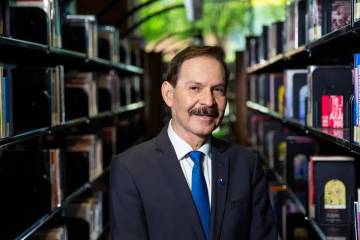
Industrial hygienist Michael Taylor holds up a painters mask Monday during a U.S. Senate field hearing at the Clark County Government Center. The mask was the type first issued to protect workers from toxic dust during excavation of the exploratory tunnel for the Yucca Mountain nuclear waste project.


Gene Griego, a former Yucca Mountain tunnel supervisor, testifies Monday at a U.S. Senate field hearing.


U.S. Sen. Harry Reid, D-Nev., speaks during a hearing Monday at the Clark County Government Center on workers exposed to silica dust inside the Yucca Mountain exploratory tunnel.

While Yucca Mountain contractors forged ahead at a record-setting pace in 1995 to drill an exploratory tunnel at the planned nuclear waste site, workers behind the giant boring machine were inhaling dangerous levels of toxic dust.

But when an industrial hygienist tried to alert managers to the problem, it took them three months to equip workers with respirators to protect them from dust laced with silica and other harmful fibrous minerals. Six months later, they found the required gear, though better than painters masks, was inadequate.

Details on how thousands of workers were potentially exposed to toxic dust during excavation of the five-mile tunnel at Yucca Mountain, 100 miles northwest of Las Vegas, were explained during a U.S. Senate field hearing at the Clark County Government Center that jarred the emotions of one witness Monday.

Many questions, however, remain unanswered as the Department of Energy proceeds with its own "lessons learned" review of the tunneling. Some of the workers are suffering from an assortment of degenerative lung ailments they claim were caused by the dust.

"I can't imagine what we have here," said Sen. Harry Reid, D-Nev., who presided over the hearing held by the Subcommittee on Energy and Water Development. "Thousands have been exposed but we don't know how many are going to get sick."

One witness, Michael Taylor, a veteran industrial hygienist who works on the Yucca Mountain Project for the Los Alamos, N.M., national laboratory, said he first became aware of high levels of harmful, silica dust after air sampling was conducted in the tunnel at the request of a federal geologist.

The samples, collected during a week in December 1995, showed that nine out of 11 exceeded the so-called action level and two exceeded the threshold for workers breathing in toxic, silica dust.

"Employees, management and supervision were notified of the results in writing," he stated.

This occurred about the same time that the 25-foot-diameter tunnel boring machine, the Yucca Mucker, set a world record by excavating 716 feet in five days. Officials under the direction of then Yucca Mountain Project Manager Wes Barnes proclaimed they were nearly a mile ahead of schedule to breakthrough at the south end of the five-mile loop in 1997.

Nevertheless, in January 1996, DOE's contractors did not have a written, silica protection program in place, and the sampling and monitoring program in the tunnel "was less than adequate."

"Workers received little or no information about the silica or fibrous mineral hazards or protective measures," Taylor said, noting that he spoke only as a health and safety professional and not as a representative of the Los Alamos lab or the Yucca Mountain Project.

It wasn't until about March 1996 that respirators, which are more effective than painters masks, were issued to scientists and workers.

Taylor said he has seen 47 health-and-safety professionals come and go on the Yucca Mountain Project.

"Many of them became frustrated with the lack of progress and ineffectiveness" of the health and safety program, he said. "I say this to demonstrate what a challenge it was to be a safety and health professional at Yucca Mountain."

When asked after the hearing why it took three months after high dust levels were recorded to upgrade the workers' protective gear, Taylor said, "I can't talk about that."

When the question was posed to Gene Runkle, DOE's senior safety adviser for the Office of Civilian Radioactive Waste Management, Runkle responded, saying, "I was not there and we have not finished the lessons learned review."

Later, a DOE spokesman, Allen Benson, said it will take about six weeks to complete the review and report preliminary findings.

"The final assessment will be factored into future contracts we write to make certain that appropriate safety measures will be part of future contracts," Benson said.

During the hearing, Gene Griego, a former tunnel supervisor who works for the Los Alamos national laboratory, said he filed a lawsuit last week alleging that Yucca Mountain Project contractors raced to complete the tunnel during the mid-1990s, deliberately exposing him and his co-workers to toxic dust that caused, in his case, chronic obstructive pulmonary disease.

Griego described how water normally used for dust control "was limited because scientists thought their experiments would be compromised if there was unlimited water use."

He paused during his testimony to compose himself before stating to Reid, "I hope out of our meeting today that DOE and its contractors are held accountable for their actions."

Another sick tunnel worker, Jeff Dean, said, "It is my opinion that the general attitude among the tunnel supervisors was focused on production. If you brought up an issue such as dust, you weren't considered a team player. ... Respira- tors would slow down production and everybody knew of the tremendous pressure the DOE was faced with."

Reid, the only senator in attendance, thanked Griego for his testimony, saying, "We all know how difficult it is."

He later said he thought what had occurred was "criminal" and that the hearing served as an indictment against the Energy Department and its contractors.

"The sad part about it is there is no price anyone can put on the health of one of these sick workers," Reid said.


Advertisement


Contact the R-J | Subscribe | Report a delivery problem | Put the paper on hold | Advertise with us
Report a news tip/press release | Send a letter to the editor | Print the announcement forms | Jobs at the R-J

Copyright © Las Vegas Review-Journal, 1997 -
Stephens Media   Privacy Statement