Home Subscribe
Jobs Cars Homes Shopping Travel Weddings Golf Best of Las Vegas Photo
.
Member Center

Recent Editions
SuMTWThFS
>> Search the site
.
.
.
.
NEWS
.
.
.
.
.
.
.


Monday, April 11, 2005
Copyright © Las Vegas Review-Journal

BEAVER DAM STATE PARK: Reservoir at park drained

Officials say dam posed safety threat

By FRANK GEARY
REVIEW-JOURNAL


Click image for enlargement.


Schroeder Reservoir at Beaver Dam State Park was 18 feet deep before it was recently breached.
COURTESY of STATE DEPARTMENT OF WILDLIFE


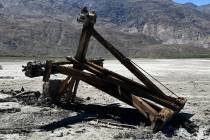
Schroeder Reservoir resembles a big mud puddle in this photo taken Wednesday, following the breach of the dam.
COURTESY of STATE DEPARTMENT OF WILDLIFE

For nearly a half-century, Southern Nevadans have ventured north for the fishing, camping and solitude of a mountain lake 30 miles from the nearest paved road.

The number of visitors annually to Schroeder Reservoir at Beaver Dam State Park has increased substantially since 2000 as the Las Vegas population has soared in recent years.

But residents are out of luck if they want to escape this summer to the eight-acre reservoir with its tree-covered canyon walls.

Last week, in a move the state Department of Wildlife said was necessary to protect the public downstream from the park, state officials broke holes in the dam and drained the reservoir. Now, it looks like an oversized mud puddle.

The emergency decision was made with little public input and no plan in place to repair or replace the 45-year-old dam, acknowledged Rich Haskins, chief of fisheries for the state Department of Wildlife. Officials say the dam posed a safety threat after water spilled over the top during January's flooding in Lincoln County, north of Las Vegas.

If similar flooding hit the area again, experts determined, the earthen dam could break, sending chunks of concrete and other debris sailing down the creek, he said.

"We consulted a lot of people about it," Haskins said. "There was no disagreement. The dam needed to be breached. It wasn't a political decision. The dam was such that we needed to react."

Lincoln County commissioners, who unsuccessfully protested the breaching of the dam, said last week they are worried local cash registers will dry up this summer along with the lake.

The number of visitors to Beaver Dam State Park is at an all-time high, with 11,334 visitors in 2004, according to figures from the state Division of Parks.

If visitors stop coming to the remote area nearly three hours from Las Vegas, then restaurants, stores, gas stations and motels in the nearby town of Caliente won't make nearly the money they have in the past, said Lincoln County Commission Chairman Tommy Rowe.

In a county with about 4,000 residents, an average of 1,000 visitors a month provides a big boost to the local economy, he said.

"I think it is going to be a big blow to our tourism," said Rowe, who fished the Beaver Dam area before and after the dam was built in 1960. "If they came in and repaired it, that would have been a much better situation for people in Lincoln County and the people from Clark County who like to come here."

Pete McKenzie, pastor at the Bible Baptist Church in Las Vegas, which has taken about 50 children to the park for a week of camping each of the past eight years, said the group might go elsewhere this summer since the reservoir is gone.

"Obviously, our desire would have been for them to work out a way to keep the dam in place," McKenzie said. "The park is just not as attractive. The reservoir was one of the best parts of the park."

Haskins and Stephen Weaver, the state Division of Parks regional manager for Eastern Nevada who oversees Beaver Dam State Park, said there are no plans for replacing or repairing the dam, but that the public will have input on the park's future.

They said replacing or repairing the dam might not be a prudent use of millions-of-dollars of taxpayer money because the reservoir has been overcome by rocks and silt in the past 45 years.

The reservoir was 48-feet deep originally, and was a great place in the 1960s and 1970s to catch fish stocked by the Department of Wildlife, they said.

But rocks and mud have flowed into the reservoir and built up on the bottom over the past four decades. Before the breach, the reservoir was only 18-feet deep.

Weaver said he doesn't believe draining the reservoir will kill the park's appeal, and it may provide a different type of recreation than in the past.

The creek above the broken dam will restore itself and start flowing again through the former reservoir acreage as trees take root around the creek, Weaver said. Also, beavers will once again dam up sections of the creek, creating small lagoons that could provide a different setting for fishing in the future, he said.

Also, Congress last year established a large wilderness area north of Beaver Dam, and the state park could serve as an ideal embarkation point for backpackers and others venturing into that area, Weaver said.

"I don't think the park has taken a fatal hit. I think there will be a draw," Weaver said. "There are other amenities there that might attract a different type of clientele, but there are going to be some very disappointed people out there. No doubt about it."

The Department of Wildlife will analyze the cost-benefit of rebuilding the dam. But, with silt build-up making the reservoir less and less viable every year, it may not make sense to build another dam at an estimated cost of $10 million, Haskins said.

The Federal Emergency Management Agency has agreed to fund 75 percent of the cost to replace the dam to current-day construction standards, but the state may not have the money to cover its share, Haskins said.

"The future is undetermined. We need to step back and look at all the options," Haskins said. "Even if we can negotiate (with FEMA), that's $2.5 million the state of Nevada has to come up with."

John Tibbetts, a 63-year-old native of Caliente, looks at the financial ramifications a little differently.

The reservoir has been the primary tourist attraction for the area, he said. Now that it's gone, he is worried visitors from Clark County and elsewhere will stop coming to the rural area near the Utah border.

"There will be some people who will go out there to camp, but the lake was the drawing card," he said. "Without the lake, there is not much out there but the mountains."


Advertisement


Contact the R-J | Subscribe | Report a delivery problem | Put the paper on hold | Advertise with us
Report a news tip/press release | Send a letter to the editor | Print the announcement forms | Jobs at the R-J

Copyright © Las Vegas Review-Journal, 1997 -
Stephens Media   Privacy Statement