Sunday, January 30, 2005
Copyright © Las Vegas Review-Journal
Guinn angers state workers
Many frustrated by call to end retiree health care benefits
By ED VOGEL
REVIEW-JOURNAL CAPITAL BUREAU

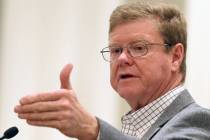
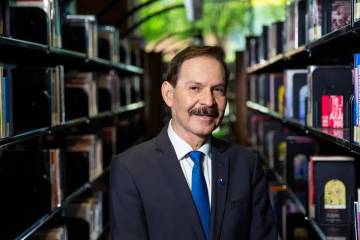
Scott MacKenzie, executive director of the State of Nevada Employees Association, talks Tuesday about reactions to Gov. Kenny Guinn's proposal to cut benefits for retired state employees. Photo by CATHLEEN ALLISON/SPECIAL TO THE REVIEW-JOURNAL
|
CARSON CITY -- Scott MacKenzie, executive director of the State of Nevada Employees Association, is a realist. As much as he detests the idea, he knows perfectly well why Gov. Kenny Guinn wants to cut out retirement health care benefits for new state employees.
Folks are putting in 30 years on a state job, retiring in their 50s and then receiving a state subsidy each month for the rest of their lives to cover most of their health care policy costs. Some will live into their 90s.
"We understand there is a health insurance cost crisis," said MacKenzie, whose organization represents 4,000 state employees. "But I am receiving calls from people who are outraged. State workers are very frustrated. Every time there is something wrong in state government they go after our benefits."
Depending on the PPO or HMO plan they take, individual state employees pay less than $5 per month for their health care policies. To cover spouses or children, they pay more.
With the Public Employees Benefit Program running in the red in 2003, state employees were required to make higher co-payments and deductibles for health care coverage in 2004.
When employees retire, the state continues to pay 72 percent of their health care premiums for as long as they live. A retiree today would pay $118 a month for health care coverage.
With health care costs rising at double-digit rates, what is now a $316 a month retirement health care subsidy will increase to $341 a month in July and $359 a month in July 2006. The state paid $25 million last year for the retirement benefit program.
In addition to health care benefits, the average retired state worker received $25,532 in retirement benefits in 2004, according to the Public Employees Retirement System.
But someone who works 30 years for state government can retire at any age and draw a pension equivalent to 75 percent of the average pay of his last three years.
Guinn surprised many in his State of the State address Monday when he asked the Legislature to cut off future retirement health care benefits for newly hired state employees. Guinn said ending the benefit would save the state $500 million over the next 30 years.
"We can no longer expect taxpayers to pay for these benefits," Guinn said. "The majority of them can never expect to receive this kind of coverage, no matter if they retired from a public or a private employer."
A Kaiser Family Foundation study, released two weeks ago, confirms Guinn's analysis. Sixty-six percent of private employers in 1986 offered retiree health care benefits. In 2004, that rate was 36 percent.
Kaiser found 8 percent of private employers eliminated subsidized benefits for future retirees in 2004 and another 11 percent plan to do so in 2005.
Forty million American retirees rely on the federal Medicare program for their retirement health care. Its premiums costs also have been increasing, up 17 percent in one year to nearly $1,000 in 2004, with deductibles now at $912 per year.
Medicare, however, is widely viewed as a limited health care plan that is particularly deficient in providing long-term care for senior citizens.
"Most people use Medicare and buy a Medicare supplemental policy," said Todd Oakwell, an AARP spokesman.
As the result of Medicare's gaps, the typical retiree in the United States paid $187 a month in premiums in 2004 for supplemental health care coverage, according to the Kaiser study.
In the same week that Guinn announced his plan to end the state retirees program, San Diego was forced to come up with $6.5 million to bail out its retiree plan.
But MacKenzie maintains the Legislature made a commitment to state employees in the early 1980s to fund the retiree health care plan. He said they gave up salary increases one legislative session in exchange for the funding of the retirement health care benefit program.
"Their raise was used to fund this," he said. "They figure they have a contract with the Legislature for it."
But Forrest "Woody" Thorne, manager of the Public Employees Benefits Program, said he is not aware of any commitment to continue the retiree program. He is a former state budget analyst.
Already, MacKenzie says people interested in working for the Nevada Highway Patrol or as prison guards have been calling him to complain about Guinn's plan. If the retirement benefit is cut out, he expects they will choose to apply for more lucrative paying jobs as local police officers and jailers.
State Personnel Director Jeanne Greene doubts cutting out the retirement benefit would affect state recruiting.
She said her department receives about 50,000 applications per year, and few people look for retiree health benefits.
"They're looking, in addition to the salary, at the primary benefits they receive," she said.
Regular state employees can retire at age 65 with five years of service, at age 60 with 10 years and at any age with 30 years of service.
A man walking into the Personnel Department office in Las Vegas last week wasn't concerned about Guinn eliminating future health care benefits.
Donnell Talley, 21, had one thing in mind as he picked up an application. "I need a job," he said.
He wants to own a home by age 24, start a business and provide for his own retirement. Saving taxpayers $500 million during the next 30 years sounds all right with him.
"The state doesn't really help people that much," he said. "You depend on yourself anyway."
Six-year state employee Lenora Guy is suspicious of Guinn's proposal. She fears the next step will be reducing current employees' retirement benefits.
"They say one thing and they do another," she said. "I just wish they'd stick to the same thing."
Already the sides are lining up to fight or support Guinn's plan. State Senate Majority Leader Bill Raggio, R-Reno, pledged his support right after Guinn's speech, while Democrats strongly rebuked the governor.
Since Democrats hold a 26-16 majority in the Assembly, they can derail any Guinn proposal if they band together.
Assembly Majority Leader Barbara Buckley, D-Las Vegas, fears the proposal could leave retirees who never worked outside of state government without any health care coverage.
Employees in the state retirement system do not pay Social Security or Medicare payroll taxes.
"We have the fourth-highest rate of uninsured people in the nation," Buckley said. "If someone retires, and they are 60 and not yet eligible for Social Security and Medicare, what will they do? We have lots of questions about this plan."
But Thorne said any state employee hired since 1987 also is eligible for Medicare. When these employees retire, Medicare becomes their primary health care policy, with the state subsidized plan providing supplemental coverage.
Nonetheless, he acknowledged if someone retired at 50, he would not secure Medicare before turning 65.
But Thorne said 70 percent of state employees who retire at an early age end up taking other jobs.
Assemblywoman Chris Giunchigliani, D-Las Vegas, hopes the Guinn proposal will lead to a re-examination of the state health care benefits plan. She favors the privatization of the Public Employees Benefits Program.
MacKenzie said health care costs might be reduced if there was a single benefits program for all 200,000 public employees in the state, not separate programs for teachers, state, county and city employees.
Giunchigliani also questioned whether the savings Guinn envisions -- an average of $16 million a year -- is worth the political aggravation.
Assembly Minority Leader Lynn Hettrick, R-Gardnerville, wants more details before backing Guinn's plan. He noted someone might retire early because of an injury. Then that person would be left without health insurance.
"We can't continue giving the benefits the way we have because it is becoming so costly, but what if someone is injured or has cancer and has to retire early?" Hettrick said. "We can't just cut them off. They never could get coverage."
Taxpayer-interest lobbyists, however, praised Guinn.
"There has got to be changes made," said Carole Vilardo, president of the Nevada Taxpayers Association. "Nothing like this will be easy to do, but we have been saying they have to look at the benefits they provide."
"The governor was brave," added George Harris, chairman of the Nevada Republican Liberty Caucus. "He has seen the future economic debt that will be saddled on taxpayers."
Review-Journal writer K.C. Howard contributed to this report.