Home Subscribe
Jobs Cars Homes Shopping Travel Weddings Golf Best of Las Vegas Photo
.
Member Center

Recent Editions
MTWThFSSu
>> Search the site
.
.
.
.
NEWS
.
.
.
.
.
.
.


Thursday, March 17, 2005
Copyright © Las Vegas Review-Journal

YUCCA MOUNTAIN: Suspicion over data surfaces

Possible falsification lends more doubts about project

By SAMANTHA YOUNG
STEPHENS WASHINGTON BUREAU

WASHINGTON -- Federal workers might have falsified Yucca Mountain documents, raising new questions about the science used by the government to build a nuclear waste repository in Nevada.

The Energy Department said Wednesday that a U.S. Geological Survey worker had "indicated that he had fabricated documentation of his work" in e-mails written between May 1998 to 2000.

The revelation sparked several investigations by the departments of Energy and Interior, including two inspector general investigations that Energy Secretary Samuel Bodman said would review the scientific data and the paperwork in question.

"We are also beginning a scientific investigation into the effects of these actions and these individuals, and if we find any deficiencies, the work will be replaced or supplemented," Theodore Garrish, deputy director of the Office of Civilian Radioactive Waste Management, told the House Appropriations subcommittee on energy and water.

The Energy Department said the documentation under review relates to computer modeling involving water infiltration and climate at Yucca Mountain.

Depending on the extent of the falsification, the project is certain to suffer delays if not terminate the project altogether, said Nevada Nuclear Projects Agency chief Bob Loux.

"Absolutely it's a major setback. I think it will preclude them from submitting a license application in the near term," Loux said. "This combined with all of the other major issues it seems to indicate to me there is a level of incompetence and mismanagement that might not be repairable and could lead to the demise of the project."

Energy Department officials said they were uncertain whether the falsification involved quality-assurance documents -- designed to verify the accuracy and credibility of scientific data -- or the data.

"It looks like a very small number of individuals," said an Energy official who requested anonymity. "Everybody needs to be careful about jumping to sweeping conclusions when it could be a matter that could be resolved quickly."

The damaging e-mails were discovered by Energy Department contractor Bechtel SAIC, which is independently reviewing the government's work toward a license application for the repository from the Nuclear Regulatory Commission.

Bechtel brought the e-mails to the Energy Department's attention Friday, sources said. A Bechtel spokeswoman Wednesday referred calls to the Energy Department.

An Interior Department official said at least two government workers were named in the e-mails, and up to 10 individuals might have had some involvement.

USGS chief Charles Groat said in a statement that "serious questions have been raised about quality-assurance practices performed" by his workers. He vowed appropriate actions once the facts are known.

The Interior Department is conducting its own investigation separate from the Energy Department.

Nevada lawmakers said any document falsification calls into question all work involving Yucca Mountain. In the 2000 presidential campaign, Bush vowed that the decision whether to store nuclear waste at Yucca Mountain would be based on "sound science."

"The proponents of Yucca Mountain have said this is all based on sound science, and now it looks like the science may have been tampered with, at least the results," said Sen. John Ensign, R-Nev.

Sen. Harry Reid, D-Nev., repeated his call to move legislation through Congress allowing for the storage of nuclear waste at locations where nuclear power is produced.

"This proves once again that DOE must cheat and lie in order to make Yucca Mountain look safe," Reid said. "We aren't just talking about false documentation on paper, this is about the health and safety of Nevadans and the American people."

Rep. Jon Porter, R-Nev., who leads a Government Reform panel overseeing federal employees, said he had scheduled an April 5 hearing in Washington on the matter.

"Decisions have been made by Congress and the federal courts based on the science," Porter said. "We're going to do whatever we can to get the facts on the table."

Rep. Shelley Berkley, D-Nev., said she planned to send a letter today to Bodman calling for an independent review.

"For the Department of Energy to conduct this investigation is like the fox watching the hen house," Berkley said.

Bodman repeated his support of the project, issuing a statement that the administration would continue to pursue aggressively a permanent geological nuclear waste repository at Yucca Mountain.

A spokesman for the Nuclear Energy Institute, an industry group that backs the project, declined to comment.

"It's too early to speculate," NEI spokesman Steve Kerekes said.

At the House hearing, Rep. Rodney Frelinghuysen, R-N.J., thanked Garrish for being "up front" about the problem.

"I'm a strong supporter of Yucca Mountain. We don't need any internal problems to interfere with the work that goes on out there," Frelinghuysen said.

Committee Chairman Rep. David Hobson, R-Ohio, who supports the project, did not comment on Garrish's statements.

Steve Frishman, a geologist and full-time consultant to the state, said the revelations raise questions about the ability of Yucca Mountain to contain radioactive particles as they travel in water moving through the mountain.

"This is right at the very heart of DOE's whole case about the safety of Yucca Mountain," Frishman said.

He said that expensive work DOE has conducted to produce computer models for its system performance assessment is in jeopardy.

"We can't trust anything that comes out of the models. ... The bottom line is the dose to an individual from the repository," Frishman said.

"If you have no way to trust the water input into the system, then you have no way to trust the predicted doses that result from releases from the repository," he said.

Frishman said the Energy Department will have to reconstruct quality assurance after the fact or go back and collect more data, adding costs to the $57.5 billion project.

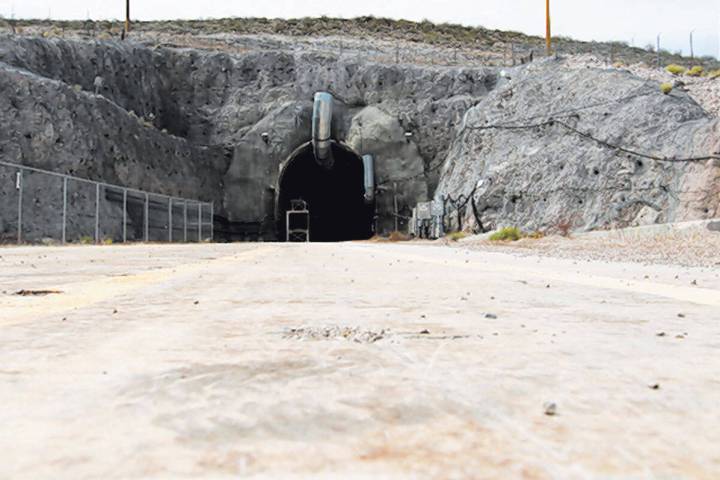
DOE officials repeatedly have pushed back the date they expect to deliver 77,000 tons of spent, commercial reactor fuel and highly radioactive defense waste to the mountain, 100 miles northwest of Las Vegas. The repository opening date has slipped from 2010 to 2012 and most recently 2015.

The project encountered another stumbling block last year when a District of Columbia appeals court panel determined the Environmental Protection Agency's 10,000-year radiation safety standard did not cover peak dose periods hundreds of thousands of years into the future as recommended by a National Academy of Sciences.

EPA scientists are reconsidering the rule that required the Energy Department to show that nuclear particles escaping from a Yucca Mountain repository would not expose an individual to more than 15 millirems of radiation annually for a period of 10,000 years.

Stephens Washington Bureau reporter Tony Batt contributed to this article.


Advertisement


Contact the R-J | Subscribe | Report a delivery problem | Put the paper on hold | Advertise with us
Report a news tip/press release | Send a letter to the editor | Print the announcement forms | Jobs at the R-J

Copyright © Las Vegas Review-Journal, 1997 -
Stephens Media   Privacy Statement