Home Subscribe
Jobs Cars Homes Shopping Travel Weddings Golf Best of Las Vegas Photo
.
Member Center

Recent Editions
MTWThFSSu
>> Search the site
.
.
.
.
NEWS
.
.
.
.
.
.
.
Dec. 26, 2006
Copyright © Las Vegas Review-Journal


Retiring justice laments influence of money

But he's hopeful times are changing

By ED VOGEL
REVIEW-JOURNAL CAPITAL BUREAU

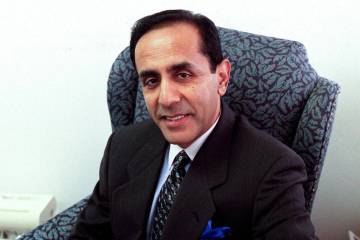
Supreme Court Justice Bob Rose will leave the high court on Jan. 1.
CATHLEEN ALLISON/SPECIAL TO THE REVIEW-JOURNAL

CARSON CITY -- Too many Nevadans hold the view that justice is for sale and only the rich can afford good lawyers, retiring Supreme Court Chief Justice Bob Rose says.

And that troubles him.

Advertisement


In leaving the state Supreme Court after 18 years, Rose laments that judicial candidates must go out and hustle campaign contributions from lawyers and others who eventually may try cases before them.

"I don't think money changes a judge's decision, but it gives a very bad perception to the average person," Rose said. "You have a lawyer who gave a judge $10,000, and you have a lawyer who gave nothing. Which lawyer do you want to make arguments for you? Does money talk? I don't believe so, but it does create the perception of impropriety to many people."

Twelve years ago, a task force chaired by Rose recommended voters approve the "Nevada plan," a process under which a merit selection committee would pick judges from a group of applicants. The judge they selected then would serve for two years.

After that time, the judge would run for re-election against all competitors. If the judge won that election, then in future elections he or she would run in a yes-or-no retention election.

Although the Nevada plan has gone nowhere, Rose, 67, is optimistic that times are changing and voters in the next few years will amend the state constitution and approve the process.

"I would like to see judges out of the money raising game," he said. "The Nevada plan doesn't do that entirely, but it reduces it a lot. Nevadans want to vote for judges. They still could vote in one contested election for each judge."

Soon after leaving office Jan. 1, Rose and his wife, Jolene, will fly to their home in Hawaii where he intends to spend two or three months forgetting about the law.

"Our home is something between a shack and a cottage," he said. "Right now they are fixing it up so it is inhabitable when we get there. It is nothing special, but it is special to us."

He wants to kayak, snorkel and walk along the beach.

Then they will return to Carson City and their home in a wooded area of the city. The home narrowly escaped a raging wildfire in July 2004.

"It was horrendous. I told Jolene to prepare yourself. We had to stay in Motel 6 with two little dogs, our pictures and keepsakes. They were the only place that would take pets. Then they (firefighters) backfired the fire and stopped it. We were so lucky."

In retirement, Rose intends to serve occasionally as a senior judge and District Court meditator. As a retired justice, he is eligible to handle court cases for an hourly fee. But he emphasizes he won't work that much.

"I have the usual problems of age," he said. "That is part of the reason I am retiring. I wanted to leave a little bit for Bob Rose while I can still climb mountains, though slowly and carefully."'

Carl Tobias, a law professor at the University of Richmond, said Rose has a reputation in the judicial community for being a straight shooter.

That was apparent last summer when the Los Angeles Times printed its "Juice vs. Justice" series. The stories suggested Nevada judges would make rulings to benefit lawyers who contributed to their campaigns.

Rose did not dodge reporters. He answered their questions. And he still maintains the newspaper did not uncover any case in which a Nevada judge made a decision as a favor to a lawyer who contributed to his campaign.

"He always has been candid," said Tobias, a former professor at Boyd Law School. "That is the most refreshening thing about Rose. He cared about the court and court administration and justice."

Rose worries the middle class today finds it increasingly difficult to get adequate representation when faced with a legal emergency.

"Paying a lawyer $200,000 to defend yourself against a serious crime is not an uncommon fee," Rose said.

"Nowadays the average person is being priced out of the legal market. Indigents are represented by public defenders. The corporations can afford to play the game full-time, all the time. But the middle class is being priced out of the legal market. It is really unfair."

That Rose should be worried about fairness should be no surprise. As lieutenant governor in 1977, he broke a 10-10 tie in the state Senate and cast a vote for the Equal Rights Amendment, saying he thought it was the fair thing to do.

Nevadans were particularly conservative at that time, and Rose said the vote hurt him politically. The following year Rose, a Democrat, was trounced by Republican Bob List in the governor's race.

"I did not run one negative commercial," Rose said. "There were tons against me."

Rose said he knew three weeks before the election that List, then attorney general, had been taking free rooms and food at the Stardust and still billing the state for those expenses. Rose never mentioned it publicly.

List contended what he did was a common practice and not illegal, but he paid the state back $3,124.

"It sounds very naive today, but I thought people should be elected on their positives and their programs," Rose said.

Although losing the governor's race was disappointing, Rose said he got over it in about three months and returned to what he was trained to do, practice law.

Then in 1986, Gov. Richard Bryan appointed him to fill a judicial vacancy on the District Court in Las Vegas. Two years later, he won the first of two bitterly negative state Supreme Court races against Myron Leavitt.

Their races were among the most vulgar in state history. Rose decided to resort to negative campaigning because he learned from the List race that nice guys don't win in Nevada politics.

"I was from the naive school of politics when I started, and I grew up real fast," Rose said. "I learned you need a lot of money and to use negative advertising when it was necessary."

Leavitt later won a state Supreme Court seat.

"I arranged a meeting with him to bury the hatchet," Rose said. "I said if we can't be friends, let's be polite and cordial. He agreed. When Myron was on this court, he was a pleasure to work with."

Reared in New Jersey, Rose graduated from New York University Law School. While in school, he decided he wanted to see the West and applied in the summer of 1964 for a job as a clerk for the supreme courts in Nevada, Arizona and New Mexico.

"Nevada wrote me back first," Rose said. "They say you have the job, but you must accept it in two weeks. I put everything I had in my Triumph and drove West. I was worried about making it through the desert. It looked pretty barren for someone from back East."

He passed the state bar a year later and became a Reno lawyer. Three years later, he was chairman of the state Democratic Party. At 31, in 1970, he was elected Washoe County district attorney and in 1974 he became lieutenant governor.

Rose chuckles on how he ended up as a lawyer in Clark County. Mike O'Callaghan was governor. He insisted the lieutenant governor move to Las Vegas.

"He said one of us is going to live in Las Vegas and it is not me," Rose recalled.

In looking back on his service on the state Supreme Court, Rose regrets most the fighting between members of the court in the mid-1990s when one faction interceded to block moves to discipline Washoe District Judge Jerry Carr Whitehead.

Whitehead later would resign to avoid federal prosecution over a disciplinary matter that never has been publicly revealed.

But not before Rose and other court members engaged in some ugly exchanges with fellow Justices Charles Springer and Thomas Steffen. Rose said he still does not talk with either Springer or Steffen, other than saying 'hello' when he sees them.

"We are supposed to be reasonable and collegial, but in that period, we were anything but collegial," Rose said. "The appropriate court procedures were not being followed (by Steffen and Springer). The court was thrown into chaos."

If he had to do it over again, Rose would not have voted with the majority in the 6-1 decision in July 2003 that suspended the constitutional requirement that tax increases need at least a two-thirds affirmative vote of the Legislature.

The decision, sought by Gov. Kenny Guinn, led to the Legislature approving a record $833 million tax increase, purportedly needed to pass the state school budget.

"In retrospect, we should have done it differently," Rose said. "We should have waited, put pressure on the Legislature to act and deferred it for two weeks to see if they could agree."

Earlier this year, the court admitted its mistake and reversed its decision setting aside the two-thirds requirement.

Rose said the court was pushed into lifting the two-thirds amendment by affidavits from educators that the public schools were at a crisis point, teachers were leaving and new teachers could not be hired.

"We may have been motivated by the need to do something rather than by the law. We took what that said to heart and believed what we were told."

He hopes he will be remembered for bringing the state Supreme Court into the modern age. When he became a justice, the state Supreme Court had no computers.

So he brought up the need for computers during a meeting of the justices. Quickly he was appointed head of a committee to look at improving court technology.

After computers were installed, Rose then started looking at how courts were tracking their records.

He noticed one district judge in Reno handled twice as many cases as the others. Rose learned that was because he counted sentencing hearings as separate cases.

It took time, but eventually the state Supreme Court established a uniform system for tracking cases throughout Nevada.

"It turned out to be the best project we did. Now we have reliable statistics. We can show how the courts are doing. It is a great tool for public accountability."

Rose said working as a district attorney was his most exciting job, prosecuting several people on murder charges in Reno.

As a district judge in Las Vegas, one of his more high-profile trials involved the 1988 case of Robert Weeks, convicted of the murders of two women whose bodies were never found.

Rose said serving on the state Supreme Court has been the most satisfying experience of his legal career.

"This job is like quicksand. The job is never done. But it is a job I wanted from the day I clerked here. I loved it."


Advertisement


Contact the R-J | Subscribe | Report a delivery problem | Put the paper on hold | Advertise with us
Report a news tip/press release | Send a letter to the editor | Print the announcement forms | Jobs at the R-J

Copyright © Las Vegas Review-Journal, 1997 -
Stephens Media   Privacy Statement