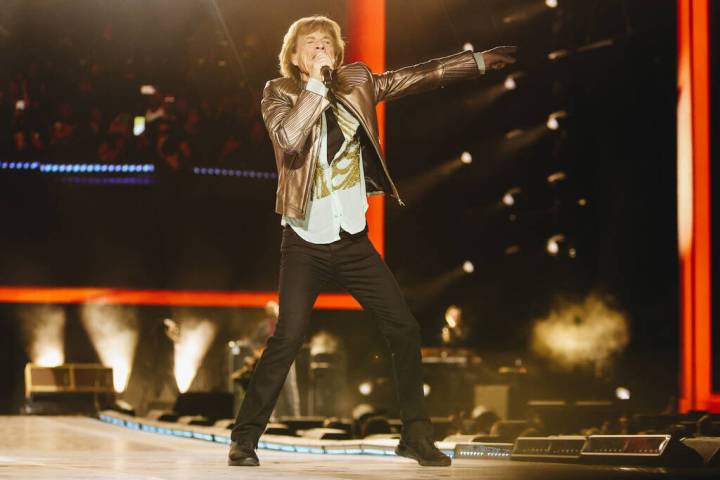
Katrina Rose Dideriksen, who portrays Tracy Turnblad in "Hairspray," poses at the Black Box Theater on the campus of the University of Nevada, Las Vegas. The musical opens for previews Feb. 6 at the Luxor. Photo by Clint Karlsen.
After moving to Las Vegas for separate show business pursuits, Myron Martin, center left, and Michael Gill, posing with the "Hairspray" cast, licensed the Broadway hit and found investors for a Las Vegas production. Photo by Ralph Fountain.
Broadway producers "used to fight movie releases tooth and nail" because they thought a movie would kill the stage show's box office, says Tom Viertel, one of the real producers behind "The Producers." But movie studios are now investing in Broadway titles and musicals are adapted from movies. When the movie adaptation of "The Producers" opened, the stage production shared in the synergy from "a great big billboard (in Times Square) that we didn't pay for."
The "Hairspray" cast rehearses on the UNLV campus for a Feb. 6 opening at the Luxor. Original Broadway director Jack O'Brien and choreographer Jerry Mitchell came to town to oversee the slightly shorter Las Vegas version. Photo by Ralph Fountain.
Ads for "Hairspray," seen in Times Square, above, and for the Luxor, below, suggest some Broadway titles have become "an internationally known brand" through touring and/or familiarity with a movie version, says the title's co-producer, Myron Martin. The two entertainment districts are still worlds apart in their culture. In Las Vegas, "shows are part of the evening. They're not the only aspect of the evening," notes "Avenue Q" producer Kevin McCollum. Photos by Mike Weatherford.
How obvious did it have to be? Did a Broadway show have to put up a backdrop of the Excalibur hotel? Stage a production number with showgirls and an overhead roulette wheel?
That sequence comes 10 songs into "Monty Python's Spamalot," but Steve Wynn says he didn't need that much time to consider the show for his hotel.
Advertisement
The casino developer says the night he saw "Spamalot" on Broadway, he sat between top-Python Eric Idle and his wife, Tania, and joked about whether he would offer them a ride to the West Coast in his corporate plane. He told them, "I think I'll wait until after the first act to decide."
"About four minutes into the show, I punched (Idle) in the ribs and said: 'OK, you're invited. I'll take you home.' "
Next year, Wynn will bring "Spamalot" to a new home at Wynn Las Vegas. By then it could be the fifth or sixth Broadway musical on the Strip. That assumes the continued success of "Mamma Mia!" and that "Avenue Q" finds its land legs, that pending productions of "Hairspray" and "The Phantom of the Opera" open as scheduled and
take root, and that rumors of "The Producers" heading to Paris Las Vegas prove true.
If all six titles are open at the same time, Broadway musicals would surpass the number of Cirque du Soleil productions on the Strip. (The fifth Cirque show will open in late May at The Mirage.)
There's even an "off-Broadway" move at the Las Vegas Hilton, with the arrival of "Menopause, The Musical" next month and "Dragapella" in March. They join "Forever Plaid" at the Gold Coast and the interactive "Tony 'N Tina's Wedding" at the Rio.
It all adds up to a seismic shift in Las Vegas entertainment, albeit one full of jitters. The shaky status of "Avenue Q" and the ho-hum reaction to a non-Broadway musical, "We Will Rock You," run counter to the big bets on the coming titles. But if the trend sticks, it has the potential to reroute the traditional course of a Broadway musical and rewrite the rules for both Las Vegas and New York.
MADE FOR EACH OTHER?
The Broadway-Vegas marriage appears to come at a pivotal time for both sides. The Strip appears to be bankrupt for new show ideas. New York has reached the point where costs have exceeded the physical limits of a historic, but aging theater district.
Both entertainment zones are sorting out the effects of corporate consolidation that's reshaping the entertainment industry on both fronts. Las Vegas is entering a new era of the megacorporation after a year of consolidation, and corporate players such as Clear Channel Entertainment are making heavy investments on both fronts.
"The idea that we talk about this thing we do as a product or as a brand is very new to the street," says Broadway producer Michael David.
Concert and big-name acts aside, the recent history of big Las Vegas productions has been a short story: Cirque, and more Cirque.
Casino-backed attempts to extend or reinvent old-Vegas spectaculars have been awkward ("EFX") to downright laughable ("Storm"). The latest original, non-Cirque project to be announced -- a multimedia production called "Aquaria" -- seems dead in the water. And when casinos back away from financial risk and let independent producers go it alone on sparse budgets, the result is, well, "Buck Wild," the campy topless cowgirl show at the Sahara.
"Vegas, like Broadway, has become a place where it's very risky to try out something new," says Michael Gill, co-producer of "Hairspray," which begins previews at Luxor on Feb. 6.
"With the Internet age and the way we communicate, the word is out on the street almost from your very first invited dress rehearsal, I would say. To workshop a production in full view of everybody has just become impossible in this town."
Nowhere was that more evident than with the early negative buzz about "Le Reve," the Cirque-like spectacle that opened at Wynn Las Vegas before it was ready. And considering that for a decade, Steve Wynn charted the course other casino heads followed, the bumpy path of "Le Reve" did not boost anyone's confidence.
"Las Vegas is not willing to take risks. That's why going from Broadway to here seems like a natural," says Gill. "Things come in pre-branded, or pre-proven. Casino execs can go to Broadway and see how things play in front of a real audience."
Factor in an estimated budget of $100 million for "Le Reve" -- producers have never confirmed a number -- and spending $35 million for the "Phantom" relaunch, on top of $40 million to build the theater, suddenly seems conservative.
And how does Las Vegas play on Broadway? David says it would be "an extraordinary thing for our little corner of the entertainment business to have yet another traffic stop to be added to our itinerary."
David is a partner in Dodger Theatricals, currently enjoying an overnight hit with "Jersey Boys," a musical biography of Frankie Valli & the Four Seasons with obvious Las Vegas appeal.
"Clearly the mother lode for a Broadway show can't be New York anymore," David says. "That's where you sort of sink the taproot as deep as you can, and hopefully find people who are interested. ... And then you try and proliferate out."
Dodger operates out of casual, loft-style office space near Dodger Stages, a complex of five small theaters for off-Broadway fare that his firm opened in late 2004. David's bushy, mountain-man beard is at odds with his thoughtful demeanor when he says, with barely a smile, that he is involved in "a most speculative business in a very dangerous, unwelcoming, expensive city."
"If shows are children," he says, "it's no place you recommend someone raise their children."
In Las Vegas, a show commands a $100-plus ticket only if and when it can get away with it. On Broadway, ticket prices are dictated more by union contracts and the historic, landlocked theaters.
"You can't add another performance or add 200 more seats," David explains. "Your store opens eight times a week at these specific times and can only have this many customers, no matter how good you are."
Las Vegas, he says, has "the latitude to respond to the world now, as opposed to trying to fit now into a world formed 50 years ago."
The relaunch of "The Phantom of the Opera" at The Venetian will turn around 10 weekly performances in a 1,820-seat theater -- essentially the same as its Broadway home -- designed by popular architect David Rockwell.
Rockwell also did the original stage design for "Hairspray," but says the "Phantom" theater combines set design with the architecture of a real building project, such as his firm's Kodak Theatre in Hollywood.
The Majestic Theatre, where "Phantom" runs on Broadway, already drips with drafty atmosphere compared to any venue on the Strip. That atmosphere will have to be created here in a space formerly occupied by the Guggenheim museum. But Rockwell will use that space to surround the audience with special effects and action.
"For me the most interesting part of theater is the relationship between the audience and the performer," Rockwell says. "In creating a theater, you get to mold essentially, out of raw clay, what that relationship's going to be. That's an interesting thing you don't get to do on Broadway."
RISKY BUSINESS
This courtship sounds rosy, but there are a few stumbling blocks. Not the least among them is Broadway's shrinking influence in the larger entertainment world and its 80 percent to 90 percent failure rate.
"Success means you make your money back," David explains. Economic pressures stemming in part from soaring ticket prices "may mean that 80 percent of the shows don't recoup, and the 90 percent (figure) might mean that 10 percent make a dime on top of their recoupment."
In New York, spending nearly $12 million to open a "Spamalot" is fine if it breaks house records and grosses $1.1 million to $1.4 million per week. But to spend $15 million to open "Chitty Chitty Bang Bang" and then struggle to keep up with the weekly operating budget, usually between $400,000 and $600,000, can mean the show will close after eight months, as "Chitty" did at the end of last year.
Until fairly recently, musicals had become so much the stereotypical province of women and gay men that Tom Viertel, co-producer of "The Producers," was excited to find his title scoring high with women in focus groups.
"Not that they were all that excited about seeing 'The Producers,' " he notes. "But they said, 'We can get our husbands to see it.' I like 'Spamalot's' chances in Las Vegas for that reason.''
Broadway's answer has in large part been the movies. "Hairspray," "The Producers" and "Spamalot" are all movie spinoffs, launching with a huge head start in familiarity.
Viertel argues that branding is less calculated, because "The Producers" and "Hairspray" -- and arguably "Spamalot" -- are based on cult movies. "Finding a good story has always been challenging," he says. "And almost always, musicals have been based on something else, from the days of 'Oklahoma' " (considered the first "modern musical" in 1943, it was based on a 1931 play, "Green Grow the Lilacs").
Viertel's group also backed "Hairspray" on Broadway and is interested in placing more titles on the Strip, but only if the casinos pony up as partners: "It doesn't really work out there unless the casinos are willing to get behind the project."
Michael Gill and Myron Martin agree. The two met as Spanish Trail neighbors after moving here for separate show business endeavors in the late '90s. That was about the time, Gill says, "smart casino executives realized they wanted producing partners from the entertainment industry."
Now Gill and Martin are licensing "Hairspray" from the New York producers, raising outside money for their end of a production that will be an equal partnership with MGM Mirage.
On Broadway, theater landlords such as the Shubert organization, which operates 17 houses, long ago quit putting up half or more of a show's capitalization costs. The shows are basically tenants, so "all of the expenses become yours (the producer's) and the assets that attach onto the show become theirs," David says. "It's parasitical, that's what it is."
But in Las Vegas, owners of a hot title can at least get the casino to finance the physical installation and share marketing costs, sometimes even backstage costs such as stagehands.
"I am not anti-union on any level," says "Avenue Q" co-producer Kevin McCollum. But unionized stagehands in New York have not responded to "the modern-world day of how technology can help. You have a load-in where everybody has to come at the same time, which (means) you physically and metaphorically start tripping over each other. ...
"I keep saying, 'Lets get smart folks.' And Vegas is very smart about that."
But, Gill says, "coming from Broadway (where he was company manager of 'Phantom'), you learn very quickly you must support and assist the casino in their overall goals if you expect that philosophy to be reciprocal."
Adds Martin: "In New York, if there's a theater available, it's yours. Here, shows have to fit within the demographic."
Casinos and creators also are grappling with the prevailing opinion on the Strip that titles need to be trimmed to 90 minutes to compete with gambling and nightclubs. Earlier this month, "Avenue Q" producers cut the show and eliminated the intermission, but did not lower ticket prices.
And then there's the issue of exclusivity, or lack thereof. An oft-repeated theory about a 2000 run of "Chicago," with middling results at Mandalay Bay, was that visitors decided they could see "Chicago" elsewhere, but not "O" at Bellagio.
On the other hand, some now wonder if Wynn's semi-exclusive -- outside New York -- deal for "Avenue Q" robbed the title of advertising exposure California tour stops would have provided.
"The more you proliferate, the more you can justify the foolhardy thing this is," says David, with a trace of a smile. "Because this is foolhardy. If nothing else, this is a really stupid thing to do for a living."
Broadway producers "used to fight movie releases tooth and nail" because they thought a movie would kill the stage show's box office, says Tom Viertel, one of the real producers behind "The Producers." But movie studios are now investing in Broadway titles and musicals are adapted from movies. When the movie adaptation of "The Producers" opened, the stage production shared in the synergy from "a great big billboard (in Times Square) that we didn't pay for."