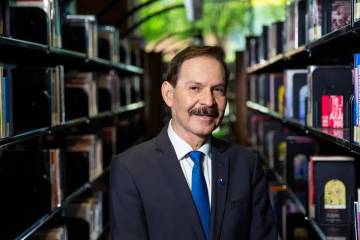
Dana White, 36, president of the Ultimate Fighting Championship, is a driving force behind the rising popularity of mixed martial arts. Photo by Ralph Fountain.
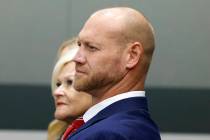
Ultimate Fighting Championship president Dana White sits ringside for the Jorge Gurgel-Mark Hominick lightweight bout on the Anderson Silva-Chris Leben undercard at the Hard Rock on Wednesday. White, a Las Vegas native, possesses such passion for mixed martial arts that he agreed to a three-round gym fight against Tito Ortiz in his successful quest to lure the light heavyweight star back to the UFC fold. Photo by K.M. Cannon.
Contract negotiations in big business can be unpredictable, says Lorenzo Fertitta, the owner of the Ultimate Fighting Championship. It's often difficult to predict where they'll lead.
But even by those unpredictable standards, the UFC was taken aback by an unusual demand when it was bidding to re-sign star light heavyweight Tito Ortiz.
Advertisement
After an acrimonious split with the UFC, Ortiz was negotiating with several other mixed martial arts organizations. But the UFC -- specifically its president, Dana White -- didn't want to see Ortiz wind up with one of its rivals, and White, 36, made it his mission to recruit him hard.
But Ortiz presented a demand that is likely unprecedented in professional sports: He wanted to fight White.
Three three-minute boxing rounds between him and White, Ortiz demanded, or he would sign elsewhere.
White, whose passion and drive built the UFC into a sport that is challenging boxing as the pre-eminent combat sport, didn't hesitate.
"Never a doubt I'd say yes (to fighting Ortiz)," White said, chuckling. "Hey, I know Tito probably has a few things he wants to take a shot at me about, but you know what? There are a lot of times when I've really wanted to smack him, so we both win."
Ortiz will fight Ken Shamrock on Saturday at Mandalay Bay in front of what will be another sellout crowd and a multimillion-dollar live gate for the UFC. A few days later, Ortiz will return to Las Vegas, find a gym, strap on a pair of gloves and get the chance to beat the tar out of his boss.
Is this a great country or what?
"Nothing Dana does, has done, or may do, would surprise me," said Brian Diamond, senior vice president for sports and specials at Spike TV, which broadcasts six UFC-related shows.
White is a businessman who eschews the norm and runs counter to conventional wisdom. He agrees to box an employee who happens to be a professional fighter. He is the creator and executive producer of six shows on Spike and stars in one of them.
He averages less than four hours of a sleep a night, which is good because it gives him more time to indulge his passion for the sport. He challenges those who denigrate it and cajoles those who show even the slightest interest in it.
White could easily run a Fortune 100 company and produce similar results, said Fertitta, whose gaming company, Station Casinos, is among the world's most successful.
White doesn't have a college degree -- he briefly attended the University of Massachusetts and a junior college he can't remember -- but his idea of studying was poring through the pages of "The Ring" magazine.
"Hell, forget about college," White says, "I barely finished high school."
He started at Bishop Gorman, where he became a casual acquaintance of Fertitta, but he was disinterested in class. White concedes he was a screw-up and said, "I wasn't a good kid, honestly."
He became so incorrigible, he said, his parents yanked him out of Gorman and shipped him to tiny Hermon, Maine, to live with his grandparents. It was a town of less than 5,000 residents whose biggest attraction was the Ecotat Gardens and Arboretum. To his parents' chagrin, White was little different in Maine than he was in Las Vegas.
"I wasn't doing a lot different than any of the other kids -- fighting, hanging out, that kind of stuff -- but I was the one who got caught," White said. "That was my problem. I was just too stupid not to figure a way to avoid getting caught. But school wasn't really for me. It bored me."
He developed an abiding love for boxing, though, and his fertile mind was churning out ideas for ways to indulge his passion.
After he graduated from Hermon High School and gave up on college, he bounced around to odd jobs. He was a bouncer at a bar in Boston, paved roads in what he calls "to this day the hardest and most demanding job I've ever had," and became a bellman at the Boston Harbor Hotel.
He was making $60,000 a year as a bellman, a fortune to most street-tough 21-year-olds in Boston in 1990, but not nearly enough for White to accept the interminable boredom the job brought on.
"You'd make 50, 60 grand a year depending on the year, but it would never get better than that," White said. "I was making that money at 20, 21, but there were guys in their 50s who had been there for 20-some years who were making the same money. It never changed."
White's desire to be a part of boxing gnawed at him, so much that one day he quit his job on the spot.
The snap decision was the springboard to a career that enriched him beyond most people's wildest dreams -- he and his wife recently bought a $2 million home in Las Vegas -- but he was left with no job, no prospects and nothing but his wits to plot his future.
"I loved the gym and being in boxing, and wearing that (bellman's) uniform and doing that job wasn't me," White said. "I had to get out of there and figure a way to get into boxing. It was going to be the only way I'd really be happy."
He opened a gym in South Boston with a friend, Peter Welsh. He operated on the periphery of the boxing scene, managing to get close enough to the big time frequently enough to whet his appetite for more.
White left Boston to return to Las Vegas, where he quickly opened three boxing gyms and taught a boxercise fitness class at several clubs.
Things finally started going White's way when he met light heavyweight contender Derrick Harmon, who was in line for a shot at then-champion Roy Jones Jr., one of the biggest names in his sport. White offered advice to Harmon, who -- surprising even White -- began to listen. It wasn't long, he said, before he was essentially negotiating the contract for Harmon to fight Jones.
Not long after, White was hanging out at the Hard Rock with Frank and Lorenzo Fertitta. They ran into John Lewis, who was fighting in the UFC and spoke glowingly of mixed martial arts. White and the Fertittas were captivated.
Soon Lewis was taking White and the Fertittas to the gym, where he began to train them. White quickly got hooked.
"It was the future. I knew it," he said. "I could see that if this was done the right way, if someone didn't run away from regulation but embraced it, if someone cleaned it up and shined it a little, this thing could be huge."
The UFC was hemorrhaging money and its owner, Bob Meyerwitz, was under siege. Powerful politicians such as Sen. John McCain (R-Ariz.) were angling to ban the sport.
McCain called it "human cockfighting." Meyerwitz kept conducting UFC cards in states without athletic commissions that would not regulate it, which only fueled the sport's outlaw reputation and further angered McCain.
White, though, saw an opportunity. In late 2000 he and the Fertittas agreed to purchase the organization, which was little more than a name and a collection of bills.
"We went to a fight and we said to each other, 'Hey, what if we did this?' or 'What if we did that?' and we all felt if we made some changes and embraced regulation, this had the potential to just go crazy," White said.
With otherwise locked doors opened for him because of the Fertitta name, White traveled the country like a carnival barker, pitching the UFC to state regulators, media, advertisers, television networks and fans.
It wasn't long before New Jersey and Nevada approved the UFC and agreed to allow mixed martial arts fights, leading to nearly every major boxing state approving it.
But the UFC continued to lose money in the early years of the Fertitta-White ownership, and White concedes the thought crossed all the partners' minds that the end was near. But he never lost faith.
"If it died, it died," White said. "I wouldn't have looked at it like a mistake. It would've been right idea, wrong time."
But with the one-man band named Dana White working 20-hour days, crisscrossing the country and pitching the fact that mixed martial arts wasn't human cockfighting -- "There has never been a serious injury or death in the UFC, and I know boxing can't say the same," he says -- the organization's fortunes improved.
Better athletes joined. Sponsors began to give it a chance. And Spike TV, looking for a sport to add to its male-targeted channel, bit on White's concept of a reality show.
It was taped in 2004, and the concept was simple. Two teams of fighters would live and train in the same house and compete for a title, with White along to prod and agitate at every step. Each week, fans could get to know a fighter personally and see a fight at the end.
Surprisingly, perhaps, to everyone but White, viewers loved it. Ratings were good from the start but quickly shot up into unheard-of levels.
"The reality show really was the vehicle that allowed us to present our product the way we wanted it, and we found that there were a lot of people out there who shared our vision," Lorenzo Fertitta said.
Today, the UFC routinely outdraws boxing in live gates, its pay-per-view sales match or exceed the best boxing events and its TV ratings are astounding even the most critical industry analysts.
The televised live finals of "The Ultimate Fighter" on June 24 from the Hard Rock went head-to-head against a NASCAR Busch Series race on FX. According to ratings by Nielsen Media Research, the fight drew 2.8 million viewers, and the race attracted 1.4 million. The UFC show attracted more men in the age-18-to-49 demographic than any other cable or broadcast channel in that time slot.
The reason behind UFC's success, Diamond said, is the unbridled passion White brings to it.
"I get phone calls all hours of the day and night from Dana," Diamond said. "He'll e-mail me or text (message) me at any time, just as easily at one in the morning as one in the afternoon. If there were 500 days in the year, he'd work at least 499 of them."
Because his hobby is work, White is having fun even when he's pulling an all-nighter. He's a fight-addicted workaholic who can't imagine having a better job.
"I don't do anything. I don't enjoy anything. I'm dying if I have a day off, so I don't take days off," White said. "If I'm not spending time with my family, then there is nothing I would want to do. No games, no hobbies, no special interests.
"This company, those fighters, this job, they're my hobby. This is my life. It's my everything."