A battle between two local developers for control of a vast swath of property in New Mexico points to a potential new hotbed of residential development in the Southwest.
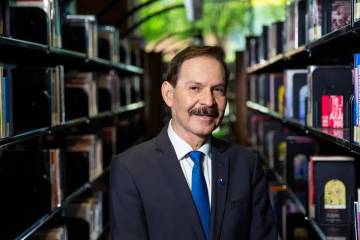
The contenders: James Rhodes, developer of Southern Nevada's Rhodes Ranch and Tuscany master plans, and Garry Goett, who created the Southern Highlands community and recently co-purchased 2,675 acres of North Las Vegas property from the federal Bureau of Land Management.
Advertisement
The prize: nearly 60,000 acres west of Albuquerque, N.M.
In September, according to filings with the Securities and Exchange Commission, Goett's ANM Holdings offered $200 a share to buy the public Westland Development Co. of New Mexico, a landholding entity with 57,000 contiguous acres of Albuquerque-area property under its purview.
In February, Rhodes' Sedora Holdings bested the ANM proposal, committing to $255 a share for Westland. Given Westland's 795,000 outstanding shares, Sedora will have to pony up about $200 million to close the deal.
Sedora's offer works out to about $3,500 an acre for Westland's property -- a steal compared with the $600,000 to $1 million per acre many builders now pay for developable land in the Las Vegas Valley. The Westland tract is more than twice the size of the 22,500-acre Summerlin community, Southern Nevada's largest master plan; it's bisected by Interstate 40 and sits just west of Albuquerque's central business district.
Through a spokeswoman, Rhodes said it's too soon to discuss plans for the acreage. He added that the acquisition is "consistent with and supplements Sedora's overall expansion plans into other Western markets," such as northern Arizona, where Rhodes plans to build 131,000 homes on 20,000 acres south of Hoover Dam.
Watchers of New Mexico real estate say Rhodes' latest deal suggests that Albuquerque is the Southwest's next big boomtown.
"New Mexico and Albuquerque are being discovered, and it is our time in the sun," said Jim Folkman, executive vice president of the Home Builders Association of Central New Mexico. "We are enjoying the same sort of growth in relative terms and percentages that Las Vegas, Phoenix, Denver and other high-growth areas have experienced."
Folkman noted that public builders, including Beazer Homes and Pulte Homes, have recently entered the Albuquerque market. In addition, Forest City Enterprises, a co-developer of Henderson's Seven Hills master plan and owner of the Galleria at Sunset mall, is building out 9,000 acres of the 12,900-acre Mesa Del Sol master plan in southeast Albuquerque.
David Murphy, publisher of SalesTraq Albuquerque, said prospects for growth are behind the flurry of construction activity.
"It's not as expensive to build here, and I think builders are naturally flowing with where they see both demand and a broader market for affordability," Murphy said. "In Las Vegas, affordability may have pushed its limit."
Albuquerque, which adds about 10,000 new homes a year, wasn't left behind in the national appreciation rise in 2004 and 2005; Murphy said home prices there have risen 50 percent in the past two years.
Despite the increased values, Albuquerque remains significantly more affordable than Las Vegas. Folkman said the median new-home price in Albuquerque was $192,000 in the fourth quarter. That compares with about $313,000 in Las Vegas at the end of 2005, based on data from SalesTraq. Steve Bottfeld, an analyst with real estate research firm Marketing Solutions in Las Vegas, said buildable land in Albuquerque is widely available for less than $40,000 an acre.
"Land prices are extremely reasonable, particularly if you compare them to prices in the three major markets that are sending in buyers and builders: Southern California, Las Vegas and Phoenix," Bottfeld said. "Albuquerque is not yet on the radar screen of most people, but it is the next big market."
Folkman said an expanding job base will propel Albuquerque's growth.
The 800,000-resident market's overall employment growth in 2005 was 1.7 percent, substantially lower than Las Vegas' 7 percent. But Intel has added a $2 billion wing to its existing Albuquerque fabrication plant, and Eclipse Aviation recently announced plans to build a manufacturing plant with as many as 2,000 workers. Mattress maker Tempur-Pedic is opening an Albuquerque factory with around 1,000 employees, and Merillat Industries is planning a 500,000-square-foot plant that will employ up to 700.
"We don't have a single economic driver like you do in Las Vegas (with the resort sector), but we have growing diversity in manufacturing and job growth," Folkman said. "Albuquerque has just been discovered for job growth, principally high-paying, high-tech jobs. We're seeing a huge shift in terms of employment."
But Bottfeld said salad days in Albuquerque don't mean an end to good times for development in Las Vegas.
"The developers who are expanding to Albuquerque are still focused on Las Vegas, but remember, you have to go where the opportunity is," he said. "They're looking around and asking where they can expand to. They're not going to diminish the resources they've applied to the Las Vegas market. Investing in Albuquerque is something new and additional to their Las Vegas developments."
Bottfeld said that the nature of development in Las Vegas is changing from an emphasis on single-family subdivisions to a concentration on high-rise and mid-rise projects, which offer greater returns on high land prices. For single-family builders unacquainted with vertical construction, Albuquerque, with its undeveloped suburban areas, could be more attractive in coming years.
The Sedora deal has to clear a key hurdle before the company can complete its land purchase.
Westland's holdings are composed of parts of the Atrisco land grant, a 17th century gift from the Spanish monarchy to New Mexico's settlers. Westland's 6,000 shareholders include heirs to the property, and two-thirds of them must approve the Sedora sale for it to close. Murphy said some descendants would like to see the Atrisco land stay vacant; a Web site, concernedheirsofatrisco.org, posits arguments that the property is worth at least $1 billion, and shouldn't be sold for less.
Murphy said it's difficult to determine if most of Westland's stockholders are on board with the Sedora buyout.
The greater Albuquerque community, however, shares a consensus about the land's fate, he said.
"The general sentiment is that it should be a thoroughly planned development, rather than a place where they throw up subdivisions willy-nilly and try to catch up on infrastructure after the fact," Murphy said. "I think the desire is to see a development with integrated styles of housing and mixed uses."