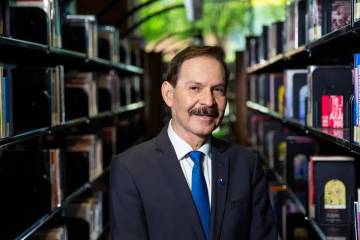
Steven Oshins said he never planned to be a lawyer; he wanted to be a chief executive or a fund manager. But Oshins became a fast success at law once he became a lawyer. He earned legal network Martindale-Hubbell's highest peer-review ratings for ethics and legal ability at age 29. Photo by Jane Kalinowsky.
Steve Oshins was on his way to a career in business when a stopover in law school changed his plans for his future.
Oshins joined his father's estate planning firm, the Law Offices of Oshins & Associates, immediately after he finished law school in 1994. Oshins quickly found his niche, leading dozens of seminars on protecting assets and writing numerous articles in trade publications. He earned legal network Martindale-Hubbell's highest peer-review ratings for ethics and legal ability at age 29, an early accomplishment Oshins attributes partly to his visibility in the estate-planning arena.
Advertisement
In 2005, the Nevada Legislature passed a bill that Oshins coauthored to create dynasty trusts, which are protected from estate taxes, creditors and divorcing spouses until the trust expires. In Nevada, dynasty trusts can continue for up to 365 years, therefore keeping a family's wealth intact for generations. Oshins' work on dynasty-trust law in Nevada has netted him national media attention, including mentions in the Wall Street Journal, Forbes magazine and on NBC News.
The Review-Journal recently asked Oshins how businesses can help write laws, why people choose dynasty trusts and how professionals can avoid the biggest mistakes in estate planning.
Question: How did you settle on law as a career?
Answer: Initially, I did not intend to be a lawyer. I went to law school with the intent of using that as a steppingstone to get a (master's in business administration) and be a CEO or manage a mutual fund or hedge fund. But I liked the law and I learned my trade very quickly.
Question: Why did estate planning specifically appeal to you?
Answer: It was a natural extension of what my dad was doing. Secondly, I was an actuarial statistics major in college, so I've always been a mathematics- and finance-oriented person, rather than the typical political science or communications major who goes to law school. Estate planning relies on having a feel for all the moving parts, and if you're not a math-oriented person, it's hard to develop the skill of following cash flows and selecting the appropriate (planning) techniques.
Question: You developed a 365-year trust in the state of Nevada. Why did you think that concept would be useful to people?
Answer: Most trusts make outright distributions to the client's children upon reaching certain ages. That method includes the inheritance in the child's estate for tax purposes, and it can also be taken by creditors and is subject to being taken in a divorce. Rather than distributing the inheritance at those staggered ages, we draft the trust to give the beneficiary direct control upon reaching a certain age. It keeps the assets from being subject to creditors or divorce and to a great extent, it keeps the assets out of the child's estate at death.
Question: Does it negate the need for other estate planning tools?
Answer: It is the backbone of the estate plan, but it's not the end all-be all, because every client has a different set of facts. If people already have significant assets, then they need to use various leveraging techniques or income tax-saving techniques. But their estate plan should focus on the beneficiary-controlled dynasty trust.
Question: What are the most common ways you see people looking to protect their wealth?
Answer: For wealth that will be received by an inheritance or a gift, the dynasty trust is the most popular method of protecting those assets. For wealth that is already owned by the individual, that person cannot set up dynasty trust for himself or herself. Therefore, that person will look at another technique called a Nevada asset protection trust, which is very similar to an offshore trust but is set up under Nevada law. Assets in a Nevada asset protection trust are sheltered from person's creditors generally beginning two years after transfer to that trust.
Question: What are the biggest mistakes people make in protecting their assets?
Answer: One of the mistakes I see very frequently is in business planning. Very often a client will ask an attorney for help setting up a new business, and the attorney will either create a formal corporation or a limited liability company and not ask any other questions.
But attorneys who do that are missing out on a great opportunity. They should ask whether the client has a parent or grandparent who would be willing to set up a 365-year dynasty trust and make a small gift of maybe $1,000 into that trust so the client could form the new business as an asset of the trust. That would place the business outside that person's estate so it's credit- and divorce-protected. Even in a community-property state such as Nevada, that business would not be part of the marital estate if there's a divorce. Dynasty trusts are something even family attorneys should be implementing.
Question: Who is your typical client?
Answer: Our typical client has a net worth between $10 million and $100 million and tends to be a business owner or a real estate investor. We do have a few billionaires, and we also have a number of clients with assets under $1 million -- people such as young doctors. Generally, our clients have creditor-protection needs and estate-tax issues. Because they tend to own businesses, that can increase their liability issues.
Question: What kinds of growth plans do you have for your law firm?
Answer: Right now, we have five attorneys. That will increase to seven attorneys after September. In the short term, I believe we will increase by approximately two attorneys per year. We have grown at a slower pace than we could have, because we didn't want to sacrifice quality for quantity. I can't throw a young attorney into a large estate without supervision until I am 100 percent positive that the attorney is trained to be nearly a clone of myself. So we're taking it very slowly. We're constantly swamped, but I feel good about the work that gets out and I feel we haven't sacrificed quality. I would eventually like to have an army of 100 superstar estate planners in our firm, if that's possible. There's no other firm out there like that.
Question: How's hiring?
Answer: It's very difficult. Every attorney we have hired has been from out of state. I look for people who want to be in prestigious firms and who want to be superstars in estate planning. You can't just hire someone who's happy to be an attorney. You have to hire someone who looks at being an attorney as just one step on the way to being a great attorney. You can't teach them to have that spark if they don't have it when they come to you. So I hire more on their heart and their technical skills than what school they attended, because that does not tell me a thing about how they're going to do in advanced estate planning.
SPONSORED LINKS
VITAL STATISTICS
Name: Steven Oshins.
Position: Member and chief executive officer, the Law Offices of Oshins & Associates.
Family: Wife, Michelle.
Education: Bachelor of science in actuarial statistics, University of California, Santa Barbara; law degree, McGeorge School of Law at the University of the Pacific.