Tonya'n LaBeaux browses through her case file Nov. 3 at the office of her Las Vegas attorney. LaBeaux claims she was cheated out of a seven-figure medical malpractice lawsuit in the 1999 death of her father, Frank Charles Molica. LaBeaux says her attorney at the time, Lawrence Davidson, settled the case without her permission for $187,500 and is on the lam while facing a federal warrant for his arrest. Photo by Jeff Scheid.
Frank Charles Molica
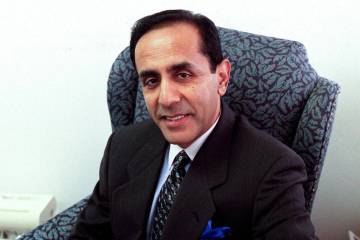
Lawrence Davidson
Attorney for Tonya'n LaBeaux wrote his wife: "I have done some very bad things."
Tonya'n LaBeaux has lost faith in the Nevada justice system.
Her lawyer is charged with forging documents that ended her $1.5 million wrongful death lawsuit against a Washoe County doctor and making off with the measly settlement he negotiated without her permission. So far, the courts have rebuffed her attempts to resurrect the case against the doctor.
Advertisement
Now LaBeaux, a California resident, is going after that attorney, Lawrence Davidson, who is charged with keeping the $187,500 settlement he negotiated.
But there is one snag in her last-resort effort to receive some compensation for her father's 1999 death: Davidson has vanished.
"I'm trying to sue Davidson personally because I have no other choice," LaBeaux, 42, said earlier this month. "Now he's gone."
LaBeaux is one of at least 17 people who say they are victims of Davidson, who was indicted by the federal government last year on charges he negotiated settlements without the knowledge of his clients and then deposited the money into his own bank account.
The government alleges Davidson illegally pocketed a total of $936,300.
Davidson was a no-show Oct. 30 for the first day of his trial. U.S. District Judge Roger Hunt issued a warrant for his arrest.
That does little to appease LaBeaux.
"You know what? I have no faith," she said.
Daniel Albregts, Davidson's attorney, repeatedly has refused to comment on his client.
LaBeaux's ordeal began on July 4, 1999, when her father, Frank Charles Molica, wrecked his off-road motorcycle during an outing near Truckee, Calif. He was airlifted to Washoe Medical Center about 5 p.m. The next morning, his primary physician released the 60-year-old from the hospital. Within seven hours, Molica was dead.
According to a coroner's report, Molica had nine rib fractures as well as lacerations to his lungs. Severe bleeding in his chest triggered a heart attack, LaBeaux said, citing the report.
"I talked to him that morning and said, 'Daddy, what do you mean they're releasing you?' " LaBeaux said.
"We had a strong case. We had a slam-dunk case," LaBeaux said of the $1.5 million lawsuit filed against Dr. Alvaro Devia.
An investigation by the Nevada Board of Medical Examiners concluded in October 2005 that Devia erred in his care of Molica. It fined him $5,000 and ordered him to pay $8,176 to cover the costs of the disciplinary proceedings.
The board's ruling says Devia was "guilty of the failure to use the reasonable care, skill or knowledge ordinarily used under similar circumstances in the treatment" of Molica.
The board concluded that Molica was released "with a worsening condition."
Attempts to reach Devia's attorney for comment were unsuccessful.
LaBeaux first hired California attorney Robert Tessier in 2000. Because he was not licensed to practice law in Nevada, he contacted the personal injury law firm of Benson, Bertoldo and Baker. Davidson, at the time a member of the Las Vegas-based firm, accepted the case.
The District Court in Reno granted Tessier permission to work in concert with Davidson, giving him equal standing in the case.
"I anticipated at the time that I would be the primary attorney involved in the case for purposes of discovery and trial, but that local counsel would also serve to shepherd the case through the Nevada screening panel," Tessier wrote in an affidavit supporting LaBeaux's lawsuit.
The medical malpractice lawsuit against Devia and the Washoe Medical Center was filed in 2002. The medical center was later dropped and added to the list of witnesses after hospital personnel agreed to testify, LaBeaux said.
The case was scheduled to go to trial in August 2005. In the year leading up to her day in court, LaBeaux said, she was more determined than ever to see the case through.
"I'd told him (Davidson), 'I'm not going to settle,' " she said.
In the summer of 2004, Tessier became impatient with the pace of pretrial preparations. He e-mailed Davidson about the scheduling of affidavits and depositions.
In August 2004, Tessier received a notice from Davidson stating that the doctor had claimed bankruptcy and that his attorney filed a notice of stay, meaning Davidson and Tessier could not proceed with their case.
Tessier said he learned months later that Davidson fabricated the documents, forging the signature of the doctor's attorney.
On Sept. 3, 2004, Davidson e-mailed Edward Lemons, a member of the medical malpractice firm that represented Devia.
"I must tell you that my client wishes to have this matter settled by next Friday, Sept. 10, 2004," the e-mail says.
Four days later, Tessier, unaware that Davidson was negotiating a settlement, e-mailed Davidson and asked about a hearing date to lift the stay on the proceedings.
"I think the hearing is in about two weeks. After that I should have all the info," Davidson wrote back.
On Sept. 9, 2004, Davidson e-mailed Lemons to finalize their negotiations.
"Please allow this letter to confirm we have settled the above-referenced case for $187,500," Davidson wrote.
None of the parties has heard from Davidson since he signed the settlement agreement, but the attorney left a note for his wife in October 2004.
"I have done some very bad things to many people and if I stuck around, not only would I lose my license and probably go to prison, but I would not be able to ensure that" the children are taken care of, Davidson wrote, according to news reports. "The second option is to commit suicide, but frankly I've never been that interested in quitting."
That same month Davidson disappeared, his legal assistant called Tessier. She asked the attorney whether he knew Davidson had settled the case.
Tessier, the primary attorney on the matter, had no clue.
The release letter, typically signed by the client before the settlement is finalized, was signed instead by Davidson.
"She was shocked to find that this case was settled, and advised me that at no time had there been any discussion with Mr. Davidson concerning settlement of her claim," Tessier wrote in his affidavit.
Still, as of October 2004, District Judge Steven Kosach had not signed off on the settlement. Tessier informed the judge that Davidson forged documents and explained Davidson settled the case without LaBeaux's approval. Kosach approved the settlement and suggested LaBeaux sue Davidson.
"That's ridiculous," said Jeffrey Galliher, LaBeaux's Las Vegas-based attorney who filed the lawsuit against Davidson. "How is that an adequate remedy? He could have said this settlement was released through criminal acts, fraud and forgery."
LaBeaux had no better luck at the Supreme Court level.
Devia's attorney, Doug Brown, told the three-judge panel that LaBeaux "chose her attorney" and should go after Davidson, not his client, according to a report in the Reno Gazette-Journal.
A power of attorney document Davidson sent to Devia's counsel with his settlement offers "appeared to authorize Davidson to sign authorizations, checks, drafts and releases on LaBeaux's behalf," the Supreme Court opinion issued July 6, 2006, says.
"We recognize that Davidson's unforeseeable, criminal, and wrongful conduct deprived LaBeaux of her day in court. However, given the narrow facts of this case, we must conclude that Davidson had apparent authority to bind LaBeaux to this settlement."
The three-judge Supreme Court panel included Chief Justice Nancy Becker and justices Michael Douglas and Ron Parraguire.
LaBeaux said she sat through the hearing in disbelief.
LaBeaux has been in regular contact with the FBI and the U.S. attorney's office, preparing to take the stand during Davidson's trial.
LaBeaux said she sensed something went wrong when the tone of the FBI agents fell flat during telephone conversations two weeks ago.
She first learned of Davidson's disappearance after a Review-Journal story published last week.