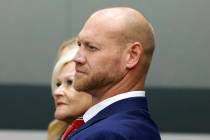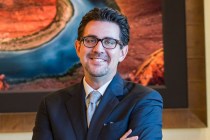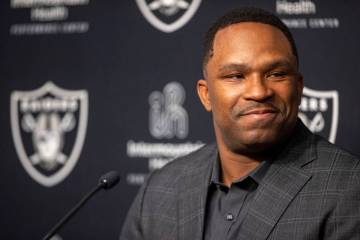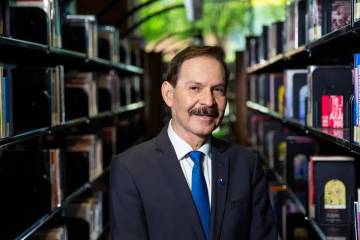
Nevada attorney general candidates Don Chairez, above, and Catherine Cortez Masto, below, drive home points Thursday during a town hall forum held at the KLVX, Channel 10 television studios in Las Vegas. Photos by K.M. Cannon.
CARSON CITY -- When Attorney General George Chanos stunned the Republican Party by announcing in March that he was disgusted with the political process and would not seek election to the office, there was a last-minute scramble for a suitable candidate.
It appeared as if Catherine Cortez Masto, a former assistant U.S. attorney and native Nevadan who formally had announced in November her intentions to run for the office as the Democratic candidate, would have a lock on the job.
Advertisement
After all, Cortez Masto had been raising money and seeking support in her bid for political office since the summer of 2005.
Chanos, appointed to the attorney general post by Gov. Kenny Guinn in October 2005, had been expected to be the incumbent candidate for the office and the favorite as well.
Enter Don Chairez, a former Clark County district judge and advocate for an initiative petition to rein in the government's ability to take private land. The eminent domain measure, somewhat pared down by the Supreme Court, will appear as Question 2 on the November ballot.
Chairez, 51, filed as a Republican running for the job on May 1, months behind his opponent in organizing and funding a campaign.
But he has emerged as a viable candidate.
A recent poll commissioned by the Review-Journal on the attorney general contest showed Chairez with a slight lead, 28 percent, to Cortez Masto, with 26 percent. Thirty-two percent were undecided.
But neither candidate's name recognition is high. Sixty-four percent didn't recognize Chairez, and 62 percent didn't recognize Cortez Masto.
Chairez, who was appointed to the Clark County District Court in 1994 and won election to the seat in 1996, said he was a bit surprised to see how well he did in the statewide poll. But his work with PISTOL, or the People's Initiative to Stop the Taking of Our Land, has given him some name recognition and visibility, he said.
"The publicity over the last month or so has given me a bounce and a boost," Chairez said.
"The people who are very well-informed and who read the newspaper, the well-informed voters, know the work I'm doing on their behalf."
The constitutional amendment has the support of 60 percent of the voters in a recent Review-Journal poll, with 20 percent opposed and 20 percent undecided.
Cortez Masto, 42, takes issue with the attorney general poll results, saying her own internal polling shows her with a lead in the race.
"Either way, I've been working very hard and talking to people all over Nevada," she said.
"I'm right on track where I want to be."
Cortez Masto -- the daughter of the late Manny Cortez, a former chairman of the Las Vegas Convention and Visitors Authority and a former Clark County commissioner -- said that when the votes are counted Nov. 7, she will be the choice for attorney general.
Eric Herzik, a political science professor at the University of Nevada, Reno, said the race appears much closer than many had thought would be the case six months ago.
"Chairez will get something of a boost given his link to the PISTOL initiative," Herzik said.
"The issue gets a lot of media attention in Clark County, but not as much up here. It's a much bigger issue in Clark County, but that's where the voters are."
Neither candidate has a lot of name recognition at this point, especially in Northern Nevada and rural areas, which could run to Cortez Masto's favor because she has so much more money than Chairez, Herzik said.
"It will be an odd campaign to watch," Herzik said.
"Both need to introduce themselves to a large part of the state. It could be much closer than anyone thought."
Unlike some other contests, the race between the two candidates, both of whom have Hispanic backgrounds, has been issue- and qualification-oriented.
Cortez Masto said her concerns are drug use, especially methamphetamine abuse; identity theft; and domestic abuse involving spouses, children and the elderly.
As the top law enforcement official in the state, the attorney general has responsibilities in these areas, she said. As a former U.S. attorney, Cortez Masto said she also sees a link connecting many of these problems. Drug abusers frequently are involved in identity theft to gain money for drugs, she said.
"As attorney general I want to lead the charge on those issues and find solutions for our state," Cortez Masto said.
As attorney general, she said, she would work to coordinate the resources of federal, state and local authorities to combat these problems.
Cortez Masto, who is running for political office for the first time, said she was surprised that Chanos decided against running for the job.
"But it isn't about who is running for the office," she said. "It's about my experience, knowledge and education. The focus is what I can bring to the state as attorney general."
Chairez said he has nothing negative to say about Cortez Masto, whom he describes as a friend, except that she opposes PISTOL.
Cortez Masto said she agrees with the idea that private property should not be taken by government and given to another private property owner, but that other elements of Question 2 give her concern, particularly the potential loss of federal highway funds if it becomes law.
Chairez said he is the most qualified candidate for the job.
In 25 years as a lawyer and a judge, Chairez said, he has participated in more than 90 jury trials and presided over 25 murder trials, far more than his opponent.
If elected, Chairez said, his main focus will be to focus more attention on public corruption.
"We need to find a way to make sure that people who do get elected to office aren't being overly influenced by the contributions made to them," he said. "The attorney general's office and the district attorneys could do more instead of punting to the feds.
"I'm willing to get into it," Chairez said. "Former Attorney General Brian Sandoval started the public integrity unit. I would like it beefed up, to see it become more active."
Chairez said he also would like to see the issue of the transfer of water from White Pine County to Las Vegas put to the voters. Not all Clark County residents, especially those who are tired of rampant growth in Southern Nevada, would support such a transfer, he said.
"It's also a fairness issue. It's unfair to turn White Pine County into Owens Valley," he said, referring to the region dried up by the Los Angeles water grab.
Chairez has been involved in the eminent domain issue for many years. It was his ruling in 1996 in favor of Carol Pappas in the dispute with the city of Las Vegas over construction of the Fremont Street Experience that, at least temporarily, turned the process on its head.
In the decision, Chairez ruled that the city broke several state and federal statutes in seizing the land for a parking garage for the project. He found that officials took the Pappas' property without following proper legal procedures, and then proceeded to transfer the private land to downtown casinos.
Chairez later was overruled by the Nevada Supreme Court in a 5-2 ruling in 2003 written by Justice Nancy Becker. The Pappas family then settled with the city of Las Vegas in 2004 for $4.5 million.
Since then, the U.S. Supreme Court, in a 2005 decision called Kelo v. New London, ruled 5-4 that a Connecticut municipality was allowed to seize property from 15 homeowners who had refused to sell their homes for the construction of private office buildings and housing.
PISTOL, and ballot measures like it across the country, were the result.
"History has vindicated me," Chairez said. "Public opinion and history have vindicated the interpretation I took of eminent domain for private to private transfers of land. I'm not apologetic. I'm proud of it."
Cortez Masto worked as a chief of staff to former Gov. Bob Miller in 1998, his final year in office, and most recently worked as assistant county manager in Clark County. She stepped down from the job last year to concentrate on her election bid.
Cortez Masto got her bachelor's degree from the University of Nevada, Reno and graduated from Gonzaga University Law School in 1990.
Chairez resigned from the Clark County bench in 1998 to run for Congress, losing by fewer than 6,000 votes to the Democratic candidate Shelley Berkley. He ran for the Supreme Court in 2002, losing to incumbent Justice Bill Maupin.
Chairez grew up in Sacramento, Calif., later earning a bachelor's degree in history from Loma Linda University. He earned a law degree from the University of Southern California.
Chairez came to Nevada in 1989, serving as a deputy district attorney in Washoe County. He later took a similar position in Clark County before his appointment to the bench.