Home Subscribe
Jobs Cars Homes Shopping Travel Weddings Golf Best of Las Vegas Photo
.
Member Center

Recent Editions
MTWThFSSu
>> Search the site
.
.
.
.
NEWS
.
.
.
.
.
.
.
Oct. 23, 2006
Copyright © Las Vegas Review-Journal


TROPICAL GLACIERS

Geologist hunts clues to global warming

By LAWRENCE MOWER
REVIEW-JOURNAL

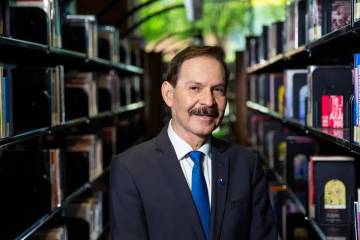
Matthew Lachniet stands next to a stalagmite sample in his lab at the University of Nevada, Las Vegas. Because the stalagmites are formed by mineral deposits in dripping water, he can determine the rainy seasons thousands of years ago. That might tell scientists studying global warming what to expect.
Photo by Isaac Brekken/Review-Journal

Like many things in the societies of scientists, Matthew Lachniet admits, the passion came about by accident. Lucky thing for him, the accident happened in one of the most beautiful places in the world.

Ten years ago, the then-23-year-old geologist noticed peculiar landmarks around the mountains of central Costa Rica while on a trip studying the area's ancient volcanos.

Advertisement

Around the mountains was a ring of dirt and rock mounds, known as moraines, which could mean only one thing: glaciers.

Lachniet soon had a mystery on his hands: How big were Costa Rica's glaciers, and what could they tell us about global warming today?

"The reason it's important is it allows us to understand how sensitive the tropics are to climate change," Lachniet said.

Through conversations with the locals and other scientists, Lachniet discovered that there indeed had been glaciers in the tropical climate during the last ice age, possibly as late as 10,000 years ago.

But the general perception among the people he talked to was that the glaciers were small, almost insignificant -- a theory Lachniet didn't believe, based on the moraines he witnessed ringing the mountains.

The effect of his research could be widespread. Most scientists believe the Earth's most tropical equatorial ecosystems were relatively resilient to the cold weather during the last ice age. Thus, the area had small glaciers.

But if Lachniet's theory is correct -- that the area was not as resilient to climate change, and thus had relatively significant glacial flow -- it could change the way scientists view the way that area will be impacted by another form of climate change: global warming.

"We write the history books, and others use them to predict the future," Lachniet said.

Lachniet, now an assistant professor at the University of Nevada, Las Vegas, has procured more than $500,000 in grants from the National Science Foundation to pursue his research, including construction of a new laboratory at the university exclusive to his work.

When he travels in the area, the Costa Rican government grants him a pass to conduct his research.

In other countries, like Guatemala, the method is often more informal.

In March, Lachniet traveled with a few friends and a local Mayan guide to an area in remote Guatemala, where they needed permission from the mayor of a town of 200 to travel.

The mayor scrawled a note onto a small piece of paper granting him permission to travel in the area and handed it to him.

Lachniet recalled the mayor's comment to him: "If anybody gives you any trouble, let me know who they are and I'll throw them in jail."

Nobody gave Lachniet and his party any trouble.

The secrets behind Costa Rica's glaciers lie not just around the mountains, but also in the stalagmites found in the area's caves.

Tall mounds of mineral deposits that develop over thousands of years of dripping water, stalagmites can be a historical rain gauge for scientists.

By dating pieces of the stalagmites, Lachniet can determine how old the pieces are and how quickly they grew. If they grew rapidly, or faster during some periods than others, he can estimate the rainfall totals, and thus how dry it was in the tropical area.

The work can be dangerous -- poisonous snakes like to spend time in the caves, and many of the local Mayans are superstitious about the caves.

But the most significant indicator of the existence of large glaciers is the moraines.

As glaciers move over land, they scrape the ground and push boulders, dirt and gravel to the end of the glacial flow, much like a bulldozer operates.

The larger the moraines, the larger the glacier. The ones in Costa Rica are roughly a quarter-mile long and about 200 feet high.

The moraines are significant enough for Lachniet to estimate their glacial creators to have been roughly 330 yards thick and 37.2 square miles wide.

Those are significant sizes for Costa Rica, but pale in comparison to the glaciers that covered North America during the last ice age, which often were tens of thousands of square miles in diameter.

About the same time the glaciers were disappearing in Central America, humans were coming onto the scene, and it is unknown if people actually witnessed the glaciers themselves.

"There is some possibility that some person was in Costa Rica and looked up and saw glaciers in the mountains," Lachniet said.

So what will this research tell humans about global warming and the effects it will have on the environment?

For one, it could tell scientists studying global warming what to predict in the future.

"If it changed a lot then, is it going to change a lot in the future?" Lachniet said.

His research methods also could become a technique for studying past environments throughout the world, including Nevada's.

Central America already had been seeing decreased rainfall over the past 100 years along with higher temperatures, but Lachniet said it's too early to say whether the rainfall totals are directly attributable to global warming.

Nevertheless, the threat from global warming is very real, he said.

"We might not make it into another ice age," Lachniet said.

He plans to take another trip to the area in March and collect additional samples from stalagmites and the moraines.

In such a tropical area, his trips may prove that the area used to be not so tropical at all.

"I love my job. It's the best job in the world."

SPONSORED LINKS

Advertisement


Contact the R-J | Subscribe | Report a delivery problem | Put the paper on hold | Advertise with us
Report a news tip/press release | Send a letter to the editor | Print the announcement forms | Jobs at the R-J

Copyright © Las Vegas Review-Journal, 1997 -
Stephens Media   Privacy Statement