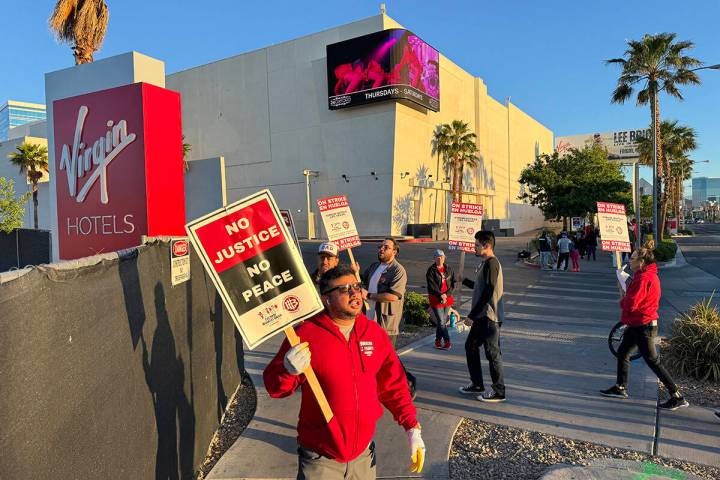
About 700 hospitality workers at an off-Strip casino have walked off the job and will withhold work for two days while pressing their employer to reach a deal over their five-year contract.




About 700 hospitality workers at an off-Strip casino have walked off the job and will withhold work for two days while pressing their employer to reach a deal over their five-year contract.

Students for Justice in Palestine claim members ended a days-long hunger strike “due to the administration’s willingness to meet demands.”

The developer said it would take $310 million to build a launching pad, a runway for spaceplanes, a control tower, a flight school and a 200-room casino resort.

The historic downtown Las Vegas gambling hall will add two bars, a restaurant and more casino floor space later this year.

Roger Thomas spent 20 years designing for Wynn Resorts. He shares his evocative design philosophy.

The band known for 1980s hits such as “Pretty in Pink” and “Love My Way” entertained an energetic crowd with their third Vegas visit over the last three years.

The Rolling Stones, the Aces, Dead & Company and Pearl Jam top the entertainment lineup for the week of May 10 to 16.

A California businessman has sued MGM Resorts International for an instance where he was allegedly drugged while playing in a private salon.

Ownership of the NHL’s team in Utah has given fans 20 choices to vote on for the franchise’s new name, according to a new survey.

Officers were diverted from another call and sped down West Charleston Boulevard to the April 8 shooting scene at the Prince Law Group in City National Bank building.

The two candidates are the top finishers among those running in the Las Vegas mayoral primary, based on a recent Emerson College voter preference poll.

A Clark County grand jury indicted three men accused of trafficking nearly 45 pounds of fentanyl, the illicit opioid said to be many more times more powerful than morphine.
Eldorado High School had barred a senior from wearing cultural regalia but reversed its position after the ACLU became involved.

Legislation that would allow mining companies to use public land regardless of whether mineral deposits have been found on the land passed the House and will head to the Senate.

On any given night, you can find something special at Lee’s Family Forum. Whether you are watching the future stars of the Vegas Golden Knights hit the ice with the Henderson Silver Knights, sitting front row to the world’s fastest football with the Vegas Knight Hawks, or watching some of the best volleyball players on […]







Las Vegas’ only indie-movie theater announced plans to launch a distribution arm to promote underseen films in markets everywhere.

With court losses mounting against Las Vegas taxpayers, the city on Wednesday defended continuing its legal battle with the would-be developer of the Badlands golf course.

Buzz around the music scene is, Zac Brown Band is prepping for a residency at the Sphere. The person providing the buzz is Zac Brown.

Clark County commissioners voted to award nine applicants a total of $66.25 million from a county housing fund.