Home Subscribe
Jobs Cars Homes Shopping Travel Weddings Golf Best of Las Vegas Photo
.
Member Center

Recent Editions
MTWThFSSu
>> Search the site
.
.
.
.
NEWS
.
.
.
.
.
.
.
Sep. 10, 2006
Copyright © Las Vegas Review-Journal


IN DEPTH: THE LONG SHADOW OF 9/11: Counting the costs

With a tourism-dependent economy, Las Vegas would be hurt more severely by a terrorist attack than most other U.S. cities.

By MARGARET ANN MIILLE
REVIEW-JOURNAL


The Las Vegas Strip is the core of Clark County's tourism-dependent economy. Las Vegas' economy went into a tailspin soon after the Sept. 11, 2001, terrorist attacks, nearly 3,000 miles away, and it took more than two years to fully rebound. Financial risk experts say a terrorist attack in Las Vegas could cost tens of billions of dollars in insured losses alone.
Photo by K.M. Cannon.


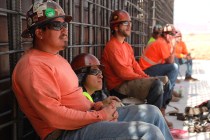
Martha Roldan waits in line with her son Steven, 2 1/2, at the Culinary Workers Union Hall on Oct. 10, 2001, to file for unemployment. It took about a year for Las Vegas' employment to return to pre-Sept. 11 levels.
Photo by Jeff Scheid.

A major terrorist strike in Las Vegas would disable its tourist-dependent economy in ways few other U.S. cities would experience.

Las Vegas' economy went into a tailspin soon after Sept. 11, 2001, and those attacks occurred nearly 3,000 miles away. With travelers suddenly afraid to fly, visitor volumes plunged, sparking a chain reaction of layoffs, bankruptcies and mortgage defaults.

Advertisement

Although the initial shudder lasted at least six months, the local economy took more than two years to fully rebound.

Financial risk experts say hypothetical terrorist scenarios set in Las Vegas show insured losses alone could run as high as tens of billions of dollars.

Beyond that, would tourists return, as they did to New York after the twin towers were destroyed, if they no longer felt safe in the nation's adult playground?

"It depends on the level of devastation that takes place," said James Medick, chief executive of the MRC Group Research Institute, a Las Vegas-based market research company. "The level of devastation would be in direct correlation to the estimation as to if and when they would return."

Tourists could swap the Las Vegas experience with an ample choice of commercial and tribal gaming venues nationwide, Medick noted. By contrast, "You can't replace as easily a city like New York. New York is a special city that is a financial epicenter, and that is a completely different formula from a convention and tourist destination, as we are."

Terrorism experts agree: It's a matter of when, not if, the nation endures another attack.

No one is saying a strike in Las Vegas is imminent or even a given. But the city's rich assortment of iconic landmarks helps elevate it to the top 10 U.S. cities at risk of an international terrorist act.

So says Risk Management Solutions, a global risk-modeling company that quantifies the risk and cost of natural and man-made disasters for the insurance industry. RMS, which has headquarters in Newark, Calif., based its ratings on the potential for symbolic value, property destruction and human casualties.

RMS calculated direct insured losses, which include property damage and injuries, deaths and job losses covered under workers' compensation, in worst-case scenarios for various attack models in Las Vegas. All are set in concentrated areas, such as the Strip.

A 2-ton truck bomb -- smaller than the fertilizer bomb used in the 1995 Oklahoma City bombing -- could cause about $2.8 billion in losses. A 10-ton bomb, which would be so large it would have to be hauled on a tractor-trailer, could inflict about $3.7 billion in damage.

A commercial airliner crashing into a high-rise would cost about $4.2 billion. A 5-kiloton nuclear bomb would do about $50 billion worth of damage, more than five times what Clark County's gross gaming revenue totaled in 2005.

Peter Ulrich, an RMS executive, characterized the 2-ton bomb as the most probable of the four scenarios. "You're more likely to see several smaller bombs," he said.

But insured losses represent only a fraction of the total economic impact. RMS pointed that out in a white paper provided as written testimony to Congress last year, explaining why it should extend the Terrorism Risk Insurance Act of 2002, known as TRIA.

"Estimates suggest that the total economic loss resulting from the World Trade Center attacks in 2001 exceeded $190 billion, of which the total insured losses were around $30 billion," the report said.

Other losses "include suspension of business activity, disruption of travel, loss of consumer confidence, decrease in worker productivity, impact on tourism, increased costs of heightened security, stock market uncertainty and other costs."

Congress did extend TRIA for two years, but it rejected recommendations to require that it cover acts of domestic terrorism and those involving chemical, biological, radiological and nuclear weapons.

That's not good enough, says Robert Reville, co-director of the Center for Terrorism Risk Management Policy at the Rand Corp., a nonprofit research organization.

The ability to recover economically from terrorist attacks is a hedge against them, he said. "If those kinds of attacks lead to long-term dislocation rather than resilience, then they are more attractive to terrorists."

According to the U.S. Department of the Treasury, 54 percent of commercial property and casualty policyholders in 2004 reported having terrorism insurance. About 3 percent were insured against attacks using nonconventional weapons.

"Most likely, a dirty bomb on the Strip would not be covered," Reville said.

Adding up the costs

The Nevada Commission on Homeland Security is considering forming a task force to determine the economic impact on the private sector should terrorists strike Las Vegas.

"We understand that Southern Nevada is a 'soft' target. Should something happen in Southern Nevada, it would impact the entire state," said Stan Smith, vice president of risk management and security for Boyd Gaming Corp. Smith isn't a commissioner, but he joined the group earlier this year on a security mission to Israel.

The commission has some estimates of how much a terrorist attack would cost the state. They spring from Nevada's vulnerability assessment of probable natural and man-made disasters, which were sent to AIR Worldwide Corp., a Boston-based risk modeling company that crunched the numbers.

Commissioners and others affiliated with them say they can't share the figures because they are part of a confidential report. At the commission's urging, Gov. Kenny Guinn last year declared it and related documents confidential by executive order. That same order says the group can make public any part of the report it wants.

In the meantime, the report is unavailable even to some emergency response managers in the state, who arguably, need to see it the most.

People familiar with the report say at least half of the eight most likely disaster scenarios pertain to terrorism. They include examples of a truck bomb exploding on the Strip, with a calculated insured loss of about $7 billion, and two attacks using nonconventional weapons such as chemical, biological or radiological threats, each estimated to cause as much as a $60 billion loss.

The least costly scenario, generating a few million dollars in losses, involves a suicide bomber striking in an area not densely populated.

The economic fallout from 9/11 was swift in Las Vegas, with hotel occupancy taking a dive days later. Hundreds of conventions were canceled through the rest of the year.

Las Vegas had roughly 2.53 million visitors in September 2001, down from nearly 3.21 million a month earlier. By March 2002, the monthly visitor count had climbed to about 3.26 million, nearly 40,000 fewer than the same month a year earlier but about 57,000 more than in August 2001.

"It took about six months," said Terry Jicinsky, a marketing executive at the Las Vegas Convention and Visitors Authority. "We saw an immediate and sharp impact. It was short-lived."

It took about a year for the combined employment of the city's main industries, gaming and hospitality, to return to pre-9/11 levels. Besides the approximately 20,000 workers who lost their jobs in just the first few months, many others saw their hours reduced.

But it wasn't until October 2003 that the local economy actually rebounded, according to Jeremy Aguero, a principal at Applied Analysis, a Las Vegas economic research firm. That is when gaming and hospitality began reaching annual employment and revenue goals they otherwise would have if the attacks hadn't happened.

It will be harder to recover from another terrorist strike on American soil, Aguero warned, because it will have the compounding effect of a series of events rather than an isolated one.

"The effects of the next attack won't be linear, they will be exponential," he said.

Economy makes city vulnerable

A recent Rand study on evolving terrorism trends said, among other things, terrorists are focusing more on soft civilian targets and emphasizing strikes that generate economic upheaval.

Renowned travel and tourism expert Alan Pisarski sees evidence of that firsthand. On behalf of the World Tourism Organization, a United Nations agency in Madrid, he has traveled twice to Egypt to assess the economic damage after terrorists struck popular tourist sites there.

Terrorists recognize Egypt's dependence on tourism, he said, and know they can debilitate its economy if they scare away tourists.

Las Vegas shares that vulnerability because of its unique economy. In that way, Pisarski said, other U.S. cities most comparable are Honolulu, Orlando, Fla., and such ski resorts as Vail, Colo.

"Typically, big cities are attractive for tourism, but once they are big enough, they have other things going for them," he said. "But Las Vegas is almost a one-industry town."

Pisarski said if terrorists strike here, the city probably would see a phenomenon known as the "ignorance of distance," meaning people in Los Angeles or Phoenix would return in weeks or months, sooner than those who live farther away.

In the widening study of terrorism, a busy Las Vegas tourist site has found its way into a study of an entertainment industry niche.

The Adventuredome at Circus Circus was included in a report on hypothetical strikes at U.S. theme parks, done by the Center for Risk and Economic Analysis of Terrorism Events (CREATE), a national research center funded by the federal Department of Homeland Security at the University of Southern California.

The study quantifies the economic impact of a terrorist attack using a large conventional bomb at 13 theme park complexes in eight states. None of the theme parks is mentioned by name in the report, but James Moore II, one of the report's authors and an investigator on CREATE's economic analysis team, identified the Nevada example in an interview with the Review-Journal.

The Adventuredome, an indoor five-acre theme park, had 4.4 million visitors in 2004, making it the 11th most-visited theme park nationwide that year, Moore said. That was fewer than Universal Studios Hollywood but more than Busch Gardens in Tampa, Fla.

Moore said a strike at one would be perceived as a strike against all, sending tourists packing to national parks and other presumably safer attractions.

In the worst-case scenario for Nevada, a strike at the Adventuredome would cost the state $1.01 billion in direct and indirect losses over two years.

"The lesson that we took from 9/11 is that people care about the safety of their households, and they will make adjustments in their behavior," said Moore, a professor and chairman of USC's Industrial and Systems Engineering Department.

"Those dollars go somewhere else."

Theme park attacks in other states also would create losses for Nevada, ranging from $668.7 million to $671 million. Meanwhile, states that would benefit from the expected tourist exodus are Arizona, Utah, New York, North Carolina, Massachusetts and Wyoming.

Moore said a main point of contention to emerge at a terrorism conference held last spring at USC was how best to spend scarce resource dollars -- on protection, response, intelligence -- in the war against terror.

"Much of our work focuses on understanding the costs of failing to protect," he said. "If we understand what it costs us to fail, that gives us a sense of how much we should be prepared to spend to avoid the failure."

SPONSORED LINKS


Advertisement


Contact the R-J | Subscribe | Report a delivery problem | Put the paper on hold | Advertise with us
Report a news tip/press release | Send a letter to the editor | Print the announcement forms | Jobs at the R-J

Copyright © Las Vegas Review-Journal, 1997 -
Stephens Media   Privacy Statement